


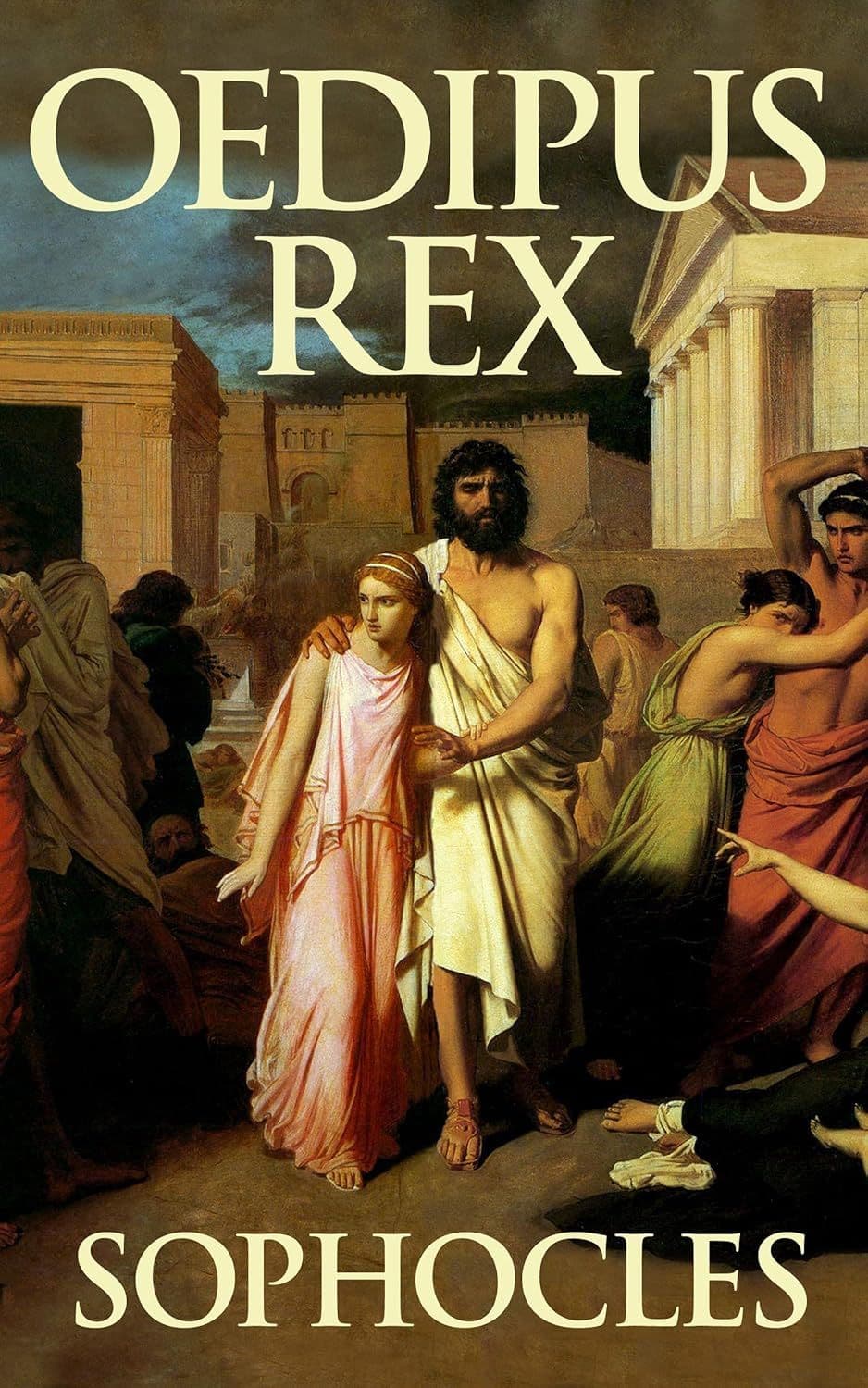
Oedipus

Seneca's Oedipus is not a Greek tragedy in Latin dress but a distinctively Roman exploration of fear, power, and the collapse of rational inquiry. Its central mechanism is the inward turn: Seneca's Oedipus begins already anxious and guilt-ridden, haunted by prophecy rather than confident in his own intelligence. The play subordinates the Sophoclean theme of knowledge versus ignorance to a darker meditation on concealment and paranoia, in which truth is hidden not because the gods are mysterious but because kingship itself breeds isolation and suspicion. The result is a tragedy about the psychological corrosion of power rather than the discovery of a crime.
Key Insights
✦What is the central argument of Seneca's Oedipus, and what does it reject?
Seneca's Oedipus is not a philosophical argument but a dramatic exploration of fear, power, and the impossibility of escaping fate. The play rejects the Sophoclean model of a confident ruler who solves a mystery through rational inquiry. Seneca's Oedipus is already anxious and guilt-ridden at the play's opening, obsessed with the prophecy that dooms him [citation:1]. The drama emphasizes concealment: truth is hidden in the underworld, in the entrails of sacrificed animals, and in the cryptic language of the oracle, and even when revealed it remains unbelievable to those who hear it [citation:1][citation:10]. The play's thematic center is kingship as a source of isolation and paranoia, not the discovery of a crime.
✦How does Seneca's Oedipus differ from Sophocles' Oedipus Rex?
The differences are fundamental and have disconcerted critics who expect a Latin version of Sophocles. Seneca's Oedipus is initially isolated and obsessed with guilt, whereas Sophocles' Oedipus is a benign ruler who confidently pursues inquiry [citation:1]. The search for truth is perfunctory in Seneca, occupying only about a hundred lines, while the theme of concealment dominates [citation:10]. Tiresias's blindness has the opposite significance: in Sophocles it signals deeper insight, while in Seneca it suggests that truth remains hidden. Seneca also introduces Roman concerns: kingship as a lightning rod for danger, the paranoia of power, and the arbitrary nature of fate rather than the Greek focus on human limitation and heroic endurance [citation:1][citation:4].
✦Does Seneca's Oedipus reflect Stoic philosophy, or does it contradict it?
This is a genuine scholarly problem. The play's chorus in Act 5 stresses that neither God nor prayer can alter a predestined life, a view of fate as arbitrary that contradicts Stoicism, which holds that fate and divinity are the same and that the cosmos is rational and benign [citation:2][citation:5]. Some scholars argue that Seneca is not interested in fate itself but in how humans comport themselves before it, and that the play can be read as a Stoic exploration of fear and paranoia rather than a refutation of Stoic cosmology [citation:7]. Others note that it is wrong to seek a consistent Stoicism in Seneca's poetry. The tension remains unresolved and is central to interpreting the play.
✦How did the play's reception develop, particularly in England?
Seneca's Oedipus, along with his other plays, was regarded as a model of classical drama in Elizabethan England. The translator Alexander Neville treated it as a work of moral instruction, urging readers to frame their lives free from the mischief depicted [citation:2]. In the twentieth century, the play was adapted by Ted Hughes and performed at the Old Vic Theatre in London in 1968, in a production by Peter Brook. George Steiner praised Hughes's version as making for 'English dramatic verse of remarkable impetus' and noted a 'coherent vision of the play' behind the liberties taken . More recent scholarship has challenged T.S. Eliot's dismissal of Senecan characters as stock types, arguing that the Oedipus resists such reduction [citation:2].
✦What is the textual history of Seneca's Oedipus, and what modern editions are available?
The play is a fabula crepidata of approximately 1061 lines of verse, written in Latin at some point during the first century AD [citation:2][citation:5]. The standard modern editions are the Loeb Classical Library volumes edited by John G. Fitch (2004, with a newer edition in 2018), which present the Latin text with facing English translation [citation:9][citation:12]. The University of Chicago Press's Complete Works of Seneca includes Oedipus in its second volume of tragedies, translated by Susanna Braund, with an introduction and notes . These editions have replaced older translations like Frank Justus Miller's, which remains available through public domain sources.
✦What is a common misconception about Seneca's Oedipus?
A common misconception is that Seneca's play is simply a lesser imitation of Sophocles, valuable only as a Roman curiosity. In fact, Seneca's Oedipus is a deliberately different kind of tragedy, shaped by Roman concerns about power, paranoia, and the psychological toll of kingship [citation:1][citation:13]. The play's divergences from Sophocles are not signs of degeneration but of a coherent artistic vision: Seneca is interested in the inward states of a ruler who is already broken by fear, not in the gradual discovery of a hidden crime. Reading the play as a failed Oedipus Rex misses its distinctive achievement and its engagement with the political anxieties of Nero's Rome.
Wealthy Psyche is an intellectual archive. We do not host, distribute, or sell book copies — physical or digital. We provide structured knowledge to help you think better, faster.