


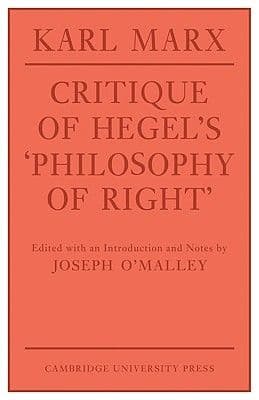
Critique of Hegel's Philosophy of Right
Marx's manuscript argues that Hegel's philosophy of right inverts the real relation between state and civil society: Hegel makes the state the actualisation of ethical life and civil society its dependent moment, whereas Marx insists that the family and civil society are the real foundations and the state is their product. The critique's distinctive mechanism is immanent inversion: Marx accepts Hegel's own demand that philosophy grasp the actual, then shows that Hegel's speculative method systematically mistakes predicates for subjects, turning the state into a mystical entity that generates the people rather than the reverse. The manuscript remained unpublished until 1927.
Key Insights
✦What is Marx's central objection to Hegel's Philosophy of Right, and how does his critique proceed?
Marx's objection is that Hegel reverses the real relation between civil society and the state. For Hegel, the state is the actualisation of ethical life, the rational whole within which particular interests are reconciled; civil society is a moment of dependence and particularity. Marx argues the opposite: the family and civil society are the real foundations, and the state is their product. His method is immanent critique. He does not reject Hegel's demand that philosophy grasp the actual; he shows that Hegel's speculative method systematically inverts subject and predicate, treating the state as a mystical subject that generates the people rather than an institution produced by social relations. This inversion is not a minor error but the core of Hegel's idealism.
✦Why did Marx abandon the manuscript, and what does its publication history reveal about its status?
Marx wrote the critique in Kreuznach in 1843 but abandoned it after completing only the section on the state, leaving the sections on family and civil society unwritten. It was first published in 1927 by the Marx-Engels Institute in Moscow, in the Marx-Engels-Archiv, edited by D. Riazanov. The text is therefore not a finished book but a working manuscript, and its incompleteness matters. Marx moved rapidly from this philosophical critique to the more directly political essays of 1844—On the Jewish Question and the Introduction to the Critique of Hegel's Philosophy of Right. The manuscript shows Marx working through Hegel's categories before abandoning philosophy for political economy. It is indispensable for understanding the genesis of his mature position.
✦How does this critique relate to Marx's later, more famous critique of Hegel in Capital?
The connection is methodological. The Critique of Hegel's Philosophy of Right establishes the technique of immanent critique that Marx would apply throughout his career: entering an opponent's framework, accepting its own standards, and demonstrating that it fails by those standards. In Capital, Marx performs the same operation on political economy, showing that classical economics generates conclusions (crisis, concentration, immiseration) that its own categories cannot accommodate. The difference is that the later critique is conducted in the medium of economic analysis rather than philosophical jurisprudence. The Hegel critique is the laboratory in which Marx developed the dialectical method he would later put to materialist use, stripped of its idealist premises.
✦What does Marx mean by 'civil society,' and how does his use of the term differ from Hegel's?
For Hegel, civil society (bürgerliche Gesellschaft) is the sphere of particularity and interdependence—the market, the legal system, and the corporations—that mediates between the family and the state. It is a necessary but incomplete moment, requiring the state to reconcile its particular interests into a rational whole. Marx radicalises the concept: civil society is not a moment to be sublated but the real foundation. It is the sphere of material production and class relations, the 'anatomy' of which must be sought in political economy. This shift is decisive for historical materialism: once civil society becomes the foundation, the state becomes a superstructure, and political philosophy must give way to the critique of political economy.
✦How did Hegel's Philosophy of Right respond to the political conditions of Restoration Prussia, and why did Marx find it objectionable?
Hegel's Philosophy of Right (1821) was written in post-Napoleonic Prussia, during the Restoration. Hegel sought to reconcile modern individual freedom with the ethical unity of the state, arguing that the rational state could accommodate the principle of subjectivity while preserving a substantive ethical order. Marx read the book in 1843, after the death of Hegel and during the period of intensified censorship under Frederick William IV. He found Hegel's reconciliation objectionable because it presented the existing Prussian state as the embodiment of reason, thereby justifying censorship, political inequality, and the exclusion of ordinary citizens from political life. Marx's critique is thus not merely philosophical but political: it targets Hegel's accommodation with an illiberal regime disguised as rational necessity.
✦Is the text accessible to readers without prior knowledge of Hegel, or does it presuppose familiarity?
The text presupposes familiarity with Hegel's Philosophy of Right and with Hegelian terminology—'sublation,' 'ethical life,' 'particularity and universality,' 'the Idea.' Readers without that background will find Marx's detailed paragraph-by-paragraph commentary difficult to follow, because it engages Hegel's arguments at a level of abstraction that assumes the reader has the original at hand. The best approach is to read Hegel's Philosophy of Right (or at least the sections on the state, §§257–360) alongside Marx's critique. For readers new to Marx's early work, On the Jewish Question and the Introduction to the Critique of Hegel's Philosophy of Right are more accessible entry points, as they address concrete political questions rather than the internal logic of Hegel's system.
Wealthy Psyche is an intellectual archive. We do not host, distribute, or sell book copies — physical or digital. We provide structured knowledge to help you think better, faster.