


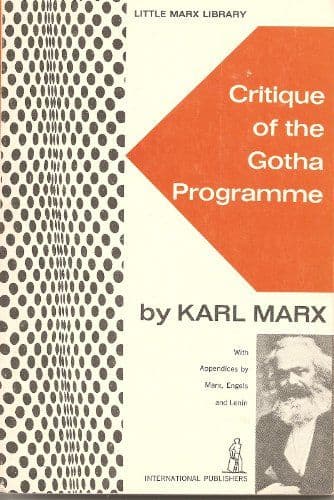
Critique of the Gotha Programme
Marx's marginal notes on the draft programme of the German Workers' Party argue that the party's proposed principles are a retrograde concession to Lassallean opportunism. The central claim is that distribution cannot be treated as an independent question: 'fair distribution' and 'undiminished proceeds of labour' obscure the fact that the mode of production determines distribution, and that bourgeois right persists in the lower phase of communism because it measures unequal individuals by an equal standard. Only in a higher phase, after labour becomes life's prime want, can the narrow horizon of bourgeois right be crossed.
Key Insights
✦What is the central argument of the Critique, and what does it reject in the Gotha Programme?
The Critique's central argument is that the Gotha Programme treats distribution as an independent problem that can be solved by moral demands about 'fair shares' and the 'undiminished proceeds of labour.' Marx insists that any distribution of consumption is a consequence of the distribution of the conditions of production. To demand 'fair distribution' without first abolishing the capitalist mode of production is to mistake the symptom for the cause. The Critique also rejects the Programme's Lassallean inheritance: the 'iron law of wages' is denounced as a Malthusian error, and the party's failure to distinguish labour from labour-power is treated as a theoretical regression that undermines the entire socialist project . The text is thus a polemic against reformist socialism as much as a positive statement of communist principles.
✦What are the two phases of communist society, and how does the principle of distribution differ between them?
In the lower phase—what Marx calls a communist society 'as it has just emerged after prolonged birth pangs from capitalist society'—the principle is 'to each according to his contribution.' This is still a form of bourgeois right, because it measures unequal individuals by an equal standard, labour. A stronger worker or one with fewer dependents will fare better than a weaker one or one with a larger family, even with equal effort . Only in the higher phase, after the division of labour has been overcome, labour has become 'life's prime want,' and productive forces have expanded sufficiently, can society inscribe on its banners: 'From each according to his ability, to each according to his needs' . The distinction matters because it denies that socialism immediately realises full communism.
✦Why does Marx say that equal right in socialism is still 'bourgeois right'?
Marx argues that the principle 'to each according to his labour' applies an equal standard—labour time or intensity—to unequal individuals. Because people differ in physical and mental capacity, in family obligations, and in endurance, an equal measure produces unequal outcomes. This is precisely how bourgeois right operates: it treats people as formally equal while ignoring the substantive inequalities that make formal equality hollow . Marx does not condemn this as hypocrisy; he treats it as an inevitable limitation of a society emerging from capitalism. Right 'can never be higher than the economic structure of society and its cultural development conditioned thereby.' The critique of bourgeois right is thus not a demand for immediate equality of outcome but a recognition that genuine equality requires a transformed mode of production.
✦How was the Critique published, and why did Engels wait sixteen years to make it public?
Marx wrote the Critique in April or early May 1875 and sent it to Wilhelm Bracke with a covering letter, but he never published it during his lifetime . Engels published it in 1891 in Die Neue Zeit, the German Social Democratic Party's theoretical journal, along with Marx's letter to Bracke and his own foreword . Engels explained that he had withheld it to avoid deepening party divisions, but that the Erfurt Congress's revision of the programme made publication necessary. In his foreword, Engels acknowledged omitting a few sharp personal expressions and replacing them with ellipses, noting that the violence of Marx's language had been provoked by the struggle against Bakunin and the need to distance the party from Lassallean influence . The published text is thus an edited document, not a verbatim reproduction of Marx's manuscript.
✦What is the significance of the Critique's treatment of the 'dictatorship of the proletariat,' and why is it so brief?
The phrase appears only once, in a passage noting that 'between capitalist and communist society there lies the period of the revolutionary transformation of one into the other. Corresponding to this is also a political transition period in which the state can be nothing but the revolutionary dictatorship of the proletariat' . The brevity is striking given the phrase's later canonical status in Leninist theory. Marx does not elaborate what this dictatorship entails, how it is organised, or how long it lasts. The passage's function in the Critique is negative: it rebukes the Gotha Programme's demand for a 'free state' by insisting that the state during the transition is an instrument of class rule, not a neutral guarantor of freedom. Later Marxists, Lenin foremost among them, would build an entire theory of the state on this single sentence, but the Critique itself offers no such elaboration.
✦Was the Critique written in response to a specific political situation, and does that context matter for reading it?
The context is essential. The Gotha Programme was the draft platform for the 1875 unity congress merging the Lassallean General German Workers' Association with the Eisenach-based Social Democratic Workers' Party. Marx and Engels had long opposed Lassalle's faction, which they regarded as opportunist and overly accommodating to Bismarck's state. The Critique was written as an intervention in this merger, intended to prevent the new party from adopting Lassallean formulas . Marx's fury is therefore political as much as theoretical: the 'monstrous attack' on the party's scientific understanding is a betrayal of what Marx saw as hard-won theoretical gains. Readers who approach the text as a neutral treatise on distribution will miss that it is a fighting document addressed to a specific tactical situation.
Wealthy Psyche is an intellectual archive. We do not host, distribute, or sell book copies — physical or digital. We provide structured knowledge to help you think better, faster.