


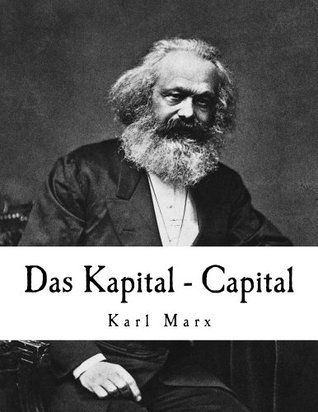
Das Kapital (Vols. I–III)
 Karl Marx
Marx’s central thesis in Das Kapital is that capitalism is not a natural order but a historically specific mode of production driven by the extraction of surplus value from labor. Volume I introduces the commodity and the labor theory of value to explain exploitation; Volume II traces capital’s circulation; Volume III resolves the apparent contradiction between value and profit through the tendency of the rate of profit to fall. Marx’s method is a critique of political economy that seeks to reveal the laws of motion of capitalism, not merely to describe its surface phenomena.
Key Details
Related Books
View AllSimilar books from the same category, ranked by shared topics and reader engagement.



Key Insights — Read in 10 Minutes
What is the central claim of Das Kapital, and what does it reject?
The central claim is that capitalism is organized around the extraction of surplus value from living labor, not around mutually beneficial exchange between free agents. Marx rejects the classical political economy view that capitalism represents a natural or harmonious order. Instead, he argues that the wage relation conceals an exploitative core: workers sell their labor-power, but the value they produce exceeds what they receive as wages. This surplus is appropriated by capital owners and is the source of profit, interest, and rent.
What specific concepts did Das Kapital introduce, and how are they used today?
Das Kapital introduced the distinction between labor and labor-power, the concept of surplus value, the tendency of the rate of profit to fall, and commodity fetishism. Labor-power refers to the capacity to work sold as a commodity; surplus value is the unpaid portion of labor time. These concepts remain central to Marxist political economy and are used in debates over exploitation, inequality, and the dynamics of capital accumulation.
What is the ‘transformation problem,’ and why does it matter for Das Kapital?
The transformation problem arises from the relationship between Volume I’s labor theory of value and Volume III’s prices of production. Critics argue that Marx failed to rigorously transform values into prices. Eugen von Böhm-Bawerk launched a major critique in 1896, and the debate continues. Some, like Fred Moseley, argue the problem dissolves under a macro-monetary interpretation of Marx’s method. The issue remains central to assessing whether Marx’s value theory is internally consistent.
How does Das Kapital differ from The Communist Manifesto?
The Communist Manifesto is a political pamphlet predicting absolute immiseration of workers and revolutionary rupture. Das Kapital is a theoretical critique of political economy that analyzes capitalism’s laws of motion without predicting inevitable collapse in the same way. Marx himself noted the two works should not be conflated. Das Kapital acknowledges rising real wages as possible within capitalism while still identifying structural contradictions and crises.
How did Engels’s editing shape Volumes II and III after Marx’s death?
Marx died in 1883 leaving only fragmentary manuscripts for Volumes II and III, totaling roughly 1,700 pages. Engels assembled and edited these drafts, publishing Volume II in 1885 and Volume III in 1894. His editorial choices, particularly in structuring the material and selecting from multiple drafts, have been debated. Engels aimed to present ‘Marx in Marx’s own words,’ but the final volumes are unavoidably shaped by his editorial judgment.
How has Das Kapital’s argument held up since its publication?
Some predictions, such as the immiseration of the working class and the inevitability of socialist revolution in advanced capitalist countries, have not materialized as written. However, Marx’s analysis of capital concentration,周期性 crises, and the commodification of labor remains widely engaged. The labor theory of value is rejected by mainstream economics, but Das Kapital continues to be read as a foundational critique of capitalism’s social forms.
Show 1 more insights
What is the most common misreading of Das Kapital?
A common misreading treats Das Kapital as a purely economic treatise predicting capitalism’s automatic collapse. Marx’s method is dialectical and his aim is a critique of political economy’s categories, not a mechanical forecast. Another misreading conflates Marx’s own analysis with the ‘Marxism’ systematized by later thinkers. Marx himself reportedly said, ‘I am not a Marxist,’ signaling the gap between his work and its doctrinal appropriations.
Wealthy Psyche is an intellectual archive. We do not host, distribute, or sell book copies — physical or digital. We provide structured knowledge to help you think better, faster.