


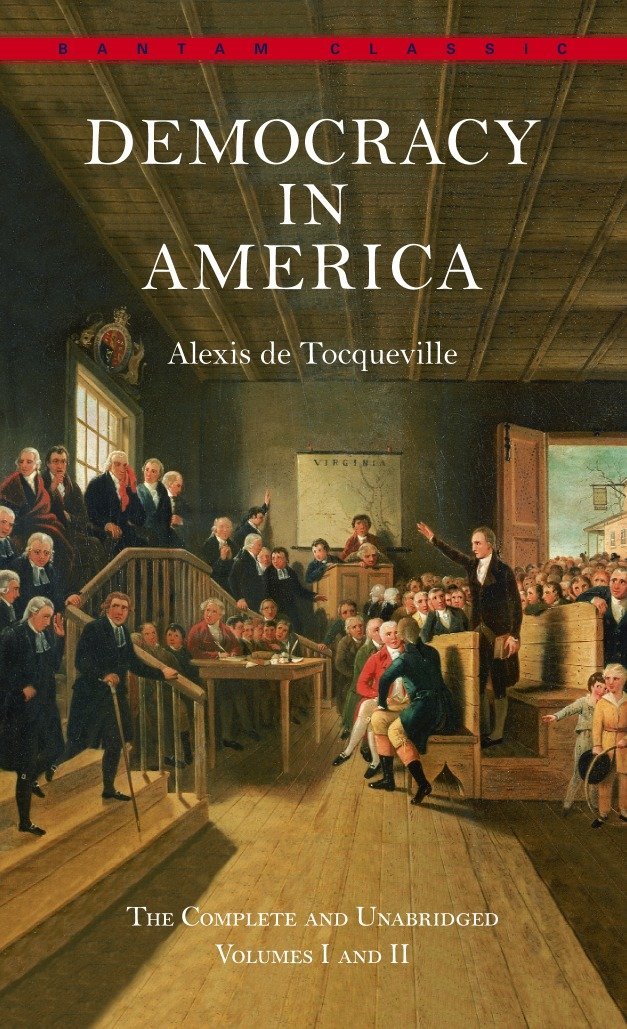
Democracy in America
 Alexis de Tocqueville
Tocqueville's central thesis holds that the irresistible march of equality of conditions—not merely political equality—reshapes every aspect of society, generating a novel form of despotism he called 'soft despotism.' Unlike tyranny, which oppresses through force, this democratic despotism operates through the atomization of individuals, the tyranny of the majority's opinion, and a paternalistic state that manages citizens' welfare while they retreat into private life. He identifies civil associations, local governance, religion, and 'self-interest rightly understood' as the cultural and institutional counterweights that might preserve liberty within an egalitarian social order.[citation:4][citation:10]
Key Details
Related Books
View AllSimilar books from the same category, ranked by shared topics and reader engagement.


Key Insights — Read in 10 Minutes
What is the central argument of Democracy in America, and what does it reject?
Tocqueville argues that the defining fact of modern society is the 'equality of conditions,' a social state that generates its own distinctive dangers rather than simply liberating individuals. He rejects the assumption that democracy naturally produces greater liberty; instead, equality can lead to a new form of 'soft despotism' in which atomized individuals surrender judgment to majority opinion and a paternalistic state, trading freedom for material comfort and equality.[citation:4]
What specific concept did Democracy in America introduce that remains central to political theory?
Tocqueville introduced the concept of 'soft despotism'—a form of domination that does not tyrannize through violence but through administrative paternalism and social conformity. He described a government that 'does not tyrannize, but it compresses, enervates, extinguishes, and stupefies a people.' This framework, along with 'tyranny of the majority' and 'individualism' in its modern sociological sense, became foundational for analyzing democratic pathologies without invoking older models of authoritarian rule.[citation:4]
How does Democracy in America differ from The Federalist Papers' account of American democracy?
The Federalist Papers focus on institutional design—faction control, separation of powers, federalism—as the primary safeguard of liberty. Tocqueville shares that concern but shifts attention to the cultural and social preconditions of free institutions: mores, religion, civil associations, and local participation. He warns that the Constitution's mechanisms alone cannot prevent majoritarian conformity or soft despotism; democracy requires a vibrant civil society that institutions cannot manufacture.[citation:19]
How has Democracy in America's argument held up since its publication?
The two volumes (1835 and 1840) contain both enduring insights and limitations. Critics note that Tocqueville relied heavily on a nine-month visit and often viewed America through the lens of French political anxieties. Robert Nisbet called it 'a great book, but not a very good one' regarding empirical accuracy. Yet his analysis of the relationship between equality, individualism, and state power has proven prescient, influencing debates about welfare states, civil society decline, and democratic erosion well into the twenty-first century.[citation:13]
What role does civil society play in Tocqueville's argument, and how has it been taken up later?
Tocqueville treated voluntary associations—religious congregations, local political bodies, professional groups—as 'schools of democracy' where individuals learn the 'arts of association' and acquire the habits of cooperation that counteract atomization. Robert Putnam's research on 'social capital' explicitly builds on this Tocquevillian framework, arguing that dense networks of civic engagement sustain democratic institutions and that their post-1960s decline poses risks Tocqueville anticipated.[citation:8]
What is a common misreading of Tocqueville's account of American democracy?
A frequent misunderstanding treats Tocqueville as a straightforward celebrant of American democracy. In fact, his admiration was deeply ambivalent. He saw America as a laboratory revealing democracy's universal tendencies, not as a model to be uncritically copied. His warnings about the 'tyranny of the majority' and the retreat into private life were meant as diagnostics of democratic vulnerability, not as endorsements of the American status quo. He was also consistently critical of American treatment of race and of slavery's compatibility with democratic principles.[citation:14]
Wealthy Psyche is an intellectual archive. We do not host, distribute, or sell book copies — physical or digital. We provide structured knowledge to help you think better, faster.