


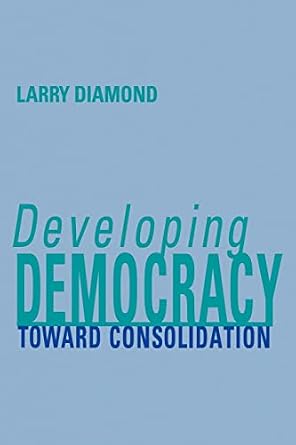
Developing Democracy: Toward Consolidation
 Larry Diamond
Diamond's central thesis is a 'developmental' theory of democracy that rejects preconditions—the idea that poor countries must first achieve certain economic or cultural thresholds before democracy becomes possible. Instead, democracy is a work in progress that emerges piecemeal, at different rates and in different forms. Assessing the 'third wave' that began in 1974, Diamond argues it has ended, leaving a widening gap between electoral form and liberal substance in many new democracies. Consolidation requires stronger institutions, decentralization, a vibrant civil society, and improved performance to generate the broad legitimacy essential for democratic survival.
Key Details
Related Books
View AllSimilar books from the same category, ranked by shared topics and reader engagement.

Key Insights — Read in 10 Minutes
What is the central claim of Developing Democracy, and what does it reject?
Diamond argues for a 'developmental' theory of democracy, which holds that democracy is a work in progress emerging piecemeal at different rates and in different forms across countries. He explicitly rejects theories that posit preconditions for democracy—the idea that countries must first achieve certain economic, social, or cultural thresholds before democracy can take root. This rejection is significant because it affirms democracy's prospects even in poor countries, while insisting that new democracies must become 'more deeply democratic' to survive.
What specific concept does Diamond develop for assessing whether democracies will endure?
Diamond defines democratic consolidation as the embrace of democratic norms, principles, and practices by all major elites, organizations, and the mass public. He identifies conditions that foster consolidation: strong political institutions (especially parties, judiciaries, and legislatures), appropriate institutional designs, decentralization of power, a vibrant civil society, and improved economic and political performance. The essence of consolidation, he argues, is broad legitimacy—generated by freedom, transparency, and the rule of law—that makes democracy 'the only game in town.'
How does Developing Democracy relate to Samuel Huntington's The Third Wave?
Diamond builds directly on Huntington's framework, adopting the 'third wave' concept (democratization beginning in 1974) but extending it in crucial ways. Where Huntington analyzed the wave's causes and mechanics, Diamond focuses on what comes after: whether third-wave democracies will consolidate or break down. Huntington himself endorsed Diamond's book as 'the definitive assessment of the third wave,' noting that Diamond highlights both progress and the extent to which many new democracies are illiberal 'hollow democracies' lacking the deeper substance of liberal democracy.
What is the 'gap' Diamond identifies between electoral and liberal democracy?
Diamond argues that while the third wave produced an unprecedented number of electoral democracies—over 60 percent of world states by the late 1990s—many are 'hollow' or 'illiberal' because they lack the deeper conditions of liberal democracy: an active and pluralistic civil society, the rule of law, protection for civil liberties, constraint on state power, and civilian control of the military. This gap between electoral form and liberal substance leaves many democracies fragile and vulnerable to breakdown, as seen in Fujimori's executive coup in Peru and military coups in Africa.
What does Diamond mean by a 'fourth wave' of democratization?
Diamond's concluding chapter argues that prospects for a 'fourth wave' of democratic expansion are promising, particularly if authoritarian countries in Asia—especially China—continue rapid economic growth and integration into global markets and information networks. Even seemingly distant countries may experience pivotal events that trigger change; Diamond cites Indonesia's 1998 financial crisis, which ended three decades of autocratic rule and led to its first democratic election. The fourth wave thesis reflects Diamond's developmental optimism: democracy can emerge even where conditions seem unfavorable.
How does this book differ from Diamond's later work on democratic recession?
Developing Democracy (1999) is fundamentally optimistic about democracy's trajectory, concluding with hopeful prospects for a fourth wave. Diamond's later books—The Spirit of Democracy (2008), In Search of Democracy (2015), and Ill Winds (2019)—trace the subsequent 'democratic recession' and growing authoritarian challenges. The shift reflects historical developments Diamond could not have anticipated: the consolidation failures he warned about materialized in many third-wave states, while external threats from Russia and China intensified. Developing Democracy is the analytical foundation; the later works diagnose what went wrong.
Show 1 more insights
What role does civil society play in Diamond's consolidation framework?
Diamond argues that a vibrant civil society—independent think tanks, mass media, trade unions, business chambers, professional associations, student organizations, and women's groups—must engage and check the state if democracy is to thrive. Civil society performs multiple functions: it monitors government accountability, channels citizen demands, socializes individuals into democratic habits, and counterbalances state power. For Diamond, civil society is not optional but a constitutive condition of liberal democracy; its weakness is a key reason many third-wave democracies remain hollow and vulnerable to authoritarian reversion.
Wealthy Psyche is an intellectual archive. We do not host, distribute, or sell book copies — physical or digital. We provide structured knowledge to help you think better, faster.