


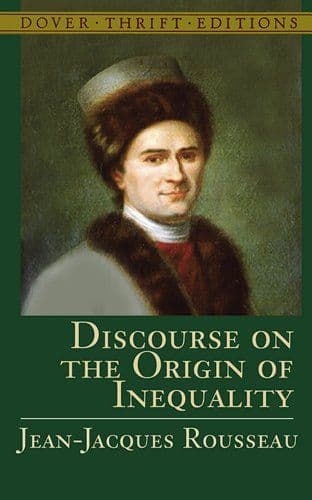
Discourse on the Origin of Inequality
Rousseau's Second Discourse argues that social inequality is not natural but historical: it originates in the transition from solitary self-sufficiency to social interdependence, when humans began comparing themselves to others and valuing esteem over mere survival. The decisive mechanism is amour-propre—the desire for recognition—which, once awakened, drives competition, vanity, and the accumulation of private property. Rousseau's central claim is that the inequalities of wealth and power that structure civilized society are therefore not divinely ordained or naturally necessary but contingent products of human development, and that they corrupt both the powerful and the powerless.
Key Insights
✦What is the central argument of the Second Discourse, and what does it reject about previous accounts of inequality?
Rousseau rejects the assumption, common to Hobbes and Locke, that inequality and social conflict are rooted in human nature itself. His argument is that humans in the state of nature were solitary, self-sufficient, and roughly equal in capacity; the inequalities that structure civilized society emerged historically, as population growth and environmental pressure forced cooperation and comparison. The decisive transformation is the awakening of amour-propre—the desire to be valued by others. Once humans began measuring themselves against one another, they developed vanity, competition, and the drive to accumulate. Frederick Neuhouser's study reconstructs this argument as a philosophical critique: nature is not the source of social inequality; amour-propre is .
✦What is amour-propre, and why is it the pivot of Rousseau's critique of inequality?
Amour-propre is the form of self-love that depends on the recognition and esteem of others. Rousseau distinguishes it from amour de soi—the natural, self-sufficient concern for one's own preservation—which does not require comparison. Amour-propre emerges only in society, when humans begin to judge themselves through others' eyes. Once this happens, a person's sense of worth becomes contingent on external opinion, and the pursuit of esteem becomes limitless and competitive. Neuhouser's reconstruction identifies amour-propre as the specific mechanism that generates social inequality: differences in natural talent or strength are insignificant in the state of nature, but once esteem becomes a scarce good that must be won from others, inequality becomes entrenched and self-perpetuating .
✦How does Rousseau's state of nature differ from Hobbes's, and why does that difference matter for their politics?
Hobbes depicts the state of nature as a war of all against all, driven by competition for scarce goods and mutual fear. Rousseau rejects this: his natural humans are solitary and self-sufficient, and because they do not compare themselves to others, they have no motive for domination. Conflict emerges only later, with social interdependence. The political consequence is profound. For Hobbes, strong sovereign power is necessary to restrain a naturally aggressive humanity; for Rousseau, the problem is not human nature but the social conditions that corrupt it. If inequality and conflict are historical rather than natural, then political institutions can be judged by whether they exacerbate or mitigate that corruption—a question Rousseau pursues in The Social Contract .
✦What role does private property play in Rousseau's account, and is he simply against it?
Private property is the crystallisation of inequality, not its ultimate cause. Rousseau famously describes the first person who enclosed a plot of land and declared it his as the founder of civil society—but the emphasis falls on the social conditions that made people willing to believe him. Once amour-propre has taken hold, property becomes a means of securing esteem and power over others. Rousseau is not a primitive communist who would abolish all property; his critique targets the extremes of wealth and poverty that property relations generate under conditions of vanity and competition. Neuhouser reconstructs four criteria by which Rousseau judges inequalities legitimate or illegitimate, suggesting a more nuanced position than simple abolitionism .
✦How did Nietzsche's criticism of Rousseau shape later readings of the Second Discourse?
Nietzsche identified Rousseau as his greatest enemy among modern thinkers, and the ground of his hostility was precisely Rousseau's appeal to nature as a normative standard. In Nietzsche's reading, Rousseau's state of nature is a 'feeble and romantic' construct—a fantasy of gentle, peaceful humanity that serves to condemn civilization from a position of weakness. Nietzsche's nature, by contrast, is 'rude and dynamic,' and he sees Rousseau's philosophy as a symptom of the ressentiment he diagnosed in modern morality. This criticism has shaped later readings by raising the question of whether Rousseau's appeal to nature is a genuine historical reconstruction or a rhetorical device for judging the present. The discourse's speculative method—Rousseau explicitly says he is conjecturing, not reporting facts—leaves it vulnerable to this line of attack .
✦What is the textual and translation history of the Discourse, and how should English readers approach it?
The Discourse was published in French in 1755. The first English translation appeared in 1761, printed in London for R. and J. Dodsley . The most widely used modern English translation is G. D. H. Cole's, available in various editions, though its Victorian prose style can obscure Rousseau's rhetorical force. Donald A. Cress's translation for Hackett is more contemporary and readable. Readers should be aware that the Discourse includes extensive endnotes Rousseau added to the main text—some longer than the passages they annotate—and these notes contain substantive arguments, particularly about amour-propre and the state of nature, that are essential to his position. Editions that omit or abridge the notes misrepresent the work's argumentative structure.
Wealthy Psyche is an intellectual archive. We do not host, distribute, or sell book copies — physical or digital. We provide structured knowledge to help you think better, faster.