


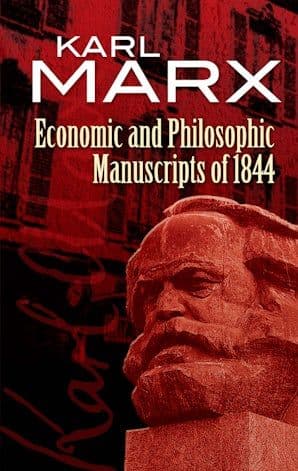
Economic and Philosophic Manuscripts of 1844
Marx's notebooks argue that alienated labour is the hidden structure of capitalist society: the worker is separated from the product, the act of production, other workers, and humanity's 'species being.' The central claim is that private property is not a natural fact but the consequence of alienated labour, and that communism is the positive transcendence of this alienation. The Manuscripts' distinctive mechanism is the fusion of political economy with Hegelian and Feuerbachian philosophy, producing a critique that is simultaneously economic and philosophical. The text remained unpublished until 1932 and transformed twentieth-century Marxism.
Key Insights
✦What are the four dimensions of alienation, and why is 'species being' the most philosophically ambitious?
Marx identifies four manifestations of alienated labour: the worker is alienated from the product (which belongs to another), from the act of production (which is external and coerced), from other human beings (competition replaces cooperation), and from 'species being' . Species being is the most ambitious because it draws on Feuerbach to name what distinguishes humans from animals: conscious, free, universal productive activity. Alienation from species being means that labour, which should be the expression of human freedom, becomes mere means of survival. This fourth dimension connects the economic analysis to a philosophical anthropology, grounding the critique of capitalism in a conception of what human life is for. It is also the dimension that later, more 'scientific' Marxists found most troubling.
✦Why did the Manuscripts remain unpublished until 1932, and how did their publication change Marxist theory?
Marx wrote the notebooks in Paris between April and August 1844, but they were abandoned and remained unknown to the socialist movement for nearly a century. They were partially published in Russian in 1927 and appeared in full in German in 1932 . The publication was transformative. Herbert Marcuse published one of the first reviews, arguing that the Manuscripts put the discussion of historical materialism's origins on a new footing and made possible a more fruitful engagement with Hegel . The text became the foundation for humanist readings of Marx across Western Europe, particularly in the post-Stalinist period, where its emphasis on alienation and species being offered an alternative to economistic orthodoxy . Without the 1932 publication, Western Marxism as we know it would be unrecognizable.
✦What is the relationship between the Manuscripts and the 'two Marxes' controversy?
The publication of the Manuscripts in 1932 generated a fierce debate about whether there were two distinct Marxes: a young humanist concerned with alienation and a mature scientist concerned with class struggle and political economy . Some Western Marxists embraced the young Marx and dismissed the later work; orthodox Soviet Marxists often dismissed the early work as immature. The controversy was largely artificial. The Manuscripts and the later works share a continuity of concern: the critique of alienation in 1844 becomes the critique of fetishism and exploitation in Capital. As one Chinese scholarly assessment argues, the Manuscripts contain the 'germ' of historical materialism, and manufacturing a radical break between early and late Marx is untenable . The text is best read as a starting point, not a refutation.
✦How does Marx's concept of alienation differ from Hegel's, and what does the difference reveal?
Hegel treats alienation as the mind's necessary self-externalization in objective reality, overcome through the mind's return to itself in self-consciousness. Marx radically changes the sense: for him, alienation is not a feature of consciousness but of material labour under capitalism . The worker's estrangement is not a philosophical stage to be overcome by thought but a social condition to be abolished by practice. Marx argues that humans are natural, objective beings whose essence consists in their necessary relation to external nature; alienation is the severing of that relation, not the fact of having it . This shift grounds the critique in political economy rather than in the philosophy of spirit, and it explains why the Manuscripts treat communism as a practical movement rather than a conceptual resolution.
✦How was the first English translation received, and how does it compare to later translations?
The first English translation was by Martin Milligan, published by Progress Publishers in Moscow in 1959 . It made the text available to Anglophone readers during the period when humanist Marxism was gaining influence, and it shaped the reception of the Manuscripts in the English-speaking world. A later translation by Gregor Benton appeared in 1974 . The differences between translations matter: terms like 'species being,' 'estrangement,' and 'objectification' carry Hegelian and Feuerbachian resonances that can be flattened or sharpened by translation choices. Readers should be aware that the Milligan translation, while historically important, is not the only scholarly option, and that the text's fragmentary structure means editorial decisions about arrangement also shape interpretation.
✦Why does Marx say communism is the 'riddle of history solved,' and what does this claim actually mean?
The phrase appears in the section on private property and communism, where Marx describes communism as the positive transcendence of private property and therefore of human self-estrangement. The claim is not that communism provides a theoretical answer to a philosophical puzzle but that it resolves the practical contradiction of capitalism: the fact that humans produce a world that dominates them. Communism, for Marx, is the return of humans to themselves as social beings, the recovery of species being. This is a Hegelian formulation—history as a process of alienation and return—but given a materialist content. The Manuscripts' communism is thus both a historical movement and a philosophical concept, which is why the text has been read as both a political programme and a philosophical anthropology.
Wealthy Psyche is an intellectual archive. We do not host, distribute, or sell book copies — physical or digital. We provide structured knowledge to help you think better, faster.