


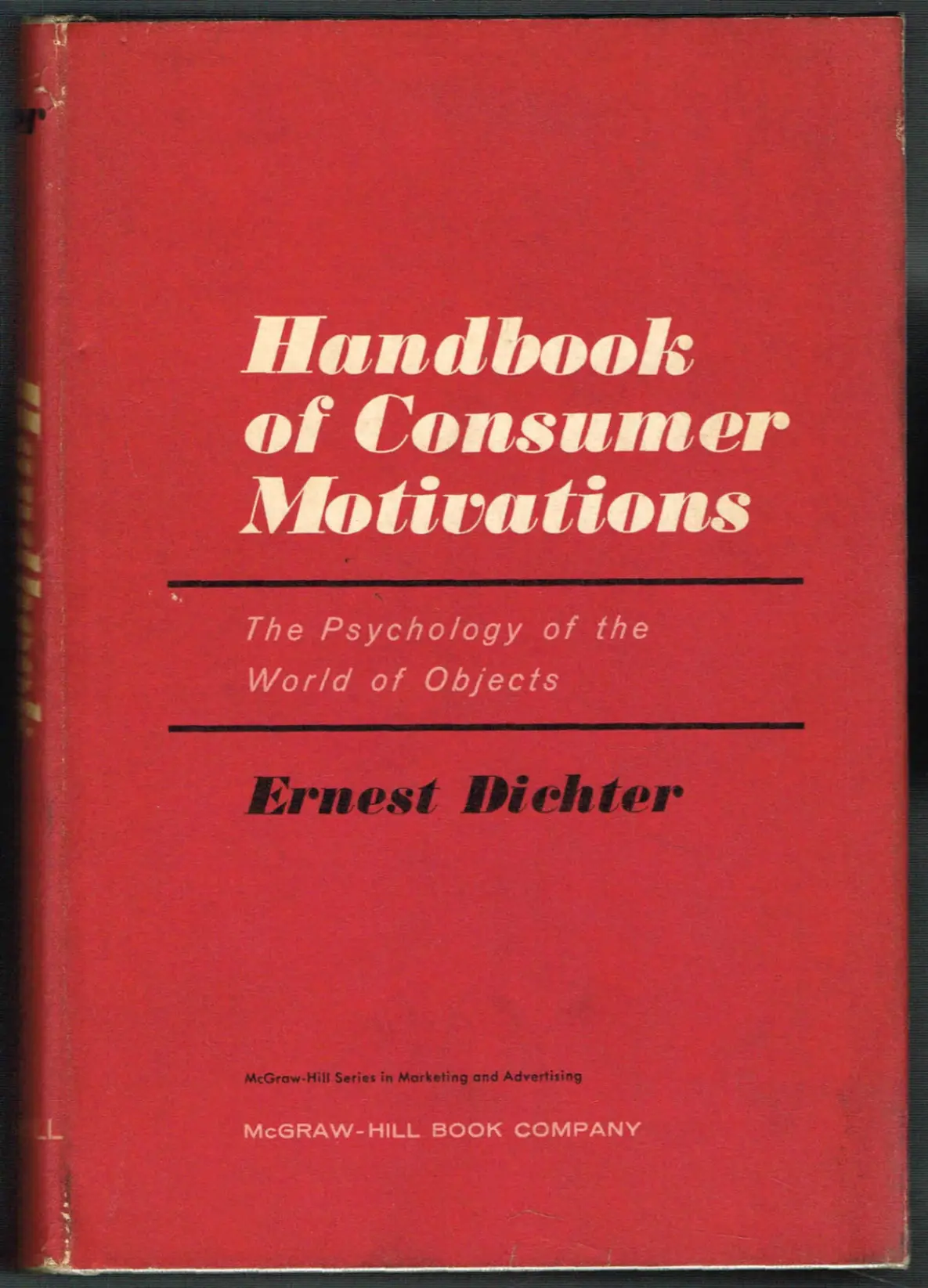
Handbook of Consumer Motivations: The Psychology of the World of Objects
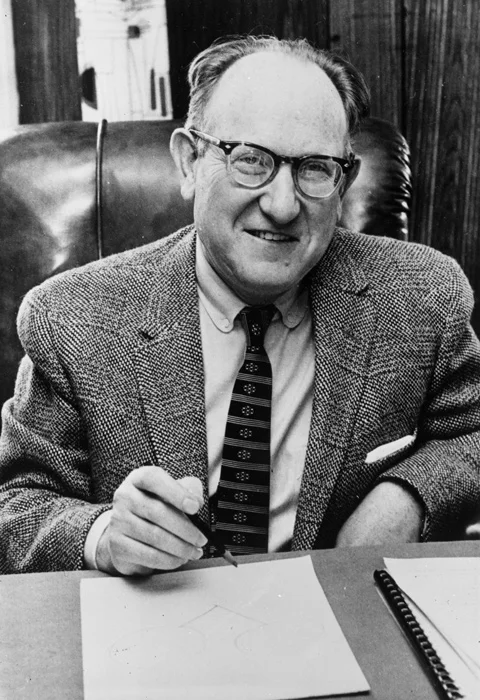 Ernest Dichter
Ernest Dichter's Handbook of Consumer Motivations organizes his Institute for Motivational Research case files into a reference work on the unconscious meanings consumers attach to everyday objects. Rather than a systematic theory, Dichter offers a catalog of interpretive claims—beets recall menstrual blood, soap functions as a morality symbol, machines carry erotic charge—drawn from depth interviews and psychoanalytic inference. The book's organizing principle is that objects are never merely utilitarian: they serve as projective surfaces for desires, anxieties, and social aspirations that consumers cannot articulate directly. Its handbook format makes it useful for browsing, not for reading through.
Key Details
Related Books
View AllSimilar books from the same category, ranked by shared topics and reader engagement.

.webp?alt=media&token=48ae434b-2ecf-4690-a2ac-e97370fc544a)

Key Insights — Read in 10 Minutes
What specific method or framework does Dichter use to generate the book's interpretive claims?
Dichter draws on over 2,500 studies conducted by his Institute for Motivational Research, using depth interviews and psychoanalytic interpretation rather than survey data or experimental methods. The book's entries typically present a consumer behavior or preference, then offer an unconscious explanation—often involving childhood experience, bodily anxiety, or symbolic association. A reviewer in the Journal of Marketing noted that Dichter 'delves too often for hidden explanations, overlooks the obvious,' citing the claim that beet aversion stems from associations with blood. The method is Dichter Deductivism, as one contemporary critic called it: interpretive conclusions presented with certainty but without the evidentiary safeguards of empirical social science.
How did academic reviewers assess the book's evidentiary standards?
Reviews were sharply divided between acknowledging Dichter's stimulation value and condemning his methodological looseness. A Journal of Marketing review called it 'a potentially dangerous book for communications experts' because 'the half-truth and no-truth are so intermingled with the truth that it would take a Philadelphia lawyer to sort it all out'. Timothy Brock, reviewing in Contemporary Psychology in 1967, wrote that the book's generalizations are 'pontificated with militant indifference to conventional safeguards' and that readers are never permitted to ask basic questions like what proportion of respondents held a given view. A third reviewer conceded the book's usefulness as a source of case histories while faulting the absence of engagement with other motivation researchers such as Haire, Martineau, and Vicary.
What is the relationship between this book and Dichter's earlier The Strategy of Desire?
The Handbook extends the theoretical framework of The Strategy of Desire (1960) into an object-by-object reference format. Where the earlier book argued broadly that human action is rooted in irrational and unconscious motivation, the Handbook applies that premise to specific consumer goods and categories, treating each as a site of psychological meaning. The later book sacrifices sustained argument for comprehensiveness, and Dichter acknowledged this in his Preface by noting it could be read as an encyclopedia. The Strategy of Desire remains the more coherent statement of his worldview; the Handbook is the archive from which that worldview was assembled.
How does Dichter's account of consumer motivation differ from Vance Packard's critique in The Hidden Persuaders?
The two men framed the same practices in opposite moral terms. Dichter insisted his methods were motivational research aimed at understanding consumers, not manipulating them, and he resisted Packard's characterization of his work as exploitation. Packard, whose 1957 bestseller brought Dichter's methods to public attention, portrayed the 'depth boys' as threats to rational self-determination. Where Dichter saw the decoding of unconscious desire as a path to more effective and even therapeutic communication, Packard saw it as a new form of social control. The controversy permanently shaped public perception of Dichter, though he reportedly welcomed the attention Packard's book brought to his field.
Is the book's psychoanalytic framework still used in consumer research today?
The specific Freudian interpretations Dichter favored—such as reading soap as a morality symbol or machines as erotic objects—have not survived as predictive science. Modern consumer psychology relies on cognitive, social, and behavioral-economic frameworks rather than depth interpretation. However, Dichter's broader insight that non-utilitarian and unconscious factors shape product choice anticipated later dual-process theories and implicit-measure research. The Handbook is best understood as a historical document of mid-century applied psychoanalysis rather than a source of current methodology. Its enduring value lies in showing how thoroughly psychoanalytic thinking once permeated commercial research.
Wealthy Psyche is an intellectual archive. We do not host, distribute, or sell book copies — physical or digital. We provide structured knowledge to help you think better, faster.