


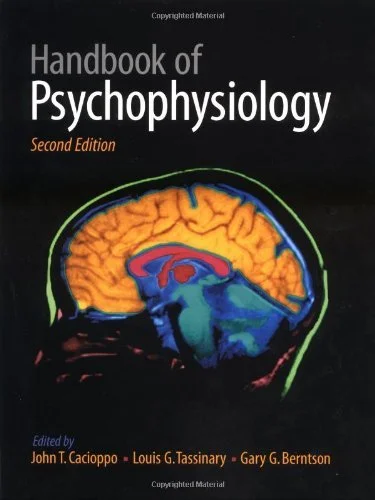
Handbook of Psychophysiology
 John Terrence Cacioppo
Edited by John T. Cacioppo with Louis G. Tassinary and Gary G. Berntson, this handbook serves as the definitive reference for psychophysiological science, mapping the biological substrates of cognitive, affective, social, and developmental processes. Its organizing framework insists that psychological phenomena cannot be understood at the skin's edge: emotion, stress, and social behavior are embodied in cardiovascular, electrodermal, neuroendocrine, and immune systems. Each edition expands coverage of central nervous system methods while maintaining the foundational commitment to strong inference, multiple measures, and careful experimental design that Cacioppo championed throughout his career.
Key Details
Related Books
View AllSimilar books from the same category, ranked by shared topics and reader engagement.


.webp?alt=media&token=48ae434b-2ecf-4690-a2ac-e97370fc544a)
Key Insights — Read in 10 Minutes
What is the central organizing claim of the Handbook of Psychophysiology?
The Handbook's foundational premise is that psychological processes—emotion, cognition, social behavior—are embodied in biological systems that cannot be understood by studying the brain or behavior in isolation. The editors frame psychophysiology as an interdisciplinary science spanning the central nervous system, autonomic and somatic systems, and cellular/humoral processes including immune and endocrine function. This means emotion is not merely a subjective state but a pattern of cardiovascular, electrodermal, and neuroendocrine responses; stress is not just a feeling but a cascade involving cortisol, cytokines, and autonomic regulation. The Handbook's chapters are organized to reflect this multi-systemic view, moving from neural foundations through systemic physiology to topical applications.
How do the successive editions of the Handbook differ in scope and emphasis?
The first edition (2000) established the template. The third edition (2007) expanded coverage of central nervous system methods, adding functional neuroimaging, event-related brain potentials, source dipole localization, lesion methods, and transcranial magnetic stimulation. The fourth edition (2017), published shortly before Cacioppo's death, added chapters on behavioral epigenetics, functional genomics, psychoneuroimmunology, interoception, and ambulatory/non-contact recording. The fourth edition also reflects the maturation of social neuroscience, a field Cacioppo co-founded with Gary Berntson in the early 1990s. Across editions, the editorial commitment to strong inference and multiple measures remains constant, but the methodological toolkit grows substantially.
What role did the Handbook play in Cacioppo's broader intellectual project?
The Handbook was the institutional anchor of Cacioppo's campaign to establish psychophysiology as a rigorous interdisciplinary science, not merely a collection of measurement techniques. His 1992 American Psychologist article with Berntson formalized social neuroscience as a distinct discipline; the Handbook provided the methodological foundation for that field. Cacioppo's President's Column in the APS Observer championed psychology as a 'hub science,' and the Handbook embodies that vision by integrating neuroscience, immunology, endocrinology, and genetics under a single psychophysiological framework. The Handbook's longevity—spanning nearly two decades and four editions—mirrors Cacioppo's own career trajectory from social psychophysiology to social neuroscience to loneliness research.
How did Cacioppo's editorial collaborators shape the Handbook's direction?
Louis G. Tassinary, a professor of architecture and former director of the Environmental Psychophysiology Laboratory at Texas A&M, contributed expertise in somatic and skeletomotor systems, including surface electromyography and environmental applications. Gary G. Berntson, Cacioppo's longtime collaborator at Ohio State, brought deep knowledge of cardiovascular psychophysiology and autonomic regulation, co-developing with Cacioppo the bivariate autonomic space model. The three editors' complementary strengths—Cacioppo's social neuroscience vision, Tassinary's somatic systems expertise, and Berntson's autonomic physiology—gave the Handbook both breadth and depth that a single editor could not achieve. Their sustained collaboration across multiple editions ensured continuity of vision while accommodating the field's rapid expansion.
Does the Handbook address consumer psychology, given its placement in that subcategory?
The Handbook's primary audience is psychophysiological researchers, not consumer psychologists, but its methods and frameworks have been applied to consumer research contexts. Cacioppo's foundational work with Richard Petty on the Elaboration Likelihood Model of persuasion—developed in the late 1970s and 1980s—directly informs consumer attitude research, and the Handbook's chapters on emotion, attention, and stress physiology provide the biological grounding for understanding consumer responses. However, the Handbook itself does not focus on consumer behavior. Its inclusion in the Consumer Psychology subcategory reflects the broader relevance of Cacioppo's work to persuasion and attitude research rather than the book's explicit subject matter. Researchers should consult Cacioppo and Petty's ELM publications for direct consumer applications.
What is the documented reception of the Handbook within the psychophysiology community?
The Handbook is widely regarded as the authoritative reference in its field, with reviewers describing it as 'essential' and 'invaluable' . The fourth edition received endorsements from prominent scholars including John J. B. Allen of the University of Arizona and Stefano F. Cappa of the Institute for Advanced Studies in Pavia, who praised its combination of exhaustive topical coverage and thorough theoretical grounding . A review in The Psychologist called it 'an essential, invaluable reference for psychophysiology researchers' . The handbook's sustained publication across four editions over two decades, with a fifth edition forthcoming, attests to its enduring standing in the field.
Wealthy Psyche is an intellectual archive. We do not host, distribute, or sell book copies — physical or digital. We provide structured knowledge to help you think better, faster.