


https://firebasestorage.googleapis.com/v0/b/wealthy-psyche.firebasestorage.app/o/images%2F1792125783537-4628042.webp?alt=media&token=98a6651d-a7cf-45e6-8189-f38f5bcb5633
 Ernest Dichter
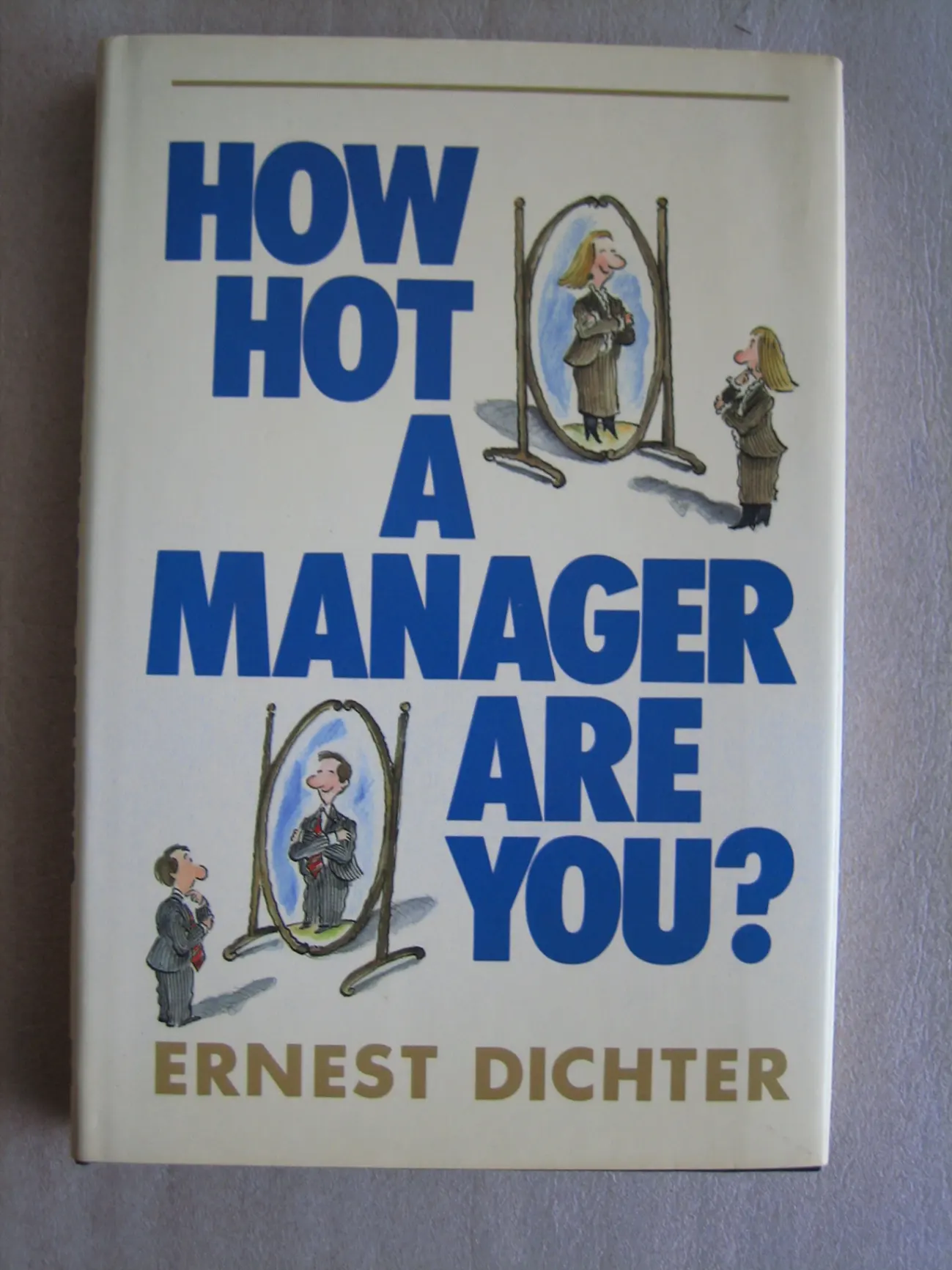
Ernest Dichter's How Hot a Manager Are You? translates motivational research into a diagnostic framework for managerial self-assessment. Rather than offering universal leadership prescriptions, Dichter argues that effective management depends on recognizing one's own motivational profile and understanding the unconscious drives shaping employee behavior. The book positions managerial competence as a psychological skill—rooted in self-awareness and interpersonal perception—not merely a technical or strategic one. It applies Dichter's psychoanalytic approach to workplace dynamics, asking managers to confront their strengths and weaknesses across planning, decision-making, creativity, motivation, teamwork, and communication.
Key Details
Related Books
View AllSimilar books from the same category, ranked by shared topics and reader engagement.


.webp?alt=media&token=48ae434b-2ecf-4690-a2ac-e97370fc544a)
Key Insights — Read in 10 Minutes
What distinguishes Dichter's approach to management in this book from conventional leadership guides?
Dichter's framework treats management as a psychological diagnostic practice rather than a set of prescriptive behaviors. Where conventional guides offer rules—delegate, communicate clearly, set goals—Dichter asks managers to assess their own motivational composition and understand the unconscious forces shaping workplace interactions. The book includes self-assessment instruments across six dimensions: planning, decision-making, creativity, motivation, teamwork, and communication. This diagnostic orientation reflects Dichter's conviction that effective influence begins with self-knowledge and perception of others' hidden motivations, not with technique. It is a management book written by a consumer psychologist, applying the same depth-psychological lens he used to decode brand preferences.
How does this book relate to Dichter's earlier work in consumer research?
How Hot a Manager Are You? extends Dichter's motivational research framework from consumers to managers and employees. His foundational insight—that people act on unconscious desires they often cannot articulate—is applied here to organizational behavior. Earlier works like Motivating Human Behavior (1971) explored motivation in workplace contexts; this book focuses specifically on the manager's own psychological profile as the instrument of leadership. The shift reflects Dichter's late-career move toward executive education and organizational consulting, domains where he continued working into the 1980s and 1990s.
How was Dichter's broader approach to influence received by critics during this period?
Dichter's reputation was permanently shaped by Vance Packard's The Hidden Persuaders (1957), which portrayed motivational research as a manipulative threat to consumer autonomy. This critique dominated public perception for decades, casting Dichter as the archetypal 'hidden persuader.' By the 1980s, however, scholarly reassessment had begun. A 2005 symposium at the University of Vienna examined Dichter's work through historical and communication-studies lenses, and a 2010 Palgrave Macmillan volume, Ernest Dichter and Motivation Research, offered new perspectives on his role in postwar consumer culture. The tension between his popular reputation as manipulator and his scholarly recognition as a pioneer persists.
What is the documented publication history and availability of this book?
How Hot a Manager Are You? was published by McGraw-Hill in 1987, with some catalog records indicating an October 1986 release date. The book runs 149 pages, includes an index and a bibliography, and carries the Library of Congress classification HF5548.8, placing it in industrial psychology and management. It is listed in major research library catalogs including Princeton, the National Central Library of Taiwan, and CiNii in Japan. The book has not remained in print and is primarily available through library collections and secondhand markets, indicating limited commercial longevity despite Dichter's broader historical significance.
How does this book fit into the broader trajectory of Dichter's published works?
Published in 1987, it was among Dichter's final books before his death in 1991, following The Naked Manager (1974), Motivating Human Behavior (1971), and his major theoretical statement The Strategy of Desire (1960). The late-career shift toward management topics parallels his work as an organizational consultant through Ernest Dichter Associates International. Unlike his consumer research books, which reached broad audiences and generated substantial controversy, this volume addresses a narrower professional readership and has received little scholarly attention. It represents the extension of Dichter's psychoanalytic method into a domain—executive self-development—that was increasingly crowded with popular management literature in the 1980s.
Wealthy Psyche is an intellectual archive. We do not host, distribute, or sell book copies — physical or digital. We provide structured knowledge to help you think better, faster.