


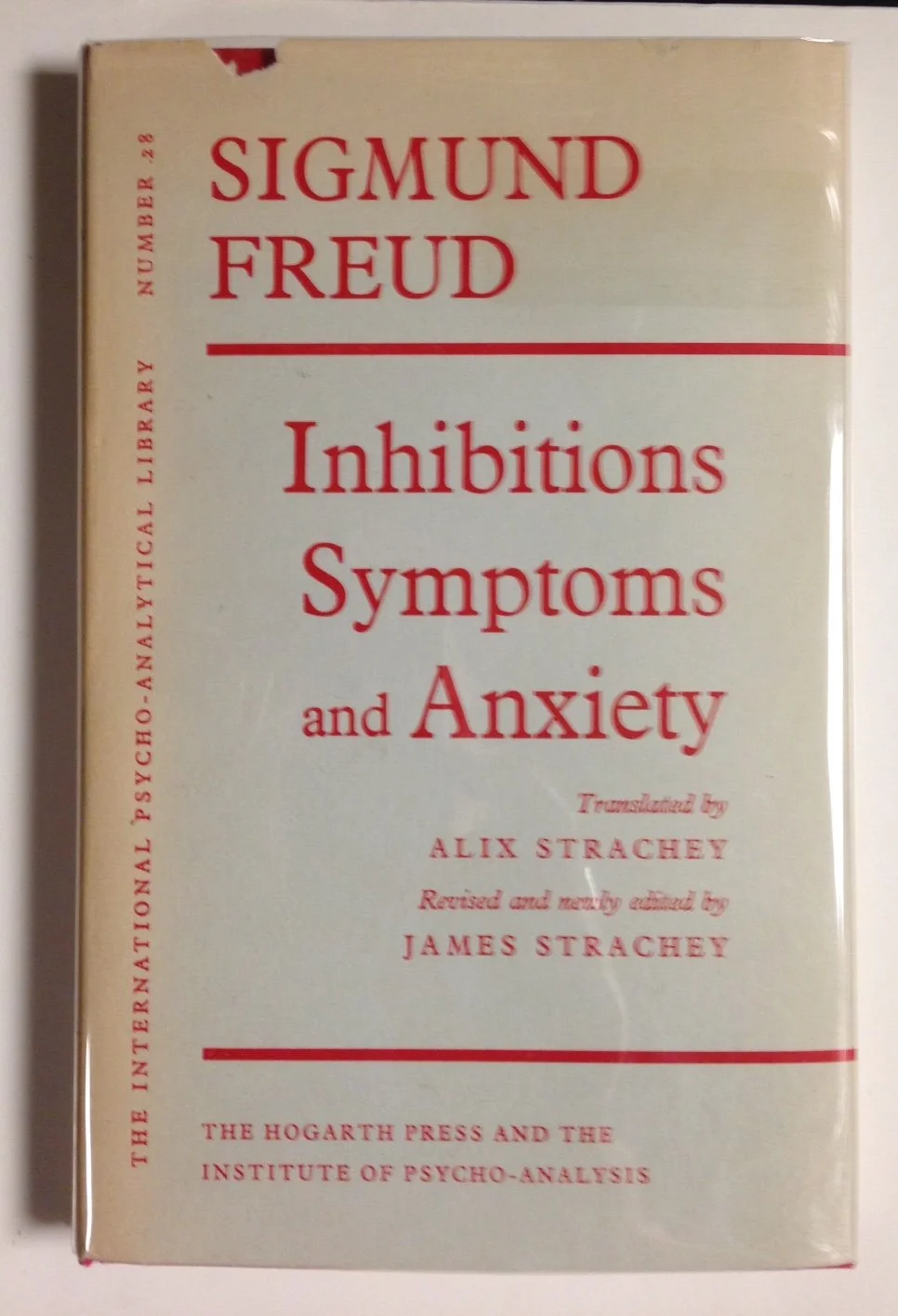
Inhibitions, Symptoms and Anxiety
 Sigmund Freud
Freud's 1926 monograph overturns his own earlier theory of anxiety. Where he had held that repression causes anxiety—dammed-up libido converting into the affect—he now argues the reverse: anxiety is a signal of danger emitted by the ego, and repression follows as a defence against it. Inhibitions are restrictions of ego functions adopted to avoid conflict with the id or superego; symptoms are compromise formations that simultaneously satisfy and punish the repressed impulse. The book's central claim is that anxiety is not a transformed libido but a signal function rooted in the trauma of birth and the fear of castration.
Key Details
Book Archives
View AllExplore detailed research articles, summaries and analyses from this book.


Related Books
View AllSimilar books from the same category, ranked by shared topics and reader engagement.



Key Insights — Read in 10 Minutes
What is the central theoretical reversal this book accomplishes?
The book reverses Freud's earlier causal sequence. In his first theory, anxiety resulted from repression: libido that could not be discharged was dammed up and transformed into anxiety. In the 1926 revision, anxiety comes first. The ego perceives a danger situation, emits anxiety as a signal, and repression is then deployed as a defence against the anxiety thus aroused. Anxiety is no longer a by-product of repression but its cause. As Freud saw several types of anxiety at work in the mind, he argued that anxiety causes repression rather than the other way around . The ego becomes the seat of anxiety, and the signal function—rather than the economic transformation of libido—becomes the concept's central feature.
What is the significance of the 'signal anxiety' concept, and how does it differ from traumatic anxiety?
Signal anxiety is the ego's anticipatory response to a danger situation—a small quantity of anxiety mobilized to activate defences before the danger becomes overwhelming. Traumatic anxiety, by contrast, is what arises when the ego is overwhelmed, when the danger situation has materialized and the ego lacks the resources to master it. The distinction is developmental: the infant's earliest experience of helplessness (Hilflosigkeit) is traumatic; the mature ego learns to anticipate danger and produce anxiety in small doses as a warning. Freud identifies the danger situations in sequence: birth, loss of the mother, loss of the mother's love, castration, and finally the superego's disapproval. Each stage corresponds to a developmental phase and its characteristic anxiety.
How does the book relate to Otto Rank's The Trauma of Birth?
The book engages directly and polemically with Rank's theory, which held that all anxiety is an abreaction of the trauma of birth and that the birth experience is the prototype of every later anxiety. Freud accepts that birth provides the model of a traumatic situation—an overwhelming influx of excitation—but he rejects Rank's claim that it is the source of all anxiety and the basis of neurosis. He argues that the fear of castration, not the trauma of birth, is the central danger situation for the male, and that separation anxiety (loss of the loved object) is the more fundamental human fear. One contemporary reader of the book noted that Freud 'wastes more of our time attacking Otto Rank. And Jung slightly' —an indication of how prominently the polemic figures.
What are inhibitions and symptoms, and how does Freud distinguish them?
Inhibitions are restrictions of ego functions—eating, walking, working, loving—adopted to avoid conflict with the id or superego. They are not necessarily pathological; Freud notes that inhibition can be a normal renunciation, and it becomes pathological when the restriction is disproportionate or serves neurotic conflict. Symptoms are compromise formations: they simultaneously satisfy the repressed impulse and punish it, or satisfy it in a disguised and self-punishing form. Inhibition restricts function; symptom creates a substitute. Freud uses the example of a child who gives up playing the piano because it arouses forbidden pleasure, and the obsessional who performs rituals that both enact and undo the forbidden wish. The distinction is between the renunciation of function and its distorted persistence.
How did Freud himself assess the book, and how was it received?
Freud's self-assessment was harsh. He wrote to Ernest Jones that the work 'contains several new and important things, cancels and corrects many earlier conclusions, and on the whole is not good' . The French preface to the book notes that the imbalance of the title—inhibition, symptom, and anxiety—is itself an index of the difficulties Freud encountered in unifying the work: anxiety occupies the central place, while symptom and especially inhibition receive only reduced treatment . The first English translation, by L. Pierce Clark in 1927, was never issued in England and was surpassed by Alix Strachey's authorized translation, published by Hogarth Press in 1936 as No. 28 of the International Psycho-Analytical Library . Later readers have called it a classic on anxiety, though not for the layman .
What is the publication and translation history of the book?
The German original, Hemmung, Symptom und Angst, was written in the summer of 1925, revised in December, and published in February 1926 by Internationaler Psychoanalytischer Verlag . The first English translation, by L. Pierce Clark, appeared in 1927 from the Psychoanalytic Institute in Stamford, but it was never issued in England . Alix Strachey's authorized translation, edited by Ernest Jones, was published in London by Hogarth Press and the Institute of Psycho-Analysis in 1936 as No. 28 of the International Psycho-Analytical Library . A revised edition of the Strachey translation was published by Hogarth in 1971 . The Standard Edition version, edited by James Strachey, appears in Volume 20 (1955) .
Show 1 more insights
What is the relationship between this book and Freud's earlier Beyond the Pleasure Principle?
Inhibitions, Symptoms and Anxiety extends and applies the dual-instinct theory introduced in Beyond the Pleasure Principle (1920). The earlier book established the repetition compulsion and the death instinct; the 1926 book applies these concepts to the clinical problems of anxiety, inhibition, and symptom formation. The signal-anxiety concept depends on the structural model of The Ego and the Id (1923), in which the ego is a differentiated agency with its own defensive functions. The 1926 book thus completes a trilogy of late metapsychological revisions: Beyond the Pleasure Principle (drive theory), The Ego and the Id (structural theory), and Inhibitions, Symptoms and Anxiety (affect and defence theory). Together they constitute the mature Freudian framework.
Wealthy Psyche is an intellectual archive. We do not host, distribute, or sell book copies — physical or digital. We provide structured knowledge to help you think better, faster.