


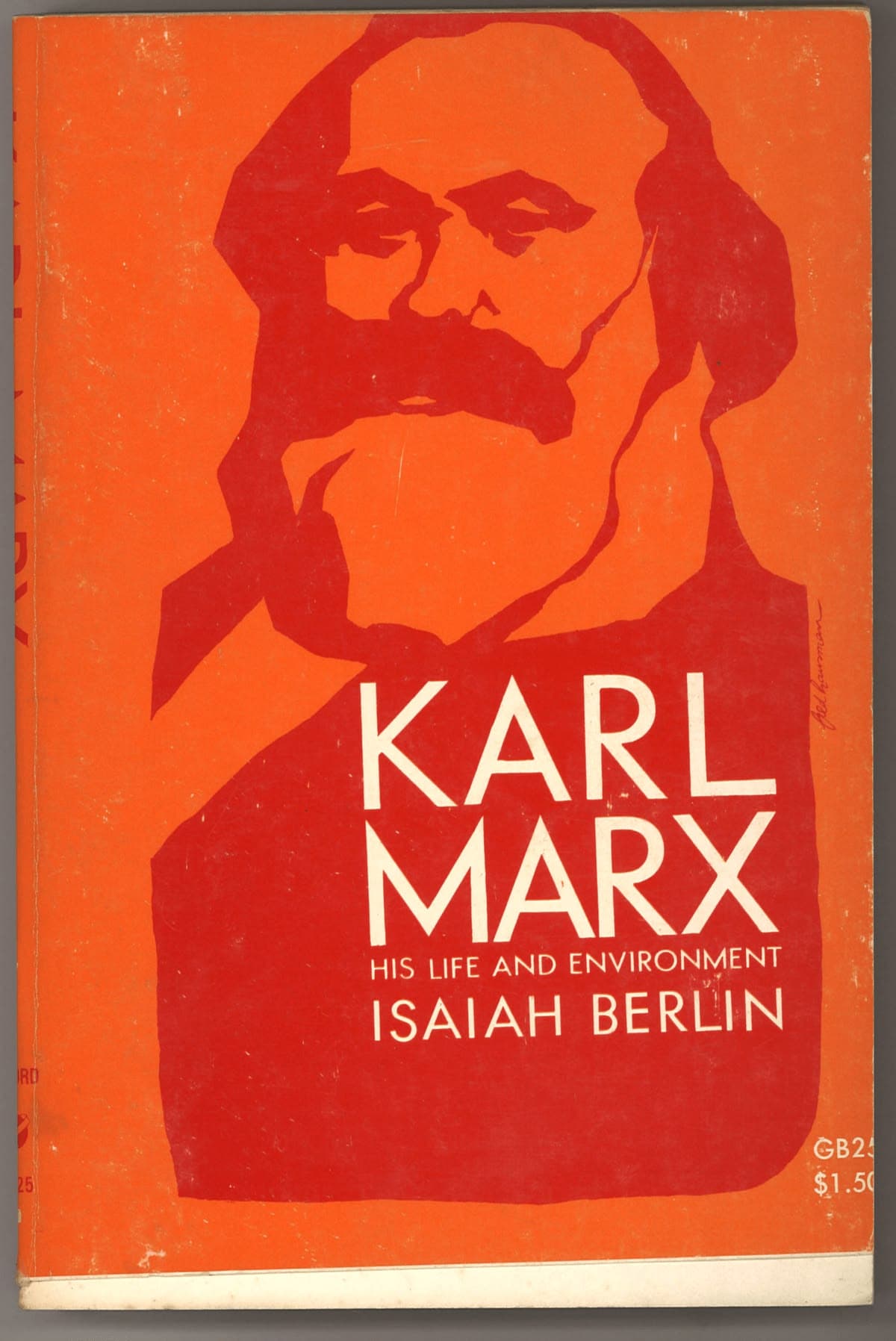
Karl Marx: His Life and Environment

Berlin's intellectual biography argues that Marx's system rests on indefensible metaphysical presuppositions, and that its power lies less in its truth than in its function as a secular eschatology. Berlin presents Marx as a figure shaped by the Enlightenment and its counter-currents, whose doctrine offered a compensatory narrative of historical inevitability to a generation of socially displaced intellectuals. The book is distinctive for treating Marx's ideas as a response to a specific cultural and psychological predicament—the condition of emancipated Jewry in Central Europe—rather than as a purely economic or philosophical system.
Key Insights
✦What is the central argument of Berlin's biography, and how does it differ from other studies of Marx?
Berlin's distinctive claim is that Marx's system depends on metaphysical presuppositions that cannot be defended, and that its historical appeal owed less to its scientific pretensions than to its function as a compensatory narrative. Marx offered a story of inevitable triumph to intellectuals who felt displaced and powerless. Berlin treats Marx not primarily as an economist or philosopher but as a thinker shaped by the Enlightenment and its counter-currents, whose doctrine answered a psychological need for certainty and recognition. This makes the book an early exercise in what Berlin later called the history of ideas: the study of how concepts migrate from abstract argument into the emotional and political needs of a historical moment.
✦What was the book's publication history, and how did it evolve across its five English editions?
The first edition appeared in 1939 from Thornton Butterworth in London, as part of the Home University Library series . A second edition followed from Oxford University Press in 1948, and the third in 1963 . The fourth edition in 1978 included a guide to further reading by Terrell Carver, and Alan Ryan contributed a foreword to later printings . The fifth edition, edited by Henry Hardy with a foreword by Ryan and an afterword by Carver, was published by Princeton University Press in 2013; Hardy thoroughly revised the text and added references for quotations . The book was also translated into numerous languages, including German, Italian, Dutch, Spanish, and Japanese .
✦How did Berlin's view of Marx change between the 1939 original and his later revisions?
Berlin revised the book in 1963, five years before publishing his essay on Disraeli, Marx, and the search for identity. That later essay approached Marx from a psychological angle, presenting his doctrine as a response to his condition as a culturally homeless exile and his craving for recognition . The revisions to the biography reflect Berlin's growing interest in the Counter-Enlightenment and in the role of cultural identity in shaping thought. One scholar has suggested that Berlin's Marx was in some ways a vehicle for Berlin's own moral positions and historical identity, and should be read as much for what it reveals about Berlin as for what it says about Marx . The 2013 Hardy edition makes these layers of revision visible.
✦How was the book received on its initial publication, and how has its reputation fared?
The book was well received as an introduction. A 1948 review in the New Zealand Listener praised Berlin's 'swift, but not cursory' delineation of Marx's social and intellectual milieu, noting that he wrote with neither animus nor adulation, and recommended the book as an excellent preparation for inquirers before tackling 'the steeper gradients of Popper or Eastman' . Peter Gay later praised it as one of the best discussions of alienation in the literature on Marx and Hegel, distinguished by its lucidity . Hugh Lloyd-Jones wrote in 1977 that after nearly forty years it still 'gleams like the golden bough through the murky forest of literature about Marx' . Its reputation as the best short account of Marx's life and thought has persisted.
✦What does Berlin mean by saying Marx's system rests on 'indefensible metaphysical presuppositions'?
Berlin's objection is not that Marx was empirically wrong about specific economic predictions but that his framework presupposes a philosophy of history that cannot be justified. Marx inherited from Hegel the idea that history has a rational direction and a discoverable meaning, while rejecting Hegel's idealism for a materialist account of that process. Berlin's later work on Vico, Herder, and the Counter-Enlightenment would develop the alternative: history does not obey laws of the kind Marx claimed, and human affairs resist the kind of scientific prediction Marx promised. The biography's critique is thus an early statement of the anti-monism that Berlin would elaborate across his career, applied here to the most influential system-builder of the nineteenth century.
✦Why does Berlin treat Marx's Jewish identity and social position as relevant to his ideas?
Berlin's later essay on Marx and Disraeli makes explicit what is implicit in the biography: Marx's development can be understood in terms of negative choices rooted in his insecurities as a culturally homeless exile, his craving for recognition, and his need to compensate for the humiliations inflicted on the first generation of emancipated Jews in Central Europe . Marx, unlike Moses Hess, could not accept the values of his inherited community, and this, Berlin suggests, distorted his social perceptions. Instead of building on the conflicted identity he had been given, Marx constructed a theory that made ethnicity, religion, and nationality evanescent. Berlin's biographical method treats ideas as responses to existential predicaments, not as pure products of reason.
Wealthy Psyche is an intellectual archive. We do not host, distribute, or sell book copies — physical or digital. We provide structured knowledge to help you think better, faster.