


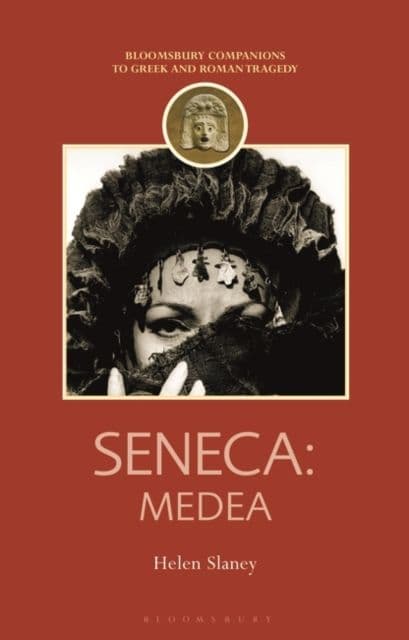
Medea

Seneca's Medea is a Latin verse tragedy in which the abandoned Medea, cast off by Jason for a new royal marriage and threatened with exile by Creon, plans and carries out a revenge that culminates in the murder of her own children. Its central mechanism is the self-fashioning of passion: Medea repeatedly addresses and commands herself, rousing her anger and her inherited power until she becomes, in her own words and acts, the Medea of myth. The play stages furor as will rather than collapse, so that rage appears as a chosen intensification of identity, which makes it a pointed counterpart to Stoic arguments about mastering the passions at their first stirring.
Key Insights
✦How does Seneca's Medea differ from Euripides's version?
Euripides gives Medea a sympathetic, socially grounded grievance, with a chorus of Corinthian women who partly share her situation, and he lets her escape in a divine chariot. Seneca concentrates on her inner escalation. She is already formidable in the opening scene, invokes the powers of the underworld, and treats the killing of her children as the culmination of a deliberate effort to match her wrongs with a greater crime. The Senecan Medea is therefore less a wronged woman in a city than a figure of concentrated, self-aware fury, and the play pays more attention to rhetoric and ritual than to social context.
✦What is the role of Medea's self-address, and why does it matter?
Medea frequently speaks to herself, urging herself to become what she has been, and her identity is built through these commands. Scholars such as Christopher Gill have discussed how this stages the problem of the self in Stoic and Roman thought, since the character does not lose control but exercises it in the service of passion. The device lets Seneca show anger as something that can seem rational from within, a pattern his prose essay On Anger describes when it warns that passion can borrow the language of justice. The effect is both psychologically vivid and philosophically unsettling.
✦Is the Medea a Stoic play, and how is that disputed?
Critics disagree about how closely Seneca's tragedies track his philosophy. The choral odes contain reflections on fate, the dangers of ambition, and the limits of human mastery over nature, which can be read in Stoic terms, and the play depicts exactly the unchecked passion that Stoic ethics condemns. Yet it offers no consoling resolution and gives Medea striking dramatic power, which complicates a purely didactic reading. Some interpreters read the plays as illustrations of Stoic doctrine, while others, including A. J. Boyle, emphasize their autonomy as dramatic and political works under the principate.
✦How did the play influence later drama?
Seneca's version was among the principal channels through which the Medea story reached Renaissance and early modern Europe, at a time when his tragedies were far better known than the Greek originals. French dramatists, notably Pierre Corneille in his Médée, adapted it, and its rhetorical intensity shaped the style of tragedy more broadly. Its features, including a powerful vengeful protagonist, the invocation of dark powers, and extended declamation, left traces in Elizabethan and Jacobean theatre. This reception is a large part of why the play remains widely studied.
✦How has the play been misread?
One common oversimplification treats Seneca's Medea as mere sensationalism, with its violence valued for shock. The violence is shaped by rhetorical and thematic design, including reflections on power, marriage, and exile. A second error treats Medea simply as a villain or, alternatively, as a straightforward victim, whereas the play deliberately holds both aspects in tension. Questions about whether the work was meant for recitation or staging, which remain debated, also affect how its rhetoric is interpreted, so readers should be cautious about confident claims on performance.
✦Which editions and translations should readers consult?
The play was written in Latin, and a good scholarly starting point is the edition with commentary by C. D. N. Costa in the Oxford series, alongside Alessandro Schiesaro's discussions of Senecan tragedy. English translations appear in the Loeb Classical Library, Penguin Classics, and Oxford World's Classics, among others. Because the manuscripts of the tragedies fall into two main families and the text has uncertain passages, readers should check notes on textual choices and how each translator renders the highly stylized Latin rhetoric.
Wealthy Psyche is an intellectual archive. We do not host, distribute, or sell book copies — physical or digital. We provide structured knowledge to help you think better, faster.