


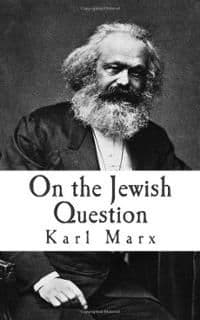
On the Jewish Question
Marx's essay argues that the 'Jewish question' is not a theological problem about Judaism but a political symptom of bourgeois society. Its central claim is that political emancipation—granting Jews equal citizenship—is not human emancipation, because the state can liberate itself from religion while leaving civil society saturated with the egoistic, money-worshipping spirit Marx identifies as 'Judaism.' The essay's notorious second part inverts Bauer's anti-Jewish polemic: the Jew is not the obstacle to emancipation; the bourgeois Christian is already a 'Jew' in his practical life. The argument's reception remains fiercely contested.
Key Insights
✦What is the essay's central argument, and how does it respond to Bruno Bauer's position?
Bauer had argued that Jews could not be emancipated unless they abandoned Judaism, since the Jewish religion is particularistic and incompatible with universal citizenship. Marx's response is twofold. First, he argues that Bauer confuses political emancipation with human emancipation: a state can be secular and grant Jews equal rights while leaving religion intact in civil society. Second, he inverts Bauer's target. The problem is not the Jew's particularism but the egoistic, money-driven character of bourgeois society itself, which Marx calls 'Judaism' in a secular sense. Christians in their practical lives are already 'Jews,' worshipping the god of money. Political emancipation is therefore incomplete; human emancipation requires the abolition of civil society's egoism.
✦Why is the second part of the essay so controversial, and what do defenders and critics say?
The second part contains passages that deploy crude stereotypes about Jews and haggling, which critics from Norman Geras to later scholars have identified as antisemitic in substance, not merely tone . Geras argued that it is 'fruitless to pretend that these themes are expressed merely ironically when there is no clear supporting evidence' . Defenders offer several lines of response. Some, like Francis Wheen, argue the essay was actually written as a defence of Jews against Bauer's demand for their conversion . Others, like Iain Hampsher-Monk, insist that 'only the most superficial reading' supports an antisemitic interpretation . Jonathan Sacks has called the charge of antisemitism an anachronism, since the term did not exist in 1844 and Marx expressed commonplace views . The debate remains unresolved.
✦What is the textual and publication history of the essay, and how does it affect reading?
Marx wrote the essay in two parts: the first in autumn 1843, the second in winter 1843–44. It was published in Paris in the first and only issue of the Deutsch-Französische Jahrbücher in spring 1844 . The essay is technically a review of Bauer's Die Judenfrage (1843), but Marx expanded it into an independent statement. The first part is largely a philosophical critique of Bauer's assumptions about the state and religion; the second is where the problematic passages appear . English translations vary: the standard version is in Marx-Engels Collected Works, vol. 3, translated by Clemens Dutt . T. B. Bottomore's translation in Early Writings (1964) was influential in presenting Marx as a humanist . Readers should note that some early English editions, like Dagobert Runes's A World Without Jews, presented the text as evidence of Marx's antisemitism .
✦How does the essay relate to Marx's other writings of the same period?
The essay belongs to the same period as the Contribution to the Critique of Hegel's Philosophy of Right: Introduction and the Economic and Philosophical Manuscripts, all written in 1843–44 and published or drafted around the same time. Together they mark Marx's break with Hegelianism and his turn toward a critique of civil society. The essay's argument about political emancipation versus human emancipation parallels the Introduction's critique of religion as the 'opium of the people.' The Manuscripts develop the concept of alienated labour, which is the economic counterpart to the essay's critique of money-worship. The essay is thus a transitional text, still Hegelian in vocabulary but moving toward the materialist analysis that would culminate in The German Ideology and Capital.
✦Was the essay influential in the socialist movement, and how did later Marxists handle it?
Its influence has been uneven and often indirect. The essay was not widely discussed in the nineteenth-century socialist movement, and many later Marxists either ignored it or treated it as an embarrassment. Soviet editions included it, but its anti-Jewish passages were not emphasized. The essay gained renewed attention after the Holocaust, when scholars began asking whether Marx's rhetoric contributed to socialist antisemitism. Abram Leon's The Jewish Question (1946) offered a Marxist analysis of Jewish history as a 'people-class' without engaging Marx's essay directly . More recently, the essay has become a standard reference point in debates about Marx, antisemitism, and the limits of secular emancipation, cited by both defenders and critics.
Wealthy Psyche is an intellectual archive. We do not host, distribute, or sell book copies — physical or digital. We provide structured knowledge to help you think better, faster.