


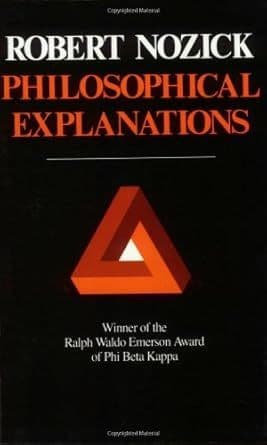
Philosophical Explanations
Nozick's book argues that philosophy should abandon the coercive aim of proof in favour of explanation—showing how something is possible given what we already accept. The central mechanism is the 'how possible?' question: given apparent excluders (determinism, sceptical scenarios, the existence of evil), how can free will, knowledge, or meaning be possible? Nozick applies this method across personal identity, the question of why anything exists, knowledge and scepticism, free will, ethics, and the meaning of life, seeking understanding rather than forced assent.
Key Insights
✦What is the central methodological claim of Philosophical Explanations, and what does it reject?
Nozick argues that philosophy should abandon the aim of proof—which he calls 'coercive' because it attempts to force belief—in favour of explanation. Harvard University Press's description states that in place of 'the usual semi-coercive philosophical goals of proof, of forcing people to accept conclusions,' the book seeks 'philosophical explanations and understanding' . The method is to ask 'how is p possible, given r1, r2, ... rn?' where the r's are apparent excluders we take for granted—determinism, sceptical hypotheses, or the existence of evil—and then to show how the target phenomenon can coexist with them . The aim is increased understanding, not forced assent.
✦What is Nozick's 'truth-tracking' theory of knowledge, and why did it attract the most attention?
Nozick's theory holds that knowledge requires four conditions: p is true, S believes p, if p were not true S would not believe it, and if p were true S would believe it . The last two are counterfactual conditions that replace the traditional justification requirement. This is an externalist, reliabilist account: knowledge depends on whether one's belief tracks the truth across close possible worlds, not on internal access to justification. The Routledge Encyclopedia notes that while Nozick made contributions to personal identity and ethics, 'his treatments of knowledge and scepticism have attracted the greatest attention' . The theory's most striking implication is that it denies the closure principle, allowing Nozick to claim we can know ordinary facts while conceding we cannot know we are not brains in vats.
✦How was the book received on publication, and what were the main criticisms?
Reception was sharply divided. Harvard University Press's blurb page quotes praise calling it 'a major book' and 'as brilliant and exciting as anything in contemporary philosophy' . But a reviewer in The British Journal for the Philosophy of Science reported that his hopes were 'largely disappointed,' describing 'seemingly endless quantities of superficially dazzling philosophical prose' and warning that if the book changes how philosophy is done, 'it will, I fear, be for the worse' . The reviewer found the first chapter's treatment of personal identity worth reading but objected to a 'regress to metaphysical speculation' and noted Nozick's unawareness of Wiggins's work on identity . The contrast between promotional praise and sceptical review is unusually stark.
✦What is the 'closest continuer' theory of personal identity, and how does it work?
Nozick proposes that something y at a later time is the same entity as x at an earlier time if y's properties causally stem from x's, and no other z stands in a closer relationship to x than y does . The theory is designed to handle problem cases—fission, brain transplants, gradual replacement—by treating identity as a matter of degree rather than an all-or-nothing relation. The Boston Review notes that while the idea may seem obvious once stated, 'spelled out in detail' the claim is 'full of surprises' and exemplifies 'philosophical rigor paying off' . The reviewer in The British Journal for the Philosophy of Science was more sceptical, finding the schema 'highly contentious' and questioning how we can identify an entity at a time without already using a criterion of identity over time .
✦How does the book's treatment of free will relate to its rejection of proof?
Nozick treats free will as an 'intractable' problem: if actions are determined they seem mechanical, and if random they seem purposeless . His response is not a decisive proof but a series of explanatory attempts. He proposes that free choices involve 'bestowing' weights on reasons rather than discovering pre-existing weights, and that this bestowal can be 'self-subsuming'—the decision fixes principles that govern the very act of deciding . Nozick himself expresses doubt about finding a fully satisfactory solution, and he ultimately rejects the self-subsumption proposal because he has 'worries about terming this bestowal nonarbitrary and nonrandom' . The chapter exemplifies the book's method: offering explanations that increase understanding without claiming to coerce assent.
✦What is the 'meaning of life' argument in the final chapter, and how does it connect to the book's larger project?
Nozick argues that meaning arises when a life transcends its own limits by connecting with something beyond itself—children, relationships, justice, truth, or beauty . The problem is that any finite context can be asked for its meaning in turn, generating a regress: my life has meaning through X, X through Y, Y through Z, and so on . Nozick's solution is to posit that the regress can stop only at something unlimited and infinite, which he hypothesizes is the structure of God's meaningfulness . The chapter is characteristic of the book's method: it takes a question most philosophers avoid, treats it with analytic rigor and speculative playfulness, and offers an explanation rather than a proof. The final section reflects on philosophy itself as part of the humanities, an art form rather than a science .
Wealthy Psyche is an intellectual archive. We do not host, distribute, or sell book copies — physical or digital. We provide structured knowledge to help you think better, faster.