


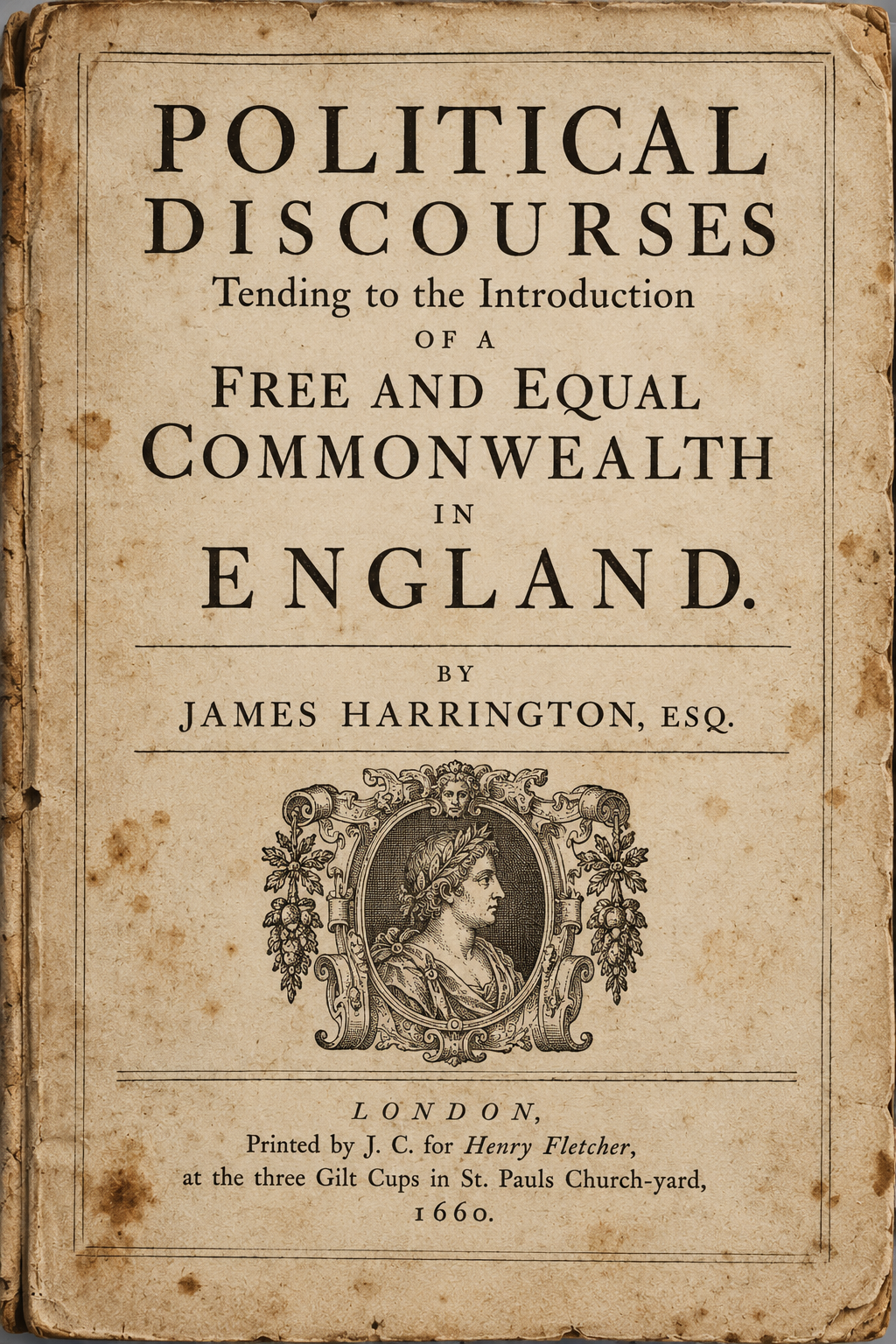
Political Discourses / Aphorisms Political
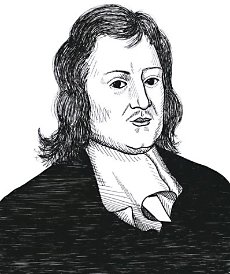 James Harrington
Harrington's Political Discourses collects two linked works from 1659: Aphorisms Political and its companion discourse, published together in 1660 under a common title page. The Aphorisms condense Harrington's republican theory into terse propositions on government, property, and interest, while the Political Discourses apply that theory to England's immediate constitutional crisis. The central argument is that government is an art of ruling according to interest, and that a free commonwealth requires the balance of property to align with popular rule. The collection serves as Harrington's short-form catechism of his system.
What are the Aphorisms Political, and how do they relate to Harrington's larger works?
Aphorisms Political is a compact work of 1659 presenting Harrington's political theory in a series of numbered propositions, modeled on the aphoristic style of Bacon and Hobbes. It covers the definition of government, the balance of property, the distinction between the empire of laws and the empire of men, and the mechanics of a free commonwealth. The work functions as a short catechism of the system developed at length in Oceana and The Prerogative of Popular Government, making Harrington's arguments accessible in a portable form suited to political debate.
How were Political Discourses and Aphorisms Political published?
Aphorisms Political was first printed in 1659 and appeared in a second, enlarged edition the same year. Political Discourses, a separate but related work, was published in 1660. In the same year, the two works were collected together under the common title Political Discourses, with a portrait of Harrington by Wenceslaus Hollar after a painting by Peter Lely. The collection brought together Harrington's shorter political writings in a single volume, distinct from the longer treatises Oceana and The Prerogative of Popular Government.
What role does 'interest' play in the Aphorisms?
Interest is central to Harrington's argument in the Aphorisms: government is defined as an art whereby a people rule themselves or are ruled by others, and the key question is whose interest the government serves. Harrington distinguishes the empire of laws — where government serves the common interest — from the empire of men, where a ruler or faction governs according to private interest. The Aphorisms present this distinction as a foundational principle, the political equivalent of a geometric axiom, from which the rest of the system follows.
What is the most common misconception about these shorter works?
A common misconception treats Aphorisms Political and Political Discourses as minor occasional pieces, lacking the substance of Oceana. In fact, the aphoristic form was a deliberate choice: Harrington believed political theory should be demonstrable, like mathematics, and that its principles could be stated as clear propositions. The Aphorisms contain in compressed form the entire architecture of his system, including the balance of property, the agrarian law, and the bicameral structure of debate and decision. They were reprinted in Toland's 1700 edition of Harrington's works alongside the longer treatises, indicating their recognized importance.
How did these works circulate in the eighteenth century?
Both Aphorisms Political and Political Discourses were included in John Toland's 1700 collection, The Oceana of James Harrington and His Other Works, which remained the standard edition for over two centuries. Toland's edition preserved these shorter texts alongside Oceana, The Prerogative of Popular Government, and A System of Politics, making them available to eighteenth-century readers in England, America, and France. French translations appeared in 1795, and the works were read by figures including John Adams and the authors of the American constitutional debates, who drew on Harrington's aphoristic formulations of republican principle.
Wealthy Psyche is an intellectual archive. We do not host, distribute, or sell book copies — physical or digital. We provide structured knowledge to help you think better, faster.