


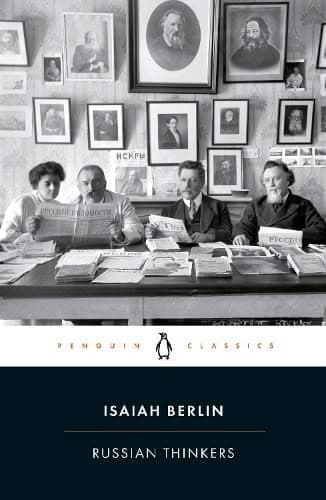
Russian Thinkers

Berlin's collection argues that the Russian intelligentsia of the nineteenth century produced the single largest Russian contribution to social change by taking imported European ideas and transforming them into a moral and political force. The essays trace this phenomenon through Herzen, Bakunin, Belinsky, Turgenev, and Tolstoy, with Berlin's central claim being that the intelligentsia's distinctive character lay not in original doctrine but in the passion and dedication with which it pursued ideas it had largely borrowed. The volume is unified by Berlin's attention to the tragic tension between individual liberty and the demand for collective salvation.
Key Insights
✦What unifies a collection of essays written over thirty years on figures as different as Belinsky, Bakunin, and Turgenev?
The unifying thread is Berlin's conception of the Russian intelligentsia as a historical phenomenon. He argues that the intelligentsia's distinctive character lay not in the originality of its ideas—he insists that scarcely a single political or social idea in nineteenth-century Russia was born on native soil—but in the fervour and moral seriousness with which it embraced ideas imported from Europe . The essays collectively portray a group of thinkers who transformed borrowed concepts into a programme for radical social change. Ronald Hingley, reviewing the collection in The Spectator, noted that Berlin's 'two cardinal theses' are the elusiveness of ultimate truth and the importance to Russia and the world of the country's digestion and regurgitation of mid-nineteenth-century ideas .
✦How does 'The Hedgehog and the Fox' fit within this collection, and what does it contribute to the volume's argument?
The essay on Tolstoy's view of history is the volume's most famous piece, and it exemplifies Berlin's method of treating ideas as responses to existential tensions. Berlin argues that Tolstoy was a fox by nature—gifted at perceiving the irreducible particularity of experience—but a hedgehog by conviction, craving a single theory that would explain history . This inner conflict, Berlin contends, animates both Tolstoy's fiction and his frustrated philosophy of history. Within Russian Thinkers, the essay serves as a case study in the intelligentsia's characteristic predicament: the inability to reconcile a clear-eyed perception of plurality with the longing for a unified truth that would give meaning to suffering and political commitment.
✦How does Aileen Kelly's introduction frame the collection, and what does it reveal about Berlin's broader project?
Kelly's introduction, 'A Complex Vision,' positions Berlin as a thinker who combined the pragmatism of English liberalism with the aspirations of European idealism . Her framing is significant because it presents Berlin's Russian essays not as a detour from his political philosophy but as central to it. The Russian intelligentsia, in Kelly's reading, serves as a case study in how moral ideals can become both a source of freedom from tyranny and a pathway to new forms of coercion. She shows how Berlin's engagement with Russian thought informed his conviction that it is through men's moral ideals—not abstract theory alone—that they may become free or unfree . The introduction thus makes the case for reading these essays as contributions to political theory, not merely intellectual history.
✦Was the collection criticized for over-identifying with its subjects, and what did reviewers see as its limitations?
Yes, contemporary reviewers noted Berlin's sympathetic immersion in Russian intellectual life as both the book's strength and a potential weakness. Ronald Hingley, writing in The Spectator in 1978, praised Berlin's 'profound erudition, philosophical zest and rhetorical panache' but dissented from what he called the 'boundless, almost ecstatic sympathy' with which Berlin contemplated Russian intellectual eccentricities . Hingley argued that the uninstructed student would gain a more balanced view from scholars like Tibor Szamuely or Richard Pipes, who were more informative even if less stimulating . The criticism points to a genuine feature of Berlin's method: he writes about thinkers he admires—Herzen above all—with a warmth that can obscure critical distance.
✦What is the editorial history of Russian Thinkers, and how does the standard edition differ from the original?
The volume was first published in 1978 by Hogarth Press in London and Viking Press in New York, edited by Henry Hardy and Aileen Kelly . It was the first of a projected four-volume series of Berlin's selected writings . A revised edition appeared in 2008 from Penguin, prepared for Penguin Classics, with a completely reset text, an expanded index, a glossary of names by Jason Ferrell, and Kelly's introduction . This edition is the standard scholarly version available today. Hardy's editorial work across Berlin's posthumous collections has been crucial in shaping how his scattered essays are read, and Russian Thinkers was the volume that established the model for subsequent collections.
✦How does the volume's treatment of Herzen differ from its treatment of other figures, and why is Herzen central to Berlin's argument?
Herzen is Berlin's hero in these essays, and the treatment he receives is notably warmer and more sustained than that of Bakunin, Belinsky, or Turgenev. Kirkus Reviews noted that Herzen, 'the sworn enemy of all systems,' holds that liberty is an absolute value not to be suppressed for the sake of future happiness or any other 'huge abstraction' . This position aligns closely with Berlin's own value pluralism and his critique of positive liberty. The New York Times review of the collection called the essay on Herzen and Bakunin 'thrilling,' praising Berlin's ability to make intellectual history feel urgent . Herzen functions in the volume as a counter-example to the intelligentsia's dominant trajectory: a thinker who resisted system-building and insisted on the primacy of individual freedom.
Wealthy Psyche is an intellectual archive. We do not host, distribute, or sell book copies — physical or digital. We provide structured knowledge to help you think better, faster.