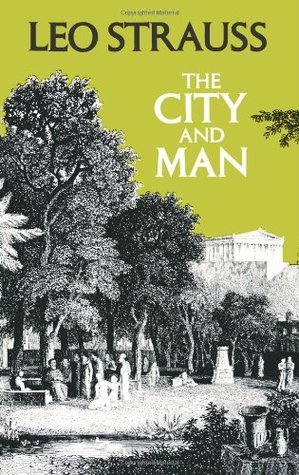
The City and Man
 Leo Strauss
Strauss's The City and Man consists of three essays on Aristotle's Politics, Plato's Republic, and Thucydides' History, unified by a single argument: classical political philosophy offers a standard of natural right by which to judge the crisis of modern thought. Its central mechanism is the recovery of the 'common-sense' understanding of the city—the polis as a way of life, not merely a state apparatus. Strauss reads Aristotle as the entry point, Plato as the full account of the best regime existing only in speech, and Thucydides as the moral thinker who shows the limits of political life. The essays are at once scholarly interpretations and a philosophic intervention.
What is the central argument of The City and Man, and how do the three essays relate to one another?
The book's central argument is that classical political philosophy, properly understood, provides a standard of natural right capable of judging the crisis of modern thought—the descent into historicism and ideology [citation:5]. The three essays on Aristotle, Plato, and Thucydides are not separate studies but a unified inquiry into the 'city and man.' Aristotle's Politics is the starting point because it articulates the common-sense understanding of the polis as a natural association ordered toward the good life [citation:6]. Plato's Republic shows that the best regime exists only 'in speech,' and Thucydides' History reveals the limits of political life under the pressure of war and necessity [citation:18].
Why does Strauss begin with Aristotle rather than Plato or Thucydides?
Strauss begins with Aristotle because the Politics provides the 'common-sense' or 'first for us' account of the city. Aristotle shows that the polis is natural, that it is the association in which human beings can achieve their highest end, and that political philosophy begins from the opinions of citizens about the good life and the good society [citation:6]. Without this initial clarification of the polis—what it is and what claims it makes—the later discussions of the best regime in Plato and the moral ambiguities of Thucydides would lack a stable foundation. Strauss's order is thus pedagogic and philosophic at once [citation:2].
What does Strauss mean by the 'best regime,' and why does he say it exists only in speech?
The best regime is the political order that is best 'always and everywhere' by nature, the standard by which all actual regimes are judged [citation:8]. Strauss insists that it exists only in speech because no actual city can fully realize the demands of justice without corruption; the best regime is a theoretical construction, not a blueprint for practical politics [citation:18]. This is crucial to his argument against ideological politics: the philosopher does not seek to impose the best regime on existing cities, because the philosophical life transcends the political life, and the best regime 'comes to sight only as the limit of the political' [citation:18].
What role does Thucydides play in the argument, and why is he treated as a political philosopher?
Strauss treats Thucydides not merely as a historian but as a moral and political thinker whose History reveals the permanent problems of political life—the tension between justice and necessity, the fragility of civic virtue under the pressure of war, and the limits of reason in the conduct of nations [citation:1]. The essay on Thucydides brings history into the orbit of philosophy, showing that the historian's account of the Peloponnesian War contains a philosophic teaching about the city and human nature. Thucydides thus completes the inquiry by showing what the polis looks like when it is most tested [citation:17].
How does The City and Man relate to Strauss's other works, particularly Natural Right and History?
The City and Man is closely linked to Natural Right and History (1953), which diagnosed the crisis of modern political thought and called for a return to classical natural right. Where Natural Right and History proceeds from the moderns to the ancients, The City and Man reverses the order, beginning with Aristotle and ending with Thucydides [citation:2]. The book is also an enlarged version of the Page-Barbour Lectures delivered at the University of Virginia in 1962, and it represents Strauss's mature engagement with the classical texts that shaped his conception of political philosophy [citation:11].
What is the most common misconception about the book's title?
The title's 'and' is often read as a simple conjunction, but Strauss intends it as both a disjunction and a conjunction, echoing the Socratic dialectic that both separates and pairs things [citation:2]. 'City and man' gestures toward the tension and interdependence between the political community and the human being who transcends it. The book is not a treatise on urban life or a study of 'man' in the abstract; it is an inquiry into the relation between the polis and the philosophic life, and into the question of how the two can coexist without the city destroying the philosopher or the philosopher corrupting the city.
Wealthy Psyche is an intellectual archive. We do not host, distribute, or sell book copies — physical or digital. We provide structured knowledge to help you think better, faster.