

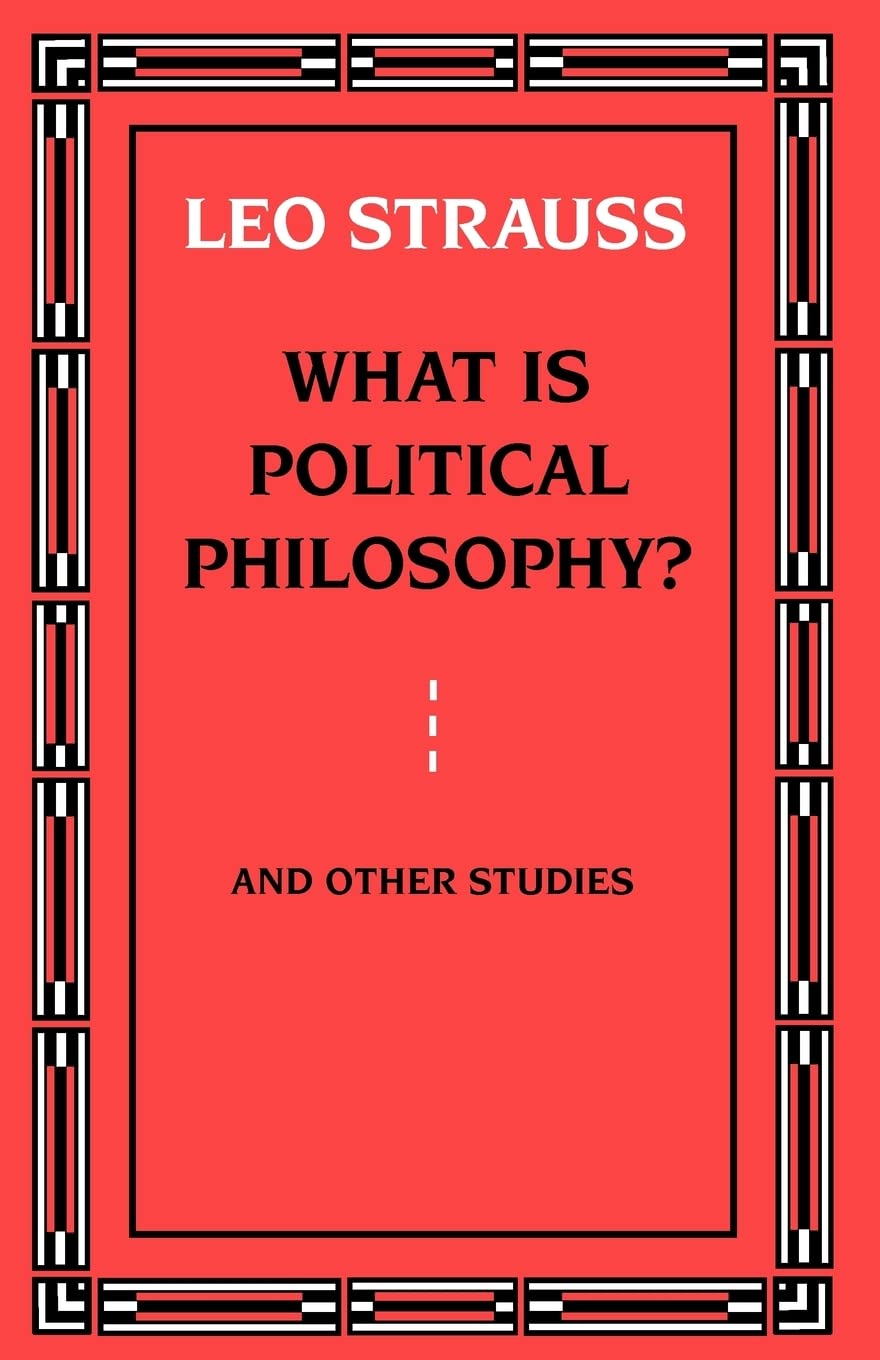
What Is Political Philosophy? And Other Studies
 Leo Strauss
Strauss's What Is Political Philosophy? argues that political philosophy is the attempt to replace opinion about political things with knowledge of their nature, and that this quest is the closest branch of philosophy to human life. Its central mechanism is the distinction between political philosophy and political thought: the former is set in motion by the disquieting awareness of the difference between conviction and knowledge, while the latter merely expounds or defends a firmly held conviction or myth [citation:1][citation:17]. The title essay offers Strauss's sole extended articulation of what political philosophy is, while companion essays engage Farabi, Maimonides, Hobbes, and Locke.
What is the central claim of the title essay, and how does Strauss define political philosophy?
Strauss defines political philosophy as the attempt to replace opinion about the nature of political things with knowledge of their nature [citation:1][citation:17]. Political things are by nature subject to approval and disapproval; they raise a claim to men's obedience and judgment, so one does not understand them as political things unless one measures them by some standard of goodness or justice [citation:1]. Philosophy itself is the quest for universal knowledge, preceded by opinions about the whole; the philosopher is distinguished by knowing that he knows nothing, and by striving for knowledge rather than possessing it [citation:1].
What is the most common misconception about the book, and how does Strauss distinguish political philosophy from political thought?
A common misconception treats 'political philosophy' as interchangeable with 'political thought.' Strauss insists they are radically different. Political thought is any reflection on or exposition of political ideas; it is indifferent to the distinction between opinion and knowledge, and may be no more than the defense of a firmly held conviction or an invigorating myth [citation:17]. Political philosophy, by contrast, is the conscious, coherent, and relentless effort to replace opinions about political fundamentals with knowledge regarding them. A political thinker is attached to a specific order or policy; the political philosopher is attached to the truth [citation:17].
How does the book relate to Strauss's Natural Right and History?
What Is Political Philosophy? was published in 1959, six years after Natural Right and History (1953), and both are products of Strauss's mature period at the University of Chicago [citation:7]. The earlier book diagnosed the crisis of modern political thought and called for a return to classical natural right; the later collection extends that project through close readings of Farabi, Maimonides, Hobbes, and Locke. The title essay provides the philosophical definition that the historical essays in Natural Right and History presuppose, while the companion studies demonstrate the interpretive method Strauss advocated.
What role does the theory of esoteric writing play in this collection?
The essay 'On a Forgotten Kind of Writing' presents Strauss's theory of esoteric writing, the idea that philosophers in eras of persecution concealed heterodox ideas within texts whose surface meaning conformed to orthodox opinion [citation:5][citation:10]. Other essays in the collection illustrate this method through studies of Maimonides and Farabi, showing how medieval Islamic and Jewish philosophers adapted their teaching to the demands of their political and religious circumstances. The theory connects to Strauss's broader argument that the tension between philosophy and the city is permanent and requires careful management.
How was the book received when it was published in 1959?
The initial critical reaction was notably sober and scholarly, as a retrospective symposium on the fiftieth anniversary observed [citation:3][citation:18]. Reviews appeared in the American Political Science Review, Political Science Quarterly, Review of Politics, and other major journals [citation:3]. In the 1950s, Strauss was publicly respected by behavioral political scientists and even contributed to David Easton's The Political System; among political theorists his reputation was even higher, with reviewers calling him 'one of the few dominant figures' in the field [citation:3].
What is the relationship between the essays and Strauss's teaching on the philosophic life?
For Strauss, the highest subject of political philosophy is the philosophic life itself, and philosophy means ascending from the cave to the light of the sun—the truth [citation:2]. This elevation of contemplation over practical life is central to his reading of the classics. He criticizes Machiavelli not for creating power politics but for lowering the classical standard of the philosophic life, making wisdom into craftiness [citation:2]. The essays in this collection consistently measure modern political philosophy against the classical understanding that the contemplative life is superior to the life of action.
Show 1 more insights
What are the main essays and studies included in the volume?
The collection contains ten essays and lectures and sixteen book reviews written between 1943 and 1957 [citation:5][citation:10]. The table of contents includes: 'What Is Political Philosophy?', 'Political Philosophy and History', 'On Classical Political Philosophy', 'Restatement on Xenophon's Hiero', 'How Farabi Read Plato's Laws', 'Maimonides' Statement on Political Science', 'On the Basis of Hobbes's Political Philosophy', 'Locke's Doctrine of Natural Law', 'On a Forgotten Kind of Writing', and 'Kurt Riezler' [citation:20]. The University of Chicago Press edition (1988) contains 315 pages [citation:12].
Wealthy Psyche is an intellectual archive. We do not host, distribute, or sell book copies — physical or digital. We provide structured knowledge to help you think better, faster.