


On Democracy
 Robert A. Dahl
Robert Dahl's On Democracy is a late-career synthesis that distinguishes between democracy as an unattainable ideal and democracy as actual practice. The book's organizing framework rests on five criteria for a fully democratic process—effective participation, voting equality at the decisive stage, enlightened understanding, control of the agenda, and inclusion of adults—against which real regimes fall short. Dahl argues that polyarchy, with its institutions of free elections, freedom of expression, and associational autonomy, is the closest achievable approximation. He then assesses the social and economic conditions, including market capitalism and inequality, that either sustain or undermine democratic institutions. The result is a primer that doubles as Dahl's final statement on democratic theory.
Key Details
Key Insights — Read in 10 Minutes
What is the difference between Dahl's ideal democracy and polyarchy?
Dahl treats ideal democracy as a theoretical standard—a system fully satisfying five criteria of political equality that no actual state has ever achieved. Polyarchy is his term for real-world regimes that approximate that standard through institutions like free and fair elections, freedom of expression, associational autonomy, and inclusive suffrage. The gap between the two is not a failure of the theory but the analytical space where democratic improvement happens. Polyarchy is thus not a lesser form of democracy but the only form democracy has ever actually taken at the nation-state level.
What five criteria define Dahl's democratic process?
Dahl specifies effective participation, voting equality at the decisive stage, enlightened understanding, control of the agenda, and inclusion of adults. These are not institutional prescriptions but procedural tests: a decision is fully democratic only if all affected members have genuine opportunities to formulate preferences, have their votes counted equally, can learn about the issues, can place items on the agenda, and are included in the demos. Dahl presents the criteria as guides for evaluating and reshaping constitutions and political practices, not as a checklist any existing state satisfies.
How does On Democracy relate to Dahl's earlier A Preface to Democratic Theory?
A Preface to Democratic Theory (1956) introduced polyarchy as an empirical concept and launched behavioralist democratic theory. On Democracy, written four decades later, is a retrospective synthesis rather than a new theoretical departure. It restates the polyarchy framework in accessible prose while adding Dahl's mature reflections on inequality, market capitalism, and citizen competence. Readers seeking the original scholarly argument should read the earlier book; those wanting Dahl's final verdict on what democracy can and cannot achieve should read On Democracy.
Why does Dahl list ten advantages of democracy instead of arguing from a single principle?
Dahl deliberately avoids grounding democracy in one foundational value. Instead he catalogs ten instrumental and intrinsic benefits—avoiding tyranny, protecting essential rights, enabling self-determination, fostering human development, promoting political equality, and others—that democracies tend to deliver relative to nondemocracies. The rhetorical purpose is cumulative: even if a reader rejects any single justification, the aggregate weight is meant to be overwhelming. Critics note this strategy risks making the case for democracy contingent on empirical outcomes rather than on a categorical moral principle.
What did Ian Shapiro contribute to the 2015 second edition?
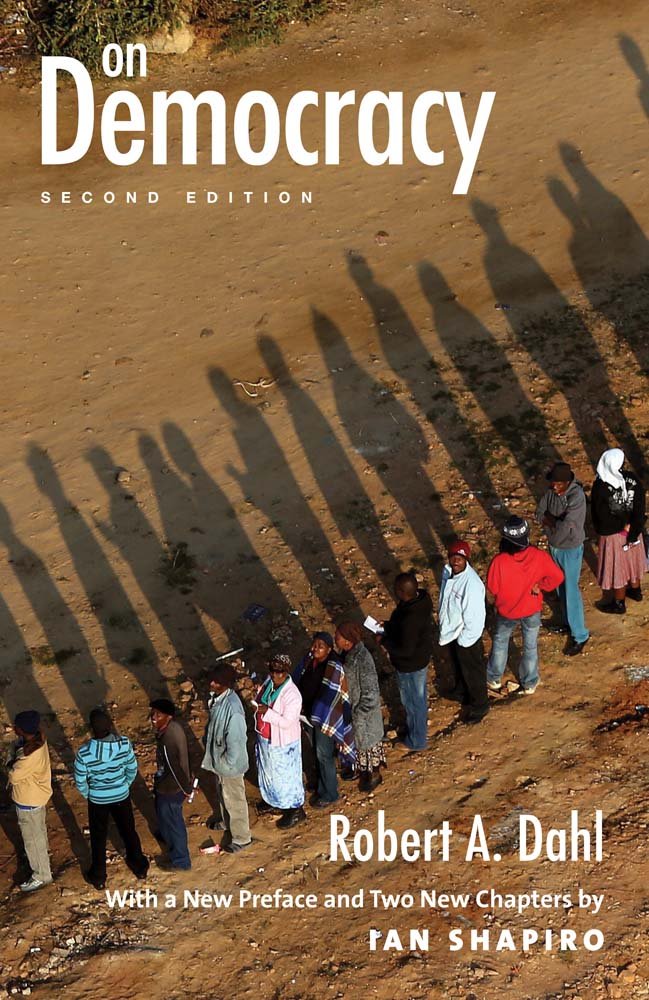
Shapiro, Dahl's successor as Sterling Professor at Yale, added a new preface and two chapters. One chapter addresses prospects for democracy after the 2010 Arab Spring; the other examines the corrosive effects of inequality and money in politics on democratic quality—a concern Dahl emphasized in his final years. Shapiro did not revise Dahl's original text. The second edition thus pairs Dahl's 1998 framework with Shapiro's extension into twenty-first-century challenges, making it the version most often assigned in courses today.
How does Dahl's procedural definition differ from Schumpeter's?
Joseph Schumpeter defined democracy minimally as a method for selecting leaders through competitive elections. Dahl accepts that elections matter but insists they are insufficient. His five criteria add substantive procedural requirements—enlightened understanding, agenda control, and inclusion—that Schumpeter's definition omits. The practical difference is significant: a regime with competitive elections but restricted suffrage, suppressed dissent, or elite-controlled agendas would satisfy Schumpeter but fail Dahl's test. Dahl's framework is more demanding because it measures democracy against political equality rather than mere leadership selection.
Show 1 more insights
What is a common misconception about On Democracy?
A frequent misreading treats polyarchy as Dahl's endorsement of existing Western democracies. In fact, Dahl uses the gap between ideal democracy and polyarchy to criticize actual regimes, including the United States. He argues that market capitalism generates inequalities that undermine political equality, and he questions whether the American constitutional system is as democratic as commonly assumed. On Democracy is not a celebration of liberal democracy's triumph but a diagnostic tool for identifying how far even established democracies fall short.
Wealthy Psyche is an intellectual archive. We do not host, distribute, or sell book copies — physical or digital. We provide structured knowledge to help you think better, faster.