


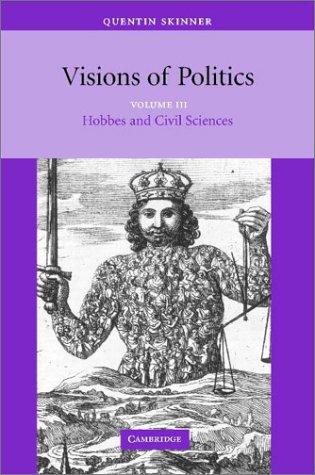
Visions of Politics
 Quentin Skinner
Skinner's Visions of Politics is his methodological summa: a three-volume collection of essays, revised and integrated, that demonstrates his contextualist approach in theory and in practice. Volume 1, Regarding Method, argues that historical texts must be read as speech acts—interventions in a discursive context—rather than as timeless philosophical systems. Volumes 2 and 3 apply this method to two rival early-modern visions: Renaissance Virtues traces the revival of a neo-Roman theory of liberty in which the virtuous citizen upholds the freedom of the republic, while Hobbes and Civil Science examines Hobbes's counter-vision of sovereignty as the exclusive property of the state and liberty as mere non-interference .
What is the central argument of Visions of Politics, and how do the three volumes relate to one another?
The collection's overarching historical interest is in comparing two contrasting visions of politics inherited by the modern West: one in which sovereignty is a property of the people and liberty is inseparable from self-rule, and one in which sovereignty is the exclusive possession of the state and liberty is mere non-interference . Volume 1, Regarding Method, articulates the contextualist approach—reading texts as speech acts situated in their discursive contexts. Volumes 2 and 3 then put this method into practice, examining the Renaissance republican vision and Hobbes's attempt to 'unbuild' it. The relationship between the volumes is one of theory and practice .
What specific methodological framework does Volume 1, Regarding Method, set out?
Volume 1 argues that if we are to write the history of ideas in a properly historical style, we need to situate texts within the intellectual contexts and frameworks of discourse that enable us to recognize what their authors were doing in writing them . Skinner emphasizes the performativity of texts and the need to treat them intertextually, using ordinary techniques of historical enquiry to grasp concepts, follow distinctions, and recover beliefs . The goal is not to perform the impossible task of getting inside the heads of long-dead thinkers, but to see things their way .
What is the connection between Visions of Politics and The Foundations of Modern Political Thought?
Visions of Politics is often described as Skinner's 'summa,' complementing and extending the monumental Foundations of Modern Political Thought (1978) . Volume 2, Renaissance Virtues, resembles Volume 1 of Foundations in consisting of essays on republican and civic thought before and during Machiavelli's time. Volume 3, Hobbes and Civil Science, goes beyond the themes of Foundations Volume 2, examining a period when 'the State' was being created to dissolve the devastating problems of religious resistance and civil war . Unlike Foundations, however, Visions is explicitly structured to integrate methodological theory with historical practice .
What is the most common criticism of Visions of Politics?
A significant criticism, articulated by Renaissance historian Mark Jurdjevic, is that rereading Skinner's arguments in retrospective collection made many of them seem less persuasive rather than more. He found the process 'somewhat disappointing' . A related critique concerns Skinner's decision to revise essays originally written in the heat of earlier debates. Reviewers noted that anyone wishing to chart Skinner's intellectual development must return to the original publications, and that by revising these essays, Skinner has been charged with violating his own teachings on the priority of situating texts in their relevant contexts .
How has the collection been received and recognized in the field?
Visions of Politics was published by Cambridge University Press in 2002 and has been widely praised. Robert Sugden wrote in the Times Higher Education Supplement that Skinner's ability to combine political and philosophical insight with minute knowledge of several centuries of political literature is 'awe inspiring' . The New York Review called it 'a deeply impressive collection which displays Skinner's exceptional range' . The three-volume set won the 2007 David Easton Award from the Foundations of Political Theory section of the American Political Science Association . Skinner himself was awarded the Balzan Prize for Political Thought, History, and Theory in 2006 .
What is the most common misconception about the collection's structure?
A common misconception treats the three volumes as independent collections of previously published essays with no unified argument. In fact, Skinner states that he chose and grouped the essays with two goals: to give each volume its own thematic unity and to integrate the volumes into a larger whole . He revised and retitled many essays for this purpose. Volume 1 preaches a particular approach; Volumes 2 and 3 practice it. The general preface and full contents across all three volumes make this integrative design explicit .
Wealthy Psyche is an intellectual archive. We do not host, distribute, or sell book copies — physical or digital. We provide structured knowledge to help you think better, faster.