


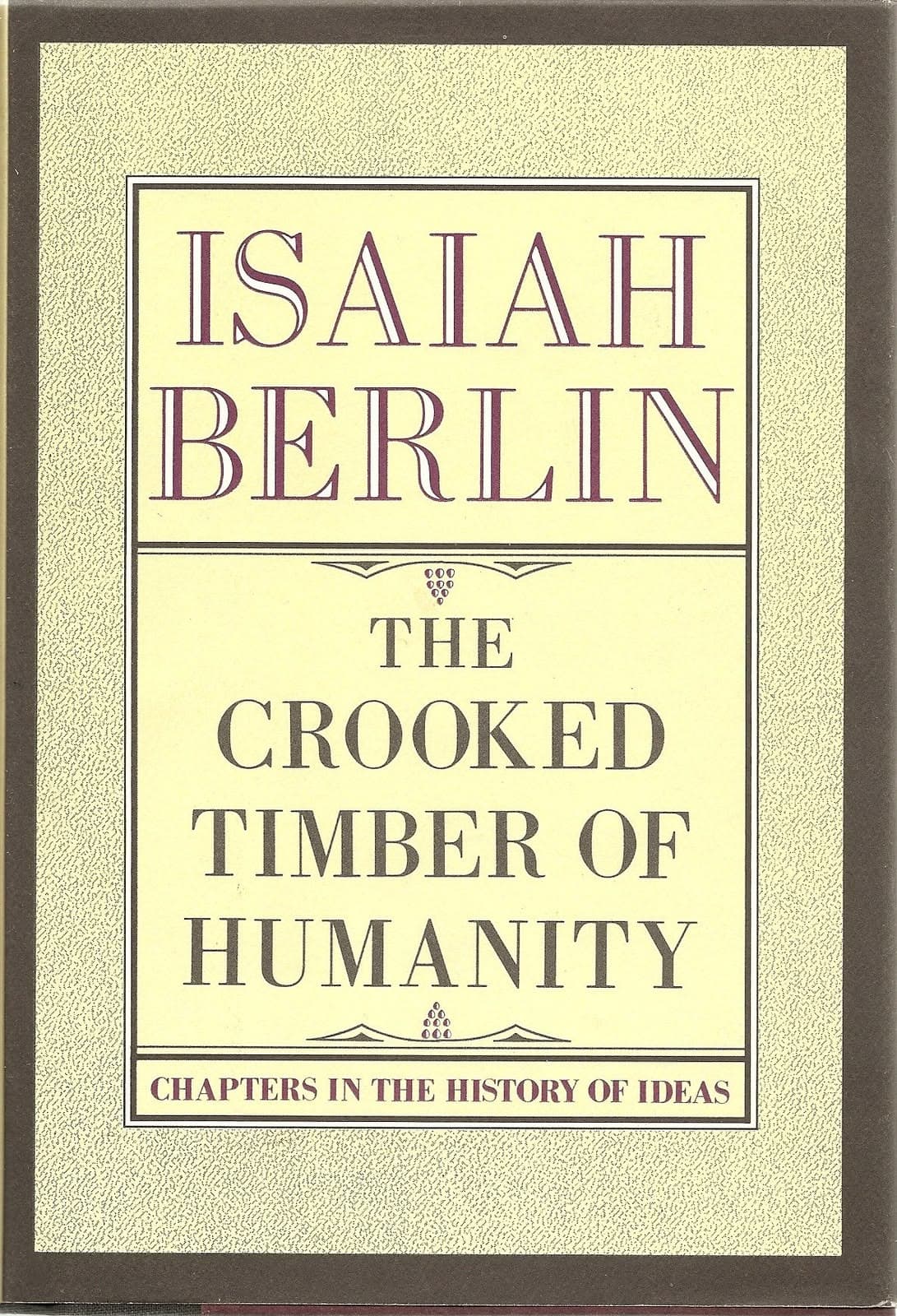
The Crooked Timber of Humanity: Chapters in the History of Ideas
Berlin's collection argues that the 'Great Goods' of human aspiration—liberty, justice, equality—do not cohere and never can, because the raw material of humanity is crooked and resists any straightening blueprint. The title, borrowed from Kant, names the book's target: the Platonic conviction that all genuine values form a single harmonious whole, knowable and compatible. Against this, Berlin traces a counter-tradition from Vico and Herder through the Romantics to the anti-Enlightenment reactionary Joseph de Maistre, showing how the pursuit of a perfect society breeds intolerance and, at its extreme, political tyranny.
Key Insights
✦What does the book's title mean, and why does Berlin adopt it as his organising metaphor?
The phrase comes from Kant, who wrote that out of the crooked timber of humanity no straight thing was ever made. Berlin uses it to name the resistance of human material to any rational straightening. The utopian believes that a perfect society is possible if only the right blueprint is applied; Berlin's point is that the timber itself—human desires, values, and histories—is warped in ways that no political carpentry can correct. This is not a counsel of despair but a diagnosis of category error. Because values genuinely conflict, any political order will sacrifice some goods for others. The title thus frames the book's central claim: pluralism is not a regrettable compromise but a permanent condition, and the dream of its overcoming is politically dangerous.
✦How does Berlin distinguish his pluralism from relativism, and is the distinction persuasive?
Berlin insists that pluralism is not relativism because cultures, while valuing different things, can still understand and criticise one another. The relativist, he explains, imagines each culture as a 'windowless box,' enclosed and incommunicable . The pluralist holds that values are objective but multiple, and that humans share enough common ground to enter other outlooks imaginatively. The New York Times reviewer found this defence less persuasive than Berlin's positive case for pluralism, suggesting that imagination and sympathy are precisely what relativists are usually accused of having in excess . Perry Anderson, in the London Review of Books, pressed a related point: Berlin's pluralism may be 'rather more discreetly monist than it suggests,' because the shared human identity that enables cross-cultural understanding quietly neutralises the radical diversity Berlin wants to affirm .
✦Why does Berlin devote the longest essay to Joseph de Maistre, a reactionary he despises?
De Maistre interests Berlin as a test case for the political consequences of anti-rationalism. The Savoyard counter-revolutionary rejected the Enlightenment's universalism root and branch, grounding authority in tradition, blood, and the executioner. Berlin traces a line from Maistre's celebration of the irrational and the punitive to twentieth-century fascism. The essay is an exercise in intellectual genealogy rather than sympathy: Berlin wants to show that the critique of Enlightenment rationalism can issue in something far worse than the rationalism it attacks. This makes the essay a counterweight to Berlin's admiration for Vico and Herder. The same insight that cultures have their own centres of gravity, which Berlin finds liberating in Herder, becomes sinister in Maistre when attached to a politics of exclusion and violence.
✦How does the editorial history of the volume affect how readers should approach it?
The book is a curated collection, not a work Berlin designed as a unified monograph. Henry Hardy edited the essays, which were written across three decades from the late 1950s to the 1980s, and the first edition appeared in 1990 from John Murray in London, followed by Knopf in New York in 1991 . A second Princeton edition in 2013 added a foreword by John Banville, a revised text, and an appendix containing letters and previously uncollected writings, including Berlin's review of Bertrand Russell's history of philosophy . Readers should treat the volume as Hardy's construction, revealing persistent themes across Berlin's career rather than a single argument developed step by step.
✦What is the relationship between this book's argument and Berlin's more famous essay on liberty?
The Crooked Timber of Humanity supplies the ethical foundation that 'Two Concepts of Liberty' presupposes. Berlin's defence of negative liberty rests on the claim that values conflict and that no single political arrangement can realise all genuine goods. If liberty, equality, and justice could be perfectly harmonised, a rational planner could legitimately override individual preferences in the name of the whole. Because they cannot, a space of non-interference becomes necessary for people to make their own tragic choices among incommensurable goods. The essays on Vico, Herder, and the Romantics show where this insight came from historically; the essay on Maistre shows what happens when the critique of rationalism is severed from liberal restraint. The volume thus connects Berlin's liberalism to his value pluralism more explicitly than the liberty essay alone.
✦Did Berlin's contemporaries find the collection repetitive, and was that criticism fair?
Yes, the New York Times review noted that the theme of pluralism versus utopianism echoes 'in one essay after another, often in the same words and images,' with the Kant quotation appearing twice and the jigsaw-puzzle metaphor three times . The observation is accurate but cuts both ways. Repetition is a feature of Berlin's essayistic method: he circled the same insight from different historical angles, refining it through application rather than systematic exposition. For readers encountering Berlin for the first time, the recurrence can feel like insistence. For those tracing his thought, the variations reveal the range and limits of a single idea across Vico, Herder, the Romantics, Maistre, and the nationalism essay. The second edition's revised text and appendix mitigate the effect by adding context and development.
Wealthy Psyche is an intellectual archive. We do not host, distribute, or sell book copies — physical or digital. We provide structured knowledge to help you think better, faster.