


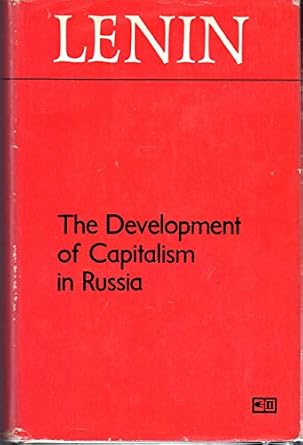
The Development of Capitalism in Russia: The Process of the Formation of a Home Market for Large-Scale Industry
 Vladimir Lenin
Lenin's central thesis is that capitalism had already become the dominant mode of production in Russia, destroying the peasant commune and creating a differentiated rural class structure of agrarian bourgeoisie and rural proletariat. Writing under the pseudonym 'Vladimir Ilyin' while in Siberian exile, Lenin uses zemstvo statistics, factory inspection reports, and the 1897 census to demonstrate that the internal market for large-scale industry was created not by external demand but by the disintegration of natural economy into commodity production. The work's distinctive mechanism is its empirical refutation of Narodnik economics, showing through over 500 sources that Russia could not bypass capitalism and that the industrial proletariat was becoming a revolutionary force.
Key Details
Related Books
View AllSimilar books from the same category, ranked by shared topics and reader engagement.



Key Insights — Read in 10 Minutes
What is the central claim of The Development of Capitalism in Russia, and what does it reject?
The central claim is that capitalism had already become the dominant economic system in Russia by the 1890s, destroying the peasant commune from within and creating a home market for large-scale industry through the differentiation of the peasantry [citation:3][citation:8]. Lenin rejects the Narodnik thesis that Russia could avoid capitalism and build socialism on the basis of the village commune. He argues the commune was not an antagonist of capitalism but 'the deepest and most solid foundation' of it, with capitalist elements constantly forming within it [citation:15]. The data showed the commune was already disintegrating into rural bourgeoisie and proletariat [citation:11].
What specific framework did Lenin develop through this work?
Lenin developed a stage theory of capitalist development in Russian industry: small commodity production (petty peasant trades), capitalist manufacture, and the factory (large-scale machine industry) [citation:15]. He also demonstrated the necessary connection between the growth of the industrial population at the expense of the agricultural, the ruin of small producers, and the formation of a home market through social division of labour [citation:14]. This framework provided the economic foundation for the Bolshevik political strategy of the industrial proletariat as the revolutionary base [citation:2].
How does this book differ from Das Kapital?
Das Kapital is Marx's abstract critique of political economy, analyzing the laws of motion of capitalism in general. The Development of Capitalism in Russia is a concrete empirical study of one country's transition to capitalism, using Marx's method of realization and reproduction as tools for analyzing Russian statistical data [citation:7][citation:14]. Lenin applies Marx's theory of expanded reproduction to demonstrate that the internal market is created by the disintegration of natural economy, not by external demand. The book is, according to Meghnad Desai, 'the only comprehensive economic history of a country from a Marxist perspective' [citation:5][citation:18].
Why was the book published under the pseudonym 'Vladimir Ilyin'?
Lenin used the pseudonym 'Vladimir Ilyin' to evade the Tsarist censorship, which would have suppressed a work by a known revolutionary [citation:1][citation:17]. The book was published legally in March 1899, with an issue of 2,400 copies that sold out quickly [citation:17]. The censorship required careful phrasing: Lenin substituted terms like 'disciples' for 'Marxists' and allusions to 'the new theory' for direct references to Marx and Marxism. In the 1908 second edition, after the 1905 Revolution, he restored the direct language [citation:17]. This strategic concealment allowed the work to circulate among Social-Democratic intelligentsia and student youth.
What was the Narodnik argument that Lenin was refuting?
The Narodniks (Populists) argued that Russia could avoid the capitalist stage entirely, building socialism directly on the peasant commune (obshchina) as a uniquely Russian institution [citation:3][citation:11]. They believed the peasantry was a homogeneous class and that the development of capitalism in Russia was an artificial imposition by the state. Lenin responded with statistical evidence that the commune was already disintegrating into class-differentiated groups—a rural bourgeoisie owning land and hiring labour, and a rural proletariat increasingly landless—and that the state's role in fostering industrialization was a predictable consequence of late capitalist development, not an alternative to it [citation:5][citation:11].
How has the book's statistical methodology been critiqued?
Contemporary critic N. P. Oganovsky identified three categories of errors: logical, methodological, and factual [citation:16]. He argued Lenin assumed the peasantry was originally homogeneous before differentiating, but the army-horse census data already contradicted this. Methodologically, Lenin mixed different indicators (land allotment, crops, livestock) without establishing which best measured proletarianization, and grouped all households into just three classes when zemstvo statisticians typically used five or more. Oganovsky also noted that Lenin's proportions for each group (20% rich, 50% poor) were arbitrary assumptions he then treated as empirical findings [citation:16].
Show 1 more insights
What role did this work play in Lenin's political development?
The book established Lenin's reputation as a major Marxist theorist and provided the economic foundation for his political strategy [citation:1][citation:5]. By demonstrating that capitalism had already transformed Russia and created a concentrated industrial proletariat, he justified a political program centered on the urban working class rather than the peasant commune [citation:2]. The work also completed his break with Narodism, which had dominated Russian revolutionary thought. Zinoviev noted that Professor Maxim Kovalevsky said 'What a fine professor might have been made out of Lenin'—testimony to the book's scholarly reception even among bourgeois academics [citation:3].
Wealthy Psyche is an intellectual archive. We do not host, distribute, or sell book copies — physical or digital. We provide structured knowledge to help you think better, faster.