


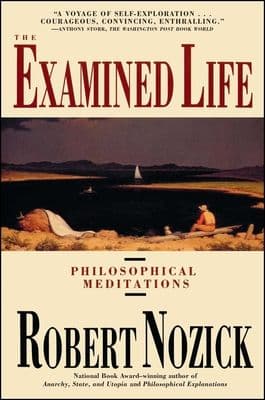
The Examined Life: Philosophical Meditations
Nozick's collection of meditations argues that philosophy should address the whole of human existence—love, death, faith, sexuality, and the meaning of life—rather than confine itself to technical argument. The book's distinctive move is methodological: Nozick deliberately abandons the coercive force of proof in favour of exploration, inviting the reader to try on and discard lines of thought. Most consequentially, the chapter 'The Zigzag of Politics' recants the hard libertarianism of Anarchy, State, and Utopia, conceding that his earlier views were 'seriously inadequate' and proposing a more humane politics responsive to community and need.
Key Insights
✦What does Nozick mean by 'philosophical meditations,' and why does he abandon argumentative proof?
Nozick's method is deliberately exploratory rather than demonstrative. He writes in the introduction that his concern is 'the whole of our being,' and he wants to speak to the reader's whole being rather than to the rational mind alone . This means offering thoughts to be tried on, not conclusions to be accepted under logical compulsion. Nozick had come to regard philosophical proof as 'too coercive,' a method that forces assent rather than inviting understanding . The meditations are thus essays in the original sense: attempts, experiments in thinking. This method suits the book's subject matter—love, death, faith, and meaning resist the kind of decisive argumentation appropriate to logic or epistemology, and Nozick's style allows him to explore without claiming finality.
✦What does 'The Zigzag of Politics' actually recant, and how far does Nozick retreat from libertarianism?
The chapter recants the 'hardcore' libertarianism of Anarchy, State, and Utopia. Nozick later described his earlier views as 'seriously inadequate' . The Google Books description calls the chapter 'notorious' for refuting his earlier claims, and reviewers noted that it proposes some form of inheritance taxation . Nozick himself clarified in a 2001 interview that he was 'no longer as hardcore a libertarian' but that rumours of his 'apostasy' were 'much exaggerated' . The recantation is thus a softening rather than a wholesale abandonment: he retains a commitment to liberty but concedes that his earlier framework was too rigid and insufficiently responsive to community, need, and the complexities of human life.
✦How was the book received, and why was it 'unkindly treated' by some critics?
Reception was mixed to negative. Anthony Quinton, in The Oxford Companion to Philosophy, described the book as 'unkindly treated' . Jane O'Grady in The Guardian called it 'disappointingly schmaltzy' . Jim Holt dismissed it as 'trickled down philosophy' . The criticism reflects a genuine tension: Nozick's exploratory, non-argumentative style was read by some as a lapse from philosophical rigour into sentimentality. Denis Donoghue offered qualified praise, noting that some passages were weaker than others . The Routledge Encyclopedia of Philosophy observes more neutrally that the book 'has not made much impact on the philosophical world,' in contrast to his technical works . The book found a wider readership outside academic philosophy, which may explain some of the disciplinary hostility.
✦How does this book relate to Nozick's earlier Philosophical Explanations?
The Examined Life is the culmination of a trajectory begun in Philosophical Explanations (1981). In that earlier book, Nozick had already abandoned philosophical proof in favour of 'explanation' as a method that promotes understanding rather than coercive assent . The Examined Life extends this approach to the most personal and existential questions: death, sexuality, love, faith, and the meaning of life. Where Philosophical Explanations tackled the traditional problems of metaphysics and epistemology, The Examined Life turns to 'the holiness of everyday life' and the texture of lived experience . The continuity is methodological; the shift is in subject matter. Readers who found Philosophical Explanations inventive but abstract will find here the same inventiveness applied to questions everyone faces.
✦What does Nozick say about the Holocaust, and why did that passage attract criticism?
In one of the book's most controversial passages, Nozick writes that the Holocaust has 'desanctified humanity' to such an extent that if humanity were obliterated now, its end would no longer constitute a special tragedy . The claim is jarring, and Kirkus Reviews singled it out as a moment where the reader 'might well want to de-train for lunch' . Nozick's point seems to be that the Holocaust has damaged the moral status of humanity in a way that cannot be undone—that something in our sense of human preciousness was permanently altered. Whether this is a profound observation or a morally obtuse one is a judgment readers must make. The passage is characteristic of the book's willingness to follow a thought into uncomfortable territory without the buffer of academic hedging.
✦Is the book a work of political philosophy, or something else?
It is only marginally a work of political philosophy. The chapter on politics draws attention because it recants earlier positions, but the book as a whole is a work of existential and moral reflection. Its subjects are death, love, faith, sexuality, wisdom, and the meaning of life—questions that belong to what used to be called 'the philosophy of life' rather than to political theory. The Routledge Encyclopedia describes it as a book about 'living and what is important in life' . Readers approaching it as a sequel to Anarchy, State, and Utopia will find only one chapter that directly addresses politics, and even that chapter is more a meditation on his own intellectual journey than a systematic revision of his political theory.
Wealthy Psyche is an intellectual archive. We do not host, distribute, or sell book copies — physical or digital. We provide structured knowledge to help you think better, faster.