


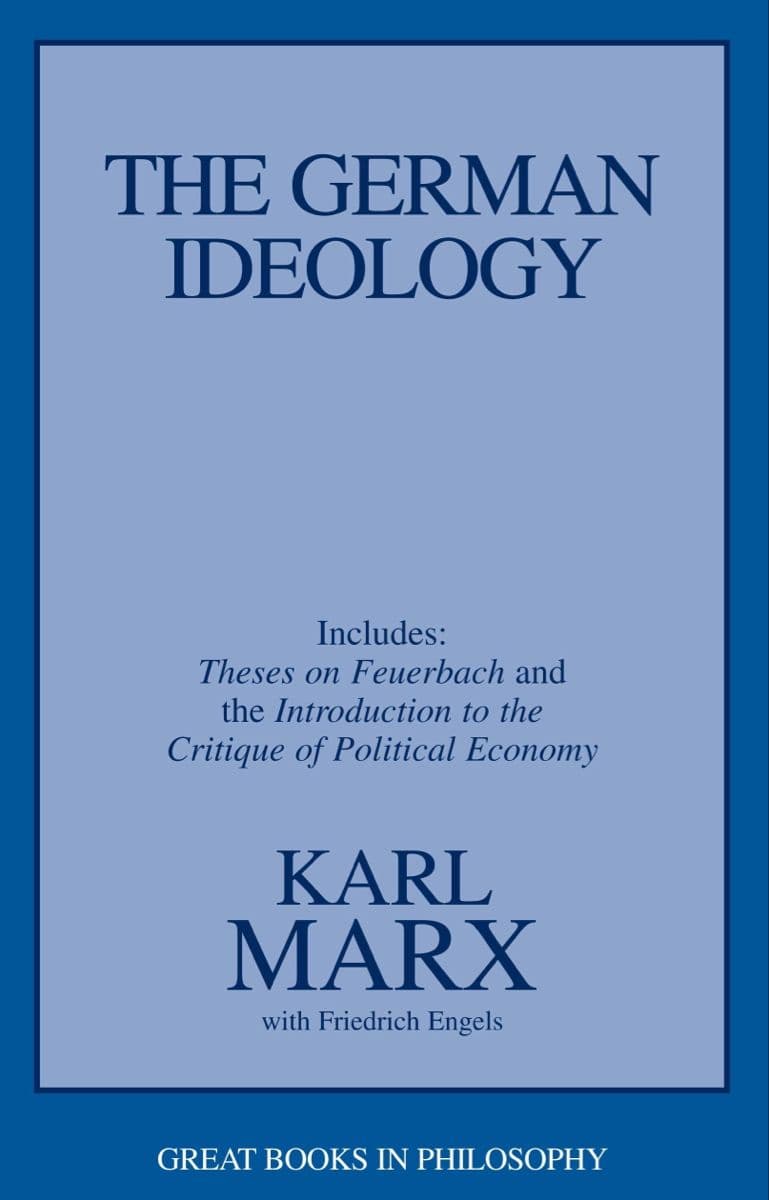
The German Ideology
Marx and Engels's manuscripts argue that the Young Hegelians mistake ideas for reality, and that philosophy must be replaced by a materialist science of history. The central claim is that consciousness does not determine social being; rather, material production and the class relations it generates determine the ideas people hold. The book's distinctive mechanism is the critique of ideology as inversion: German philosophers imagine that conceptual revolutions change the world, while the real foundation—civil society and productive forces—operates beneath their notice. The work was abandoned unpublished and appeared in full only in 1932.
Key Insights
✦What is the central argument of The German Ideology, and what does it reject?
The central argument is that the Young Hegelians—Feuerbach, Bruno Bauer, and Max Stirner—remain trapped in idealism because they believe that changing ideas can change reality. Marx and Engels counter that consciousness is determined by material conditions: the way people produce their livelihood shapes their social relations, and those relations shape the ideas they hold. The book rejects the philosophical premise that critique alone can liberate, insisting instead that liberation requires the practical overthrow of existing social relations. This is the first full statement of historical materialism, the doctrine that social being determines consciousness rather than the reverse . The polemical target is not philosophy as such but the illusion that philosophical criticism is politically efficacious.
✦Why was the book not published during Marx and Engels's lifetimes, and how did it finally appear?
Marx and Engels wrote the manuscripts in 1845–46 but could not find a publisher. The work was abandoned, as Marx later put it, to the 'gnawing criticism of the mice'—the manuscript was damaged by rodents over decades . It was retrieved from the estate and first published in full in 1932 by the Soviet Union's Marx-Engels-Lenin Institute . This publication history matters enormously for interpretation: the text is not a finished book but a set of rough, unedited drafts, some sections barely sketched and others—particularly the critique of Stirner—running to hundreds of pages. Readers should not expect the polish of the Manifesto or Capital; they are encountering working notes, not a completed treatise .
✦How does the manuscript's fragmentary state affect how scholars interpret it?
The fragmentary state has generated persistent misreadings. A major critical essay argues that because the text is 'rough, unedited, and unfinished,' scholars have wrongly attributed to it a crude empiricist or positivist conception of history that Marx and Engels did not actually hold . The most important section, 'I. Feuerbach,' is not a unified introduction but a 'conglomerate of fragments' with two different beginnings and sections of varying polish, some of which originally belonged elsewhere . The standard editions imposed a coherent chapter structure that the manuscripts do not support. The MEGA² critical edition, still in progress, presents the fragments chronologically and without editorial smoothing, allowing readers to see the text as Marx and Engels left it.
✦What is the relationship between The German Ideology and the earlier The Holy Family?
The German Ideology continues and radicalises the critique begun in The Holy Family (1845). Where The Holy Family still engaged the Young Hegelians on philosophical terrain, The German Ideology breaks with philosophy altogether, proposing a 'materialist science' of history as its replacement. The section on Bruno Bauer is essentially a continuation of the quarrel already pursued in The Holy Family and Marx's On the Jewish Question . The decisive new element is the critique of Feuerbach, which Marx had largely spared in the earlier work. By 1845–46, Marx and Engels concluded that Feuerbach's materialism remained contemplative and ahistorical, unable to grasp that the material world is shaped by human productive activity. The German Ideology is thus the record of a break not just with Hegelian idealism but with all previous materialism.
✦Why does the critique of Max Stirner occupy so much of the manuscript?
The Stirner section is by far the longest, running to roughly 117 sheets compared to about nine for Bruno Bauer . The disproportion reflects the seriousness with which Marx and Engels took Stirner's challenge. Stirner's The Ego and His Own (1844) pushed the critique of Hegelian abstraction to an individualist extreme, denying any universal reason or moral constraint beyond the unique individual's will. Marx and Engels saw this as a dangerous distraction from the concrete struggle for communism, and their response is correspondingly massive. But the section is also notoriously tedious, tracking Stirner's circuitous argument nearly step by step and burying genuine insight under nicknames and heavy irony. Readers seeking the core of historical materialism can safely focus on the Feuerbach section.
✦How has the concept of ideology developed from this text, and what did later critics make of it?
The German Ideology is often cited as the foundational text of ideology critique, but its account is problematic. Terry Eagleton and Raymond Williams both questioned whether the text's tendency to treat ideology as mere mystification or false consciousness can sustain a progressive politics . If all ideas are determined by material conditions, then the critique of ideology is itself determined, and the critic's claim to see through illusion becomes hard to justify. Williams suggested the key opposition in the text is not between ideology and science but between practical consciousness and the apparatus that obscures agency. Later Marxist thinkers—Gramsci, Althusser, and the Frankfurt School—developed more nuanced accounts of ideology precisely because the cruder model in The German Ideology proved inadequate to the complexity of cultural and political life.
Wealthy Psyche is an intellectual archive. We do not host, distribute, or sell book copies — physical or digital. We provide structured knowledge to help you think better, faster.