


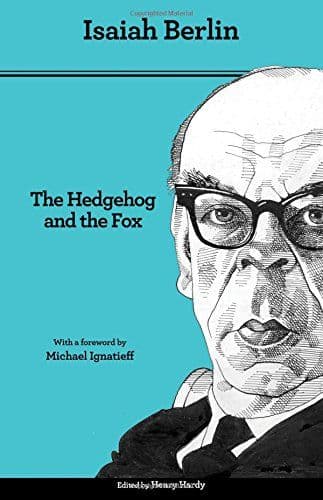
The Hedgehog and the Fox: An Essay on Tolstoy's View of History

Berlin takes a fragment from the Greek poet Archilochus—the fox knows many things, the hedgehog one big thing—and turns it into a diagnostic tool for intellectual history. The essay's central claim is that Tolstoy was a fox by nature, gifted at perceiving the irreducible particularity of human experience, yet a hedgehog by conviction, craving a single theory that would explain history's course. This inner conflict, Berlin argues, is the key to Tolstoy's fiction and to his tortured philosophy of history: he could see what monism missed but could not stop believing monism must be true.
Key Insights
✦What is the central distinction between foxes and hedgehogs, and what does it have to do with Tolstoy?
Berlin borrows the terms from a fragment attributed to Archilochus: the fox knows many things, the hedgehog one big thing. He uses them to mark a temperamental divide between those fascinated by the infinite variety of experience and those who relate everything to a single, all-embracing system. The essay's argument is not that one type is superior but that Tolstoy is a diagnostic puzzle: a writer whose genius lies in fox-like perception of particularity, yet who desperately wanted the moral certainty of a hedgehog's unitary vision. This contradiction, Berlin contends, animates both Tolstoy's fiction and his frustrated attempts to formulate a theory of history in works like War and Peace.
✦What was the essay's original publication history, and how does it relate to Russian Thinkers?
The essay first appeared in a shorter form as 'Lev Tolstoy's Historical Scepticism' in Oxford Slavonic Papers in 1951, before being published as a book by Weidenfeld and Nicolson in London and Simon and Schuster in New York in 1953 . It was later included, in a revised version edited by Henry Hardy and Aileen Kelly, in Berlin's 1978 collection Russian Thinkers, and that revised text became the basis for many subsequent separate editions . Readers encountering the essay in a standalone volume should check whether they are reading the original 1953 text or the later revised version, as the differences, while not drastic, reflect Berlin's continued engagement with the material.
✦How did Berlin's contemporaries receive the essay, and what did later critics make of the fox–hedgehog dichotomy?
The essay was widely praised on publication. E. H. Carr called it 'brilliant' and 'searching and profound' in the Times Literary Supplement; W. H. Auden found it 'beautifully written'; Max Beloff in the Guardian judged it 'ingenious' and 'exactly what good critical writing should be' . Later critics have been more ambivalent about the dichotomy's afterlife. Berlin himself cautioned that the classification, if pressed too far, becomes 'artificial, scholastic and ultimately absurd,' useful only as a starting point for investigation . Perry Anderson famously inverted the charge, suggesting Berlin was himself a hedgehog pretending to be a fox—an accusation Berlin firmly denied, insisting he was a fox . The metaphor's popularity has arguably outrun its analytical precision.
✦Is the fox–hedgehog distinction a neutral typology, or does it carry Berlin's own philosophical commitments?
Berlin insisted the essay was 'a kind of enjoyable intellectual game' that was taken more seriously than he intended . Yet the distinction maps onto his value pluralism: foxes perceive that values are multiple and often incommensurable, while hedgehogs seek a single system that harmonises them all. Berlin's sympathies, philosophically, lie with the foxes, but the essay's treatment of Tolstoy is not a simple endorsement of foxhood. Tolstoy's tragedy, in Berlin's reading, is that he could not accept his own fox-like insight into plurality; he craved the hedgehog's certainty and suffered for it. The essay thus dramatises a tension Berlin felt personally and traced across intellectual history, rather than offering a clean moral hierarchy of temperaments.
✦What did Henry Hardy's 2013 Princeton edition add to the essay, and why does it matter?
The 2013 Princeton edition, edited by Henry Hardy with a foreword by Michael Ignatieff, added an appendix containing material that illuminates the essay's context and reception: a parody by John Bowle titled 'The Owl and the Pussy-Cat,' a review by A. J. P. Taylor, extracts from Berlin's letters, and excerpts from interviews with Ignatieff . This editorial apparatus transforms the essay from a standalone text into a documented episode in intellectual history, showing how it was received and how Berlin later reflected on it. For scholars, the appendix provides evidence of the essay's gestation and its author's ambivalence about the dichotomy's popularity. For general readers, it offers a richer sense of the essay as a cultural event, not merely a critical argument.
✦How does the essay's account of Tolstoy relate to Berlin's broader critique of monism in political thought?
The essay is an early and accessible statement of the anti-monism that runs through Berlin's later work. Tolstoy's longing for a single truth that would explain history—his hedgehog conviction—mirrors the Enlightenment's confidence that all genuine questions have one rational answer. Berlin's critique, developed more fully in essays on Vico, Herder, and the Counter-Enlightenment, is that this monism misdescribes human reality: values conflict, cultures differ, and no system can capture the particularity that foxes perceive. The essay's contribution is to show this philosophical error not as an abstract doctrine but as a lived contradiction in a great writer. Tolstoy becomes a case study in what happens when a fox's perception of plurality is at war with a hedgehog's demand for unity.
Wealthy Psyche is an intellectual archive. We do not host, distribute, or sell book copies — physical or digital. We provide structured knowledge to help you think better, faster.