


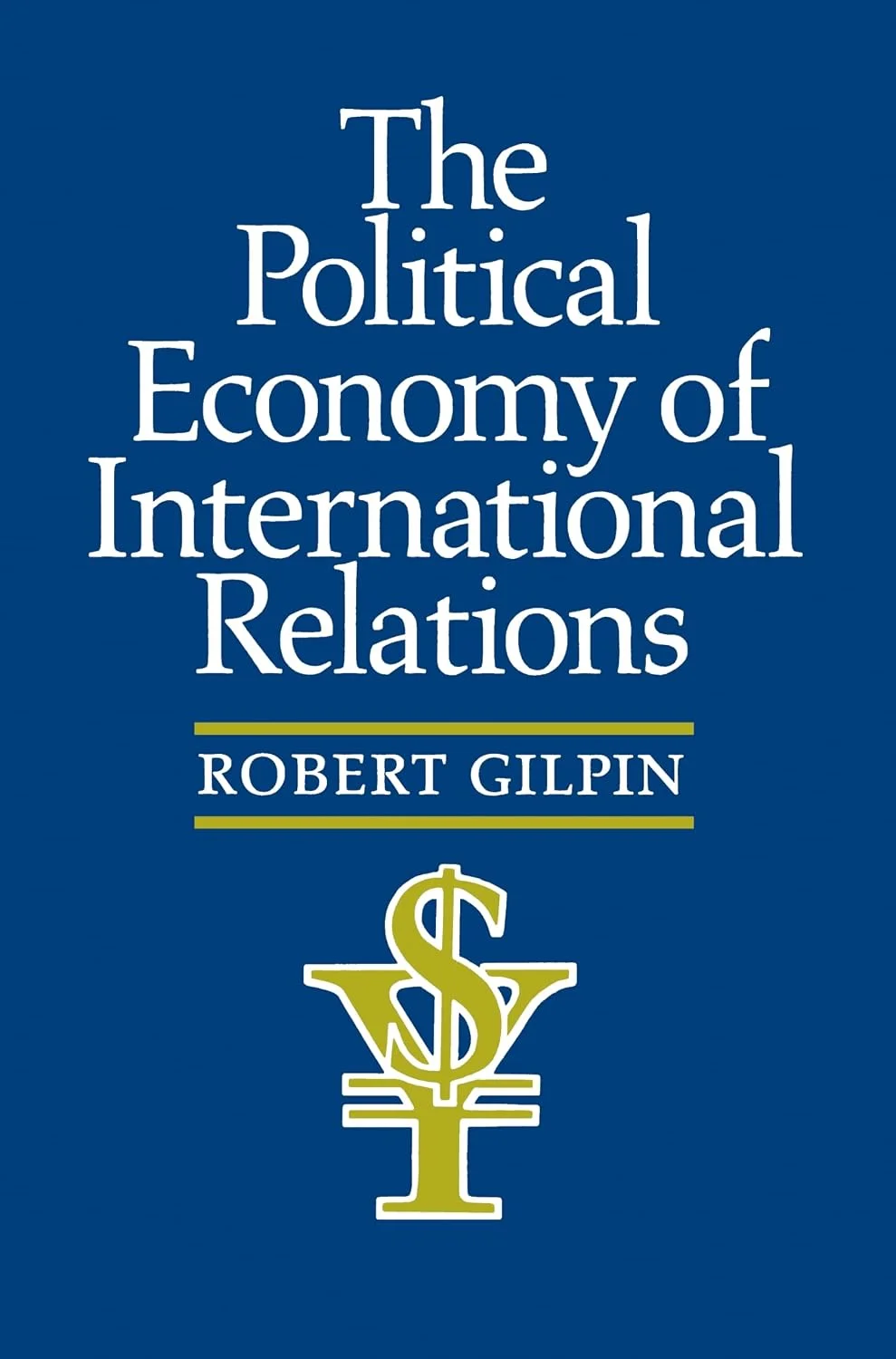
The Political Economy of International Relations
 Robert Gilpin
Gilpin's central argument is that a stable, liberal international economic order requires a hegemonic power to provide the public goods—a stable reserve currency, open markets, and rules enforcement—that no smaller state has the incentive to supply. When American hegemony waned in the 1970s, the postwar liberal order became threatened by protectionism and economic nationalism. Gilpin rejects the optimistic liberal view that cooperation can be sustained without leadership. Instead, he forecasts a future of 'benign mercantilism'—regional blocs and sectoral protectionism managed by states pursuing their own interests, rather than a restored global liberalism.
Key Details
Related Books
View AllSimilar books from the same category, ranked by shared topics and reader engagement.


Key Insights — Read in 10 Minutes
What is Gilpin's core argument about the relationship between hegemony and international economic order?
Gilpin argues that a stable, liberal international economy requires a hegemonic power to provide essential public goods: a stable reserve currency, open markets for goods and capital, and rules enforcement. Without a hegemon willing to bear these costs, the liberal order erodes into protectionism and conflict. He rejects the liberal institutionalist view that cooperation can be sustained through regimes alone. When American hegemony declined in the 1970s, Gilpin predicted that the postwar liberal order would give way to 'benign mercantilism'—state intervention to promote domestic values rather than restored global liberalism [citation:1][citation:5].
How does Gilpin's framework differ from Robert Keohane's After Hegemony?
Gilpin, a self-described 'soft realist,' contended that state power and security interests remain the key determinants of international economic affairs. Keohane's liberal institutionalism argued that international regimes could sustain cooperation even after hegemony declined, because institutions create their own momentum and facilitate reciprocity. Gilpin was more skeptical: he believed non-state actors remain fundamentally dependent on state power, and that the distribution of power shapes the rules of the system. His view is less sanguine than theories of cooperation that conclude liberal order is possible without hegemony [citation:1].
What does Gilpin mean by 'benign mercantilism,' and why did he see it as the likely future?
Benign mercantilism is a policy of state intervention designed to promote domestic values and order rather than to prey on other states' vulnerabilities. Gilpin saw it as the best achievable outcome once pluralistic leadership failed to emerge. He already observed manifestations in the 1980s: sectoral protectionism that accommodated different national capacities to adjust, and emerging regional blocs in North America, Western Europe, and the Pacific. Because the Europeans were unprepared to assume a global role and Japan could not act as a market of last resort, Gilpin foresaw a fragmented world economy managed by states pursuing narrower interests [citation:1].
How did Gilpin's book respond to the specific economic conditions of the 1980s?
Gilpin wrote against the backdrop of America's dramatic shift from world's major creditor to largest debtor, made possible by Japanese underwriting of the Reagan budget deficit. He argued that US competitiveness was eroded by dollar overvaluation, which altered consumer tastes and strengthened foreign producers. He noted that the US destroyed the Bretton Woods system in August 1971, that protectionism had increased, and that Reagan's macroeconomic policies undermined stability through exchange rate misalignment and massive bilateral trade deficits. His conclusion was more pessimistic than economists who saw these developments as a temporary conjuncture [citation:1].
What are the three ideologies of political economy that Gilpin analyzes?
Gilpin structures the book around three competing perspectives: liberalism, nationalism, and Marxism. He assesses each ideology's contribution to understanding the problems burdening the world economy. His own allegiance is to liberalism—the belief that the economy is an autonomous system separated from the political realm—but he is fair-minded in presenting the alternatives. A reviewer noted that one of the book's strengths is that the reader can see how policy prescriptions follow from ideological premises, making the ideological foundations of economic policy explicit rather than implicit [citation:16].
What is the common misconception about Gilpin's argument in this book?
A common misreading is that Gilpin simply predicts the inevitable collapse of the liberal order. His argument is more conditional: the order can be sustained if a hegemon is willing to bear the costs, but if the hegemon's commitment wanes, the order will fragment. He did not claim collapse was certain—he identified a 'hegemon's dilemma' in which serving the interests of the world as a whole steadily undermines the hegemon's own position, creating a need for policy change before it is too late. His concern was with initiating a change in US policy, not declaring the game over [citation:11].
Wealthy Psyche is an intellectual archive. We do not host, distribute, or sell book copies — physical or digital. We provide structured knowledge to help you think better, faster.