


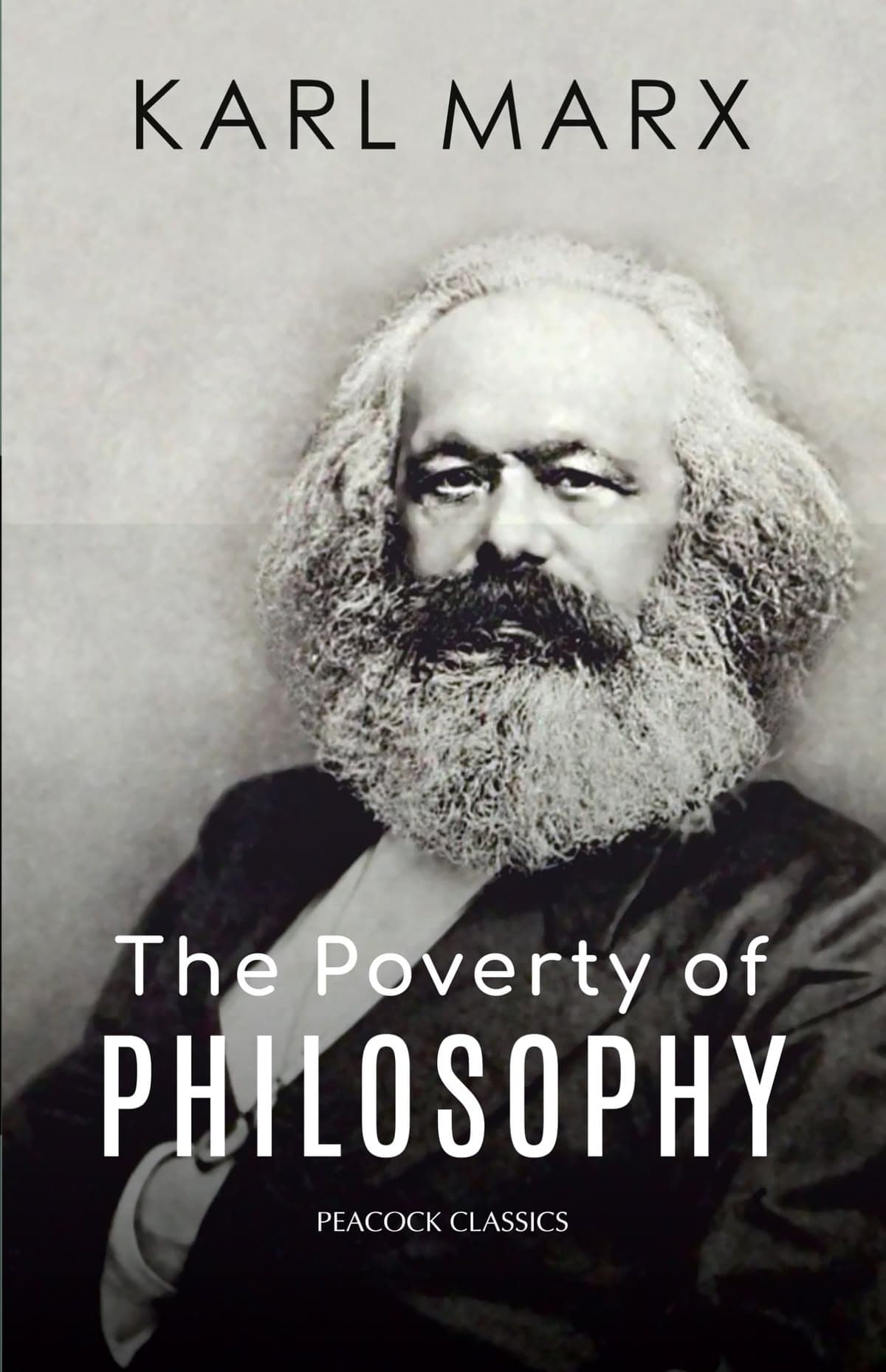
The Poverty of Philosophy: Answer to the "Philosophy of Poverty" by M. Proudhon
Marx's polemic argues that Proudhon's attempt to derive a just economy from the 'constituted value' of labour is incoherent because it treats historically specific bourgeois relations—competition, division of labour, property—as eternal categories. The book's distinctive mechanism is immanent critique: Marx shows that Proudhon's reformist formula merely reproduces the exploitation it claims to abolish, because value determined by labour time under capitalism already presupposes class antagonism. Written in French for a European radical audience, it marks Marx's first mature economic polemic and his decisive break with utopian socialism.
Key Insights
✦What is Marx's central objection to Proudhon's 'constituted value,' and why does it fail?
Proudhon proposed that if commodities exchanged in proportion to the labour time embodied in them, exploitation would disappear and equality would be realised. Marx's objection is that this formula merely describes what capitalism already does in principle: commodities under capitalism do tend to exchange at their labour values. The problem is not the measure of value but the social relation behind it. Labour time determines value only because producers are separated from their means of production and must sell their labour-power. A just exchange of equivalents between commodity owners leaves the fundamental exploitation—the unpaid surplus labour extracted in production—untouched. Proudhon's reform, Marx argues, would perfect the wage relation rather than abolish it .
✦Why did Marx write the book in French, and what does that reveal about its intended audience?
Marx composed the work in French rather than German to reach Proudhon's own readership and the broader European radical circles in which Proudhon was influential . The choice signals that the target was not German philosophy but French socialism, and that Marx sought to intervene directly in the debates of the organised left. Proudhon's followers were a significant force in the Communist League and in French working-class politics, and Marx regarded their reformist influence as an obstacle to a revolutionary programme. The French text was published in Paris and Brussels in 1847, and Marx later attempted to republish it in the French socialist newspaper L'Égalité in 1880 .
✦How did Engels later qualify the book's economic terminology, and what does that qualification mean for readers?
In his preface to the 1885 German edition, Engels noted that the terminology of The Poverty of Philosophy 'does not entirely coincide' with that of Capital. The book speaks of labour as a commodity and of the 'purchase and sale of labour,' whereas the mature Marx distinguished labour from labour-power . Engels also corrected the thesis that the natural price of labour coincides with the wage minimum, a claim Marx later revised. These qualifications do not invalidate the polemic, but they mean readers should not treat its economic formulations as Marx's final position. The book is a transitional work, written before Marx had completed his critique of political economy, and its value lies more in the method of immanent critique than in the technical precision of its categories.
✦What was the immediate reception of the book, and how did it affect Marx's relationship with Proudhon?
The book ended Marx's friendship with Proudhon, who had been a significant intellectual interlocutor in Paris. Marx sent Proudhon a copy, and the rupture was permanent. One reviewer describes the polemic as 'watching Einstein mock grade schoolers,' noting that Marx 'proceeds to bury him six feet under' rather than offering correction or guidance . The book was not republished in full during Marx's lifetime, though excerpts from the section on strikes appeared in various socialist papers between 1872 and 1875 . Its immediate influence was thus limited, but it served to delineate the Communist League's position from Proudhonian reformism.
✦What does the book contribute to historical materialism that The German Ideology had not already established?
The Poverty of Philosophy applies historical materialism to economic categories for the first time. Where The German Ideology had sketched the materialist conception of history in philosophical opposition to the Young Hegelians, the polemic against Proudhon demonstrates how the method works on political economy. Marx shows that competition, monopoly, division of labour, and property are not eternal categories but historical products of bourgeois society. The famous formulation—'The hand-mill gives you society with the feudal lord; the steam-mill, society with the industrial capitalist'—states the core thesis in its most memorable form . The book thus marks the transition from philosophical critique to economic analysis, the path that would culminate in Capital.
✦Is The Poverty of Philosophy still worth reading, or is it superseded by Marx's later works?
It is worth reading for two reasons, though not as a substitute for Capital. First, it is the clearest demonstration of Marx's method of immanent critique: he does not oppose Proudhon from an external standpoint but shows that Proudhon's own premises generate conclusions he refuses to accept. Second, it reveals Marx's political break with reformist socialism more sharply than the Manifesto, which is addressed to a broader audience. That said, the economic content is thinner than Capital, and the polemical tone—which Marx himself regretted in later years—can obscure the argument. Readers seeking Marx's mature economics should go to Capital; readers seeking to understand how he arrived there will find this book instructive.
Wealthy Psyche is an intellectual archive. We do not host, distribute, or sell book copies — physical or digital. We provide structured knowledge to help you think better, faster.