


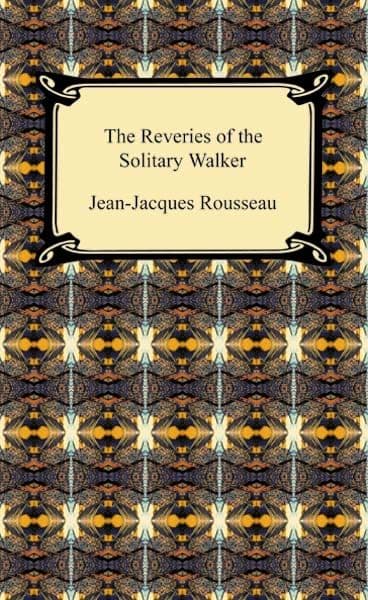
The Reveries of the Solitary Walker
Rousseau's final work is a sequence of ten 'Walks' in which he abandons political argument for an inward exploration of the soul's search for happiness. Its central claim is that the only reliable felicity available to a persecuted solitary is the pure sentiment of existence—a state of pre-reflective contentment in which past and future vanish and one feels merely that one is. The Fifth Walk, describing his stay on the Island of Saint-Pierre, articulates this state as the work's philosophical core: a happiness that requires no thought, no action, and no society, only the passive awareness of being.
Key Insights
✦What is the 'sentiment of existence' in the Fifth Walk, and why does Rousseau treat it as the summit of happiness?
The sentiment of existence is Rousseau's name for a state of consciousness in which one feels one's own being without any accompanying thought, desire, or project. In the Fifth Walk, he describes drifting in a boat on the Lake of Bienne, hearing only the lapping water, until the self dissolves into a pure awareness of existing. This state, he argues, is preferable to all the 'pleasures of life' because it has no dependence on external objects and therefore cannot be taken away by others. It is also, crucially, not a state of thought: reflection reintroduces comparison, memory, and anticipation, all of which disturb contentment. The sentiment of existence is happiness reduced to its minimum—and, for Rousseau, its most secure form.
✦Why did Rousseau write the Reveries as a private manuscript rather than a public work, and what does that mean for how we read it?
Rousseau opens the Reveries by declaring himself alone on earth, with no brother, neighbour, or friend but himself. He presents the work as written for his own eyes, not for publication. This is not merely a literary pose: after the condemnation of Emile and the Social Contract, and his subsequent flight and persecution, Rousseau genuinely believed he had no audience left. The Reveries is thus an unusual philosophical text—it does not address a reader, and its arguments are conducted as a 'conversation of the soul with itself.' Thomas Pangle has argued that this private form is essential to the work's philosophical teaching: Rousseau is exploring the life of the sage who has withdrawn from politics, not prescribing a model for citizens . Readers who approach it as a public treatise will misjudge its aims.
✦How does the Reveries relate to Rousseau's Confessions, and which text should be read first?
Rousseau himself called the Reveries an 'appendix' to the Confessions. The two works overlap in episodes—his stay on the Island of Saint-Pierre appears in both—but treat them differently. The Confessions is a chronological narrative addressed to the public, defending Rousseau's character against his enemies. The Reveries is non-chronological, fragmentary, and written without any expectation of being read. The Confessions explains what happened; the Reveries explores what it felt like and what philosophical conclusions can be drawn from it. Readers new to Rousseau's autobiography should start with the Confessions for the narrative and biographical context, then turn to the Reveries for the philosophical distillation. Scholars such as Eli Friedlander have read the Reveries as a philosophical transformation of the Confessions' experiences .
✦What is the textual history of the Reveries, and why is there no definitive edition?
Rousseau wrote the Reveries between 1776 and 1778 and died before completing or revising it. The first edition appeared posthumously in 1782, assembled by three friends—the Marquis de Girardin, Paul Moultou, and Pierre-Alexandre Du Peyrou—but it contained careless errors and false readings, some from misreading the manuscript and some from attempts to improve Rousseau's style . This flawed text was reprinted for over a century and a half. Two critical editions based on fresh manuscript examination appeared in 1948, by John S. Spink and Marcel Raymond, working independently. Raymond's edition became the basis for most subsequent publications, but as one scholarly note observes, there is to date no edition completely faithful to Rousseau's manuscript . English translations have inherited these textual problems, and readers should check which French edition a translation is based on.
✦Is the Reveries an apolitical work, and does it abandon the concerns of the Social Contract?
The question has been genuinely contested. The Reveries is written from an explicitly nonpolitical perspective: Rousseau addresses the happiness of the solitary individual, not the legitimacy of the state . Some readers, such as Harry Neumann, have argued that this makes Rousseau 'radically apolitical,' and that the Reveries represents a reduction of reality to private reverie. This reading has been vigorously disputed. As one respondent notes, it would require casting aside the Social Contract, Emile, and the Discourses, and ignoring Rousseau's own statement in the Confessions that everything in his thought was 'radically connected with politics' . The more defensible view is that the Reveries explores a condition—solitary happiness—that Rousseau regards as unavailable to citizens and unnecessary for political theory, but which completes his account of human possibility. It is a complement to his politics, not a refutation of it.
✦How does Rousseau's 'sentiment of existence' differ from Descartes's cogito, and why does the contrast matter?
Descartes's cogito establishes the self's existence through the act of thinking: I think, therefore I am. Rousseau's sentiment of existence reverses the priority. In the Fifth Walk, he describes a state in which thinking stops and yet the self feels itself more intensely than at any other time. Being is prior to thought, and happiness consists in the passive awareness of being rather than in the activity of reasoning. Eli Friedlander has read the Reveries against Descartes's Meditations precisely to bring out this contrast: where Descartes seeks certainty through doubt and reflection, Rousseau seeks contentment through the suspension of reflection . The contrast matters because it marks Rousseau's departure from the Enlightenment's privileging of rational consciousness. For Rousseau, the highest human good is not thought but feeling.
Wealthy Psyche is an intellectual archive. We do not host, distribute, or sell book copies — physical or digital. We provide structured knowledge to help you think better, faster.