


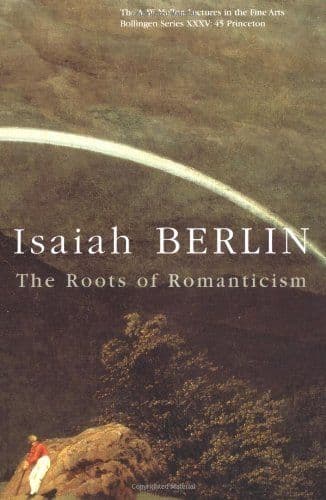
The Roots of Romanticism
Berlin's Mellon Lectures argue that Romanticism was not a literary mood but a revolution in the history of ideas: the moment the will replaced reason as the central human faculty. He traces this shift from Kant's moral philosophy through Schiller, Fichte, and the Jena circle to its 'unbridled' culmination, contending that the Romantics destroyed the Enlightenment premise of a single objective truth in ethics. The book's distinctive claim is that this revolution's consequences were unpredictable—fueling both totalitarian politics and, paradoxically, the liberal appreciation of human diversity that Berlin himself defended.
Key Insights
✦What is the central thesis of Berlin's account, and what does it reject about conventional histories of Romanticism?
Berlin rejects the treatment of Romanticism as primarily an aesthetic or literary phenomenon. For him, it was a philosophical revolution whose core was the elevation of the will—spontaneous, creative, unconstrained—above reason as the defining human capacity. This shift, which he traces from Kant's moral philosophy through Schiller and Fichte to the Jena Romantics, destroyed the Enlightenment's confidence in a single objective truth accessible to all rational beings. The most consequential result was not in poetry but in ethics and politics: once the will becomes sovereign, no external standard can adjudicate between competing human projects. Berlin's distinctive move is to insist that this revolution's effects were neither uniformly good nor bad, but genuinely unpredictable.
✦Where does the text come from, and what did Henry Hardy change in editing it for publication?
The book is not a written treatise but the transcript of six A. W. Mellon Lectures Berlin delivered at the National Gallery of Art in Washington, D.C., in March and April 1965, under the title 'Some Sources of Romanticism' . The BBC recorded and later broadcast them. Hardy edited the transcripts for the 1999 first edition, published by Chatto & Windus in London and Princeton University Press . A second Princeton edition in 2013 added a foreword by John Gray, illustrations, a revised text, and an appendix containing Berlin's correspondence about the lectures and their reception . Readers should know they are encountering spoken lectures shaped for oral delivery, not a polished monograph.
✦How has scholarly reception challenged Berlin's portrait of the Romantics?
A substantive critique concerns Berlin's characterization of the early German Romantics as irrationalist celebrants of the will. One reviewer notes that Berlin attributes to Friedrich Schlegel a claim about a 'terrible unsatisfied desire to soar into infinity,' whereas Schlegel's actual language concerns a longing for the infinite without the 'soaring' . More broadly, the reviewer argues, drawing on Manfred Frank's work on early German Romanticism, that figures like Schlegel were skeptics about the possibility of absolute knowledge—a position of humble acceptance of human finitude, not a rejection of reason . Berlin's dramatic contrast between Enlightenment rationality and Romantic voluntarism may therefore oversimplify the philosophical positions involved.
✦Why does Berlin treat Kant as a 'father' of Romanticism despite Kant's own hostility to it?
Berlin acknowledges the tension explicitly. Kant detested Romanticism and was a philosopher of science, so the paternal link cannot lie in his epistemology. Berlin locates it specifically in Kant's moral philosophy: the idea that the will is autonomous and that moral worth resides in the intention behind an act rather than in its consequences or conformity to external law. This primacy of the will, Berlin argues, captivated the Romantics even though Kant intended it to serve reason. Schiller and Fichte developed the doctrine further, and the Romantics then severed the will from its rational moorings entirely. Kant thus supplies the conceptual ingredient that the Romantics transformed into something he would have repudiated.
✦What does Berlin mean by 'unbridled' Romanticism, and why does he see it as politically dangerous?
'Unbridled Romanticism' names the phase in which the will is released from any residual constraint—rational, moral, or social. Berlin associates this with figures like Fichte in his more nationalist register and with the Jena circle's celebration of creative genius. The danger is political: once the individual or collective will becomes the sole source of value, there is no principled limit to what it may demand. Berlin sees this logic feeding into twentieth-century nationalism and totalitarianism, where the 'authentic' will of a people or a leader justifies coercion. Yet he refuses a simple condemnation: the same Romantic impulse also underlies the modern respect for individual self-expression and cultural difference.
✦How does the book relate to Berlin's better-known essay 'Two Concepts of Liberty'?
The Roots of Romanticism supplies the historical genealogy for the warning at the heart of 'Two Concepts of Liberty.' In that essay Berlin argues that positive liberty—self-mastery—can slide into coercion when a ruler claims to liberate a person's 'real' or rational self against their empirical desires. The lectures show where this idea came from: the Romantic elevation of the will as the authentic core of the person. Berlin's historical narrative makes the conceptual point concrete. At the same time, the lectures complicate any simple reading of Berlin as an anti-Romantic. He credits Romanticism with enriching the liberal understanding of human diversity and the inadequacy of any single rational blueprint for life.
Wealthy Psyche is an intellectual archive. We do not host, distribute, or sell book copies — physical or digital. We provide structured knowledge to help you think better, faster.