


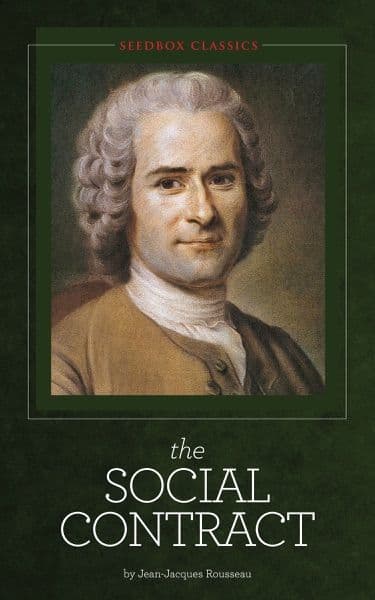
The Social Contract; or, Principles of Political Right

Rousseau's central argument is that legitimate political authority arises only from a pact in which each individual alienates himself entirely to the community, creating a collective body whose general will is the sole sovereign. The distinctive mechanism is the general will's generality: it must apply to all citizens equally and concern only common interests, which is why Rousseau rejects representative government and factions. Freedom, on this account, is obedience to a law one has prescribed to oneself—a formulation that makes coercion in the name of the general will conceptually possible, and that has been the source of the work's enduring controversy.
Key Insights
✦What is the general will, and how does it differ from the sum of individual wills?
The general will is the collective will of citizens directed toward the common good, not the aggregation of private preferences. Rousseau insists it must be general in two senses: in its origin (all citizens participate) and in its object (it concerns everyone equally). When factions form, the will of each association becomes partial and the general will is obscured. The Stanford Encyclopedia notes that Rousseau rejected Diderot's notion of a general will of the human race, confining the concept to a particular society . The general will is not what everyone happens to want; it is what citizens would will if they attended to the common interest rather than their particular interests—a distinction that raises the question of who determines when the general will has been correctly identified.
✦How does the 'forced to be free' passage work, and why has it been read as a precursor to totalitarianism?
Rousseau argues that citizens who refuse to obey the general will can be compelled to do so, and that this compulsion makes them free by forcing them to follow the law they themselves prescribed as members of the sovereign. The paradox is that coercion is presented as liberation. Hostile readers from J. L. Talmon to Isaiah Berlin have treated this as the seed of totalitarian politics: once a ruler claims to know the general will better than citizens themselves, coercion in its name becomes unlimited. The Stanford Encyclopedia notes that hostile writers have portrayed Rousseau as a source of inspiration for authoritarian aspects of the French Revolution and thence for fascism and communism . Defenders reply that Rousseau's general will is procedurally constrained and that the passage describes a logical consequence of self-legislation, not a licence for tyranny.
✦Why does Rousseau reject representative government, and what does he propose instead?
Rousseau holds that sovereignty is the exercise of the general will and therefore cannot be alienated or represented. Power can be delegated to magistrates, but the will cannot: a representative who decides for the people usurps their sovereignty. Citizens must assemble periodically to decide on laws and to judge whether the government has acted within its bounds. This is why Rousseau's model suits small states: direct participation by all citizens is impractical in large commercial nations. The implication is radical: the English, who believe themselves free, are free only during elections, after which they are slaves. The tension between this ideal and the scale of modern states is one reason Rousseau's constitutional projects for Corsica and Poland adjust the model to local conditions.
✦How did Kant receive the Social Contract, and what did he transform in adapting it?
Kant was profoundly influenced by Rousseau; a portrait of Rousseau was reportedly the only image on display in his house . The third formulation of the categorical imperative—the formula of the kingdom of ends—recalls Rousseau's general will. But Kant detached the idea of universal legislation from the particularity of a single society. Where Rousseau's general will is bounded by the nation and shaped by its history, Kant's moral law addresses rational agents as such. The Stanford Encyclopedia notes that this reversal is ironic: Rousseau had rejected the notion of a general will of the human race, and Kant universalises the very concept Rousseau confined to particular communities . This divergence marks the distance between Rousseau's civic republicanism and Kant's cosmopolitan moral philosophy.
✦What is the textual history of the Social Contract, and how does the published text differ from Rousseau's draft?
Rousseau published the Social Contract in 1762 through Marc-Michel Rey in Amsterdam. The book was suppressed in Paris and burned in Geneva because of the chapter on civil religion. A significant draft, known as the Geneva Manuscript, survives and reveals Rousseau's revisions. Scholars have shown that in the draft, Rousseau was more open to epistocratic rule by a Legislator who would guide the general will; in the published text, he cut passages that would have allowed the general will to be known only through the lawgiver's laws, and strengthened the claim that sovereignty cannot be alienated . The published version is thus more democratic in its insistence on citizen agency, though the Legislator remains a troubling figure in the text.
✦How has the Social Contract been misread or oversimplified in Anglophone scholarship?
A persistent misreading treats Rousseau as a proto-totalitarian, projecting onto the Social Contract the worst excesses of the French Revolution and later authoritarian regimes. One scholarly critique identifies Irving Babbitt, J. L. Talmon, Lester G. Crocker, and more recently Jonathan Israel and Michael Coffman as conservative Anglo-American critics who misappropriate Rousseau by ignoring the nuance of his concepts . The charge is that these readings impose ideological frameworks rather than engaging the text. Defenders point out that Rousseau's insistence on citizen deliberation, his rejection of factions, and his procedural constraints on sovereignty make the totalitarian reading untenable. The debate matters because it shapes how the Social Contract is taught: as a foundational text of democratic theory or as a cautionary tale about popular sovereignty.
Wealthy Psyche is an intellectual archive. We do not host, distribute, or sell book copies — physical or digital. We provide structured knowledge to help you think better, faster.