


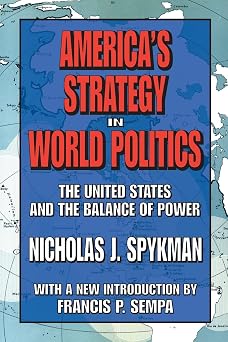
America's Strategy in World Politics: The United States and the Balance of Power
Written less than a year after Pearl Harbor, Spykman's book argued that the United States could no longer rely on hemispheric defense or the Atlantic and Pacific oceans as buffers. The central thesis: America's security depends on maintaining a balance of power in the Eurasian Rimland—the coastal fringes of Europe, the Middle East, and East Asia. If a single hostile power or coalition controlled those regions, the U.S. would be geopolitically encircled. Spykman inverted Mackinder's Heartland dictum: who controls the Rimland rules Eurasia; who rules Eurasia controls the destinies of the world.
Key Details
Related Books
View AllSimilar books from the same category, ranked by shared topics and reader engagement.

Key Insights — Read in 10 Minutes
What specific concept did Spykman introduce in America's Strategy in World Politics, and how did it revise Mackinder?
Spykman introduced the Rimland concept, which he defined as the coastal fringes of Eurasia—Europe, the Middle East, and East Asia. Unlike Mackinder, who located decisive power in the interior Heartland, Spykman argued the Rimland was the key to global dominance because of its resources, population, and strategic location between land and sea. He inverted Mackinder's famous dictum into: 'Who controls the Rimland rules Eurasia; who rules Eurasia controls the destinies of the world.' This reframing shifted American strategic attention from the Soviet interior to the coastal regions where the Cold War would actually be contested .
Why did Spykman argue that hemispheric defense was no longer sufficient for American security?
Spykman reasoned that the conquests of Germany and Japan had created the specter of geopolitical encirclement: hostile forces controlling Europe, the Middle East, and East Asia could choke off America's access to markets, raw materials, and strategic depth even without invading the Western Hemisphere. He rejected the assumption that the Atlantic and Pacific provided permanent security buffers. In his analysis, the United States had to conduct military operations across the oceans and actively shape the postwar balance of power, not retreat to a defensive position in the Americas .
How did Spykman's theory differ from the actual containment policy that the United States later adopted?
Many scholars have linked Spykman's Rimland thesis to Cold War containment, and there is real continuity in the emphasis on denying Soviet control of Western Europe, the Middle East, and East Asia. However, some analysts argue that the actual containment strategy reflected Mackinder's logic more than Spykman's. Spykman's vision called for a balanced Eurasian landmass with the United States playing the offshore balancer—supporting Germany and Japan as counterweights to Soviet and Chinese power. Containment, by contrast, was more purely defensive and focused on isolating the Heartland rather than maintaining a flexible balance .
What did Spykman predict about the postwar rise of China and the need for alliances with Japan?
Writing in 1942, Spykman looked beyond the immediate war to envision a postwar order in which the United States would need to balance emerging Eurasian powers. He anticipated that China would become a significant independent power in Asia and that the United States would likely need to ally with Japan to counterbalance Chinese influence. He also foresaw a resurgent Germany and Japan as potential balancers against Soviet power. These predictions, made decades before the Sino-American rapprochement and the U.S.-Japan alliance's evolution, demonstrate the forward-looking character of his balance-of-power framework .
How was the book received when it was published, and what did contemporary reviewers emphasize?
The New York Times called it a 'provocative book' and praised Spykman for moving in 'enduring company' alongside Machiavelli, Hamilton, and Mahan. The reviewer highlighted the book's central thesis: that only a balance of power can confine international conflict to non-violent means. Foreign Affairs described it as a 'pioneer work' for American scholarship but warned that Spykman's geopolitical approach failed to give due weight to historical traditions and psychological factors. The book was widely read and debated as the United States grappled with its postwar role .
What is the significance of Spykman's timing—writing before the United States entered the war?
Spykman wrote the book before the attack on Pearl Harbor and published it less than a year after the U.S. entered the war. This timing gave his argument an urgent, prescriptive character. He was intervening in the isolationist-interventionist debate, arguing that the United States could not remain aloof from global power politics. The book was designed to persuade Americans that the Eurasian balance of power directly affected their security and that hemispheric defense was an illusion. His wartime audience was forced to confront the geopolitical realities he described .
Wealthy Psyche is an intellectual archive. We do not host, distribute, or sell book copies — physical or digital. We provide structured knowledge to help you think better, faster.