


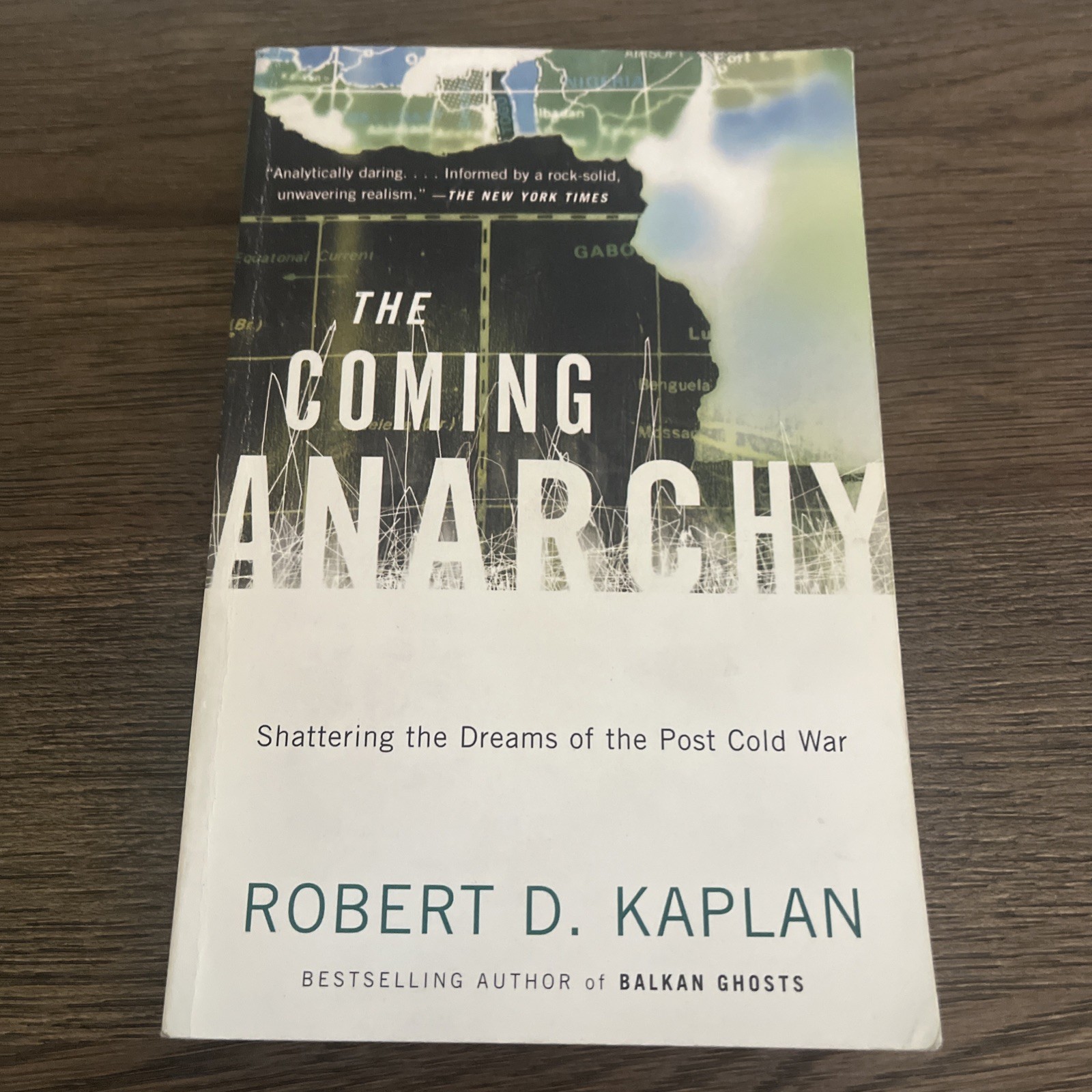
The Coming Anarchy: Shattering the Dreams of the Post Cold War
 Robert D. Kaplan
Kaplan argues that the post-Cold War dream of global peace has been shattered by a new kind of threat: environmental scarcity, overpopulation, crime, disease, and tribalism are dissolving the social fabric of much of the developing world, beginning in West Africa. Using Sierra Leone and Ivory Coast as microcosms, he contends that central governments are withering away, replaced by tribal domains, private armies, and organized crime. The book expands his 1994 Atlantic Monthly article, which drew directly on Thomas Homer-Dixon's research on environmental scarcity and conflict, into a broader warning that this anarchy will eventually reach the developed world.
Key Details
Related Books
View AllSimilar books from the same category, ranked by shared topics and reader engagement.

Key Insights — Read in 10 Minutes
What is the central claim of The Coming Anarchy, and what does it reject?
Kaplan argues that the post-Cold War expectation of global peace and prosperity was a delusion. He contends that environmental scarcity, overpopulation, crime, disease, and tribal identity are dissolving the social fabric of much of the developing world, producing a 'withering away of central governments' and the rise of private armies and criminal domains. He rejects the assumption that democracy and markets alone would stabilize the post-Cold War order, writing that 'Democracy is problematic; scarcity is more certain.' His West African examples serve as a microcosm of a condition he expects to spread globally.
What specific intellectual framework did Kaplan draw on, and who was its key source?
Kaplan drew heavily on the environmental scarcity research of Canadian political scientist Thomas Homer-Dixon, whom he called the 'paradigm-builder of our age.' Homer-Dixon's work argued that scarcities of renewable resources like water, cropland, and forests drive violent conflict. However, Homer-Dixon himself warned against environmental determinism, noting that politics, culture, and human ingenuity can prevent scarcity from turning to violence—caveats critics say Kaplan largely ignored. Kaplan also cited military theorist Martin van Creveld on the decline of the state and the rise of low-intensity conflict.
How did the original 1994 Atlantic article influence Washington policy circles?
The February 1994 article 'The Coming Anarchy' won widespread acclaim among Washington policymakers and has been described as one of the most 'dangerously influential' articles of modern times. It shaped debates about post-Cold War security, environmental conflict, and the limits of humanitarian intervention. Its influence on the Clinton administration's Africa policy remains debated; some scholars argue it reinforced a fatalistic view that African conflicts were intractable and intervention futile, while others note that policymakers also invoked it to argue for engagement with failing states. The article also became a lightning rod for anthropologists and Africa specialists who rejected its portrait of the continent.
Why did anthropologists and Africa specialists respond to the book with such hostility?
Critics argued that Kaplan's portrait of West Africa was 'misleading at best; at worst it promotes dangerous ideas about Africa, American foreign policy, and international relations.' They contended his observations were 'superficial,' his conclusions 'glib,' and his portrayal of African violence as the product of environmental determinism ignored the roles of politics, governance, and specific actors. Adekeye Adebajo described the original article as based on 'half-baked theories, racist stereotypes, superficial observations and sheer ignorance.' The controversy centered on whether Kaplan's vivid prose obscured the analytical weaknesses of his causal claims.
How does The Coming Anarchy differ from Kaplan's later work like The Revenge of Geography?
The Coming Anarchy is a collection of previously published essays, with the title chapter serving as its centerpiece, whereas The Revenge of Geography is a systematic theoretical argument. The earlier book is diagnostic and alarmist, focused on environmental and demographic pressures in the developing world. The later book is a rehabilitation of classical geopolitics as a general lens, drawing on Mackinder and Spykman. Both share Kaplan's conviction that deep structural forces—whether environmental or geographic—shape political outcomes more than ideology or leadership. The Coming Anarchy provided an early, regionally specific expression of this worldview.
How has the book's central warning held up since its publication?
Some of Kaplan's West African observations proved accurate in outline: Sierra Leone's civil war intensified after 1994, state collapse occurred in Somalia and Liberia, and resource-driven conflicts persisted. However, his broader claim that West Africa was a microcosm of global collapse has not been borne out. Many developing regions experienced economic growth and improved governance, and the 'anarchy' he predicted for the developed world did not materialize. The book's Malthusian framing has been widely criticized as environmental determinism. Its enduring value lies in its vivid journalism and its role in shaping post-Cold War security discourse, not in its predictive accuracy.
Show 2 more insights
What is a common misconception about the book's relationship to the original Atlantic article?
Readers often treat the 2000 book as merely a reprint of the 1994 article. In fact, the book is a collection of essays, most of which were previously published elsewhere, with the title chapter as its centerpiece. The additional essays cover diverse topics including Henry Kissinger's study of Metternich, Joseph Conrad's fiction, and a counterintuitive concluding chapter titled 'The Dangers of Peace,' which argues that a little anarchy can be beneficial. The book thus offers a broader, more heterogeneous set of arguments than the single influential article it takes its title from.
What role did Homer-Dixon's research play in the controversy over the book's accuracy?
Kaplan cited Homer-Dixon's work as the scholarly foundation for his claims about environmental scarcity driving conflict, which lent the argument academic credibility. However, Homer-Dixon's own research was more carefully qualified than Kaplan's dramatic presentation suggested. Homer-Dixon explicitly warned against environmental determinism, emphasizing that political and economic factors mediate the relationship between scarcity and violence. Critics argued that Kaplan appropriated Homer-Dixon's conclusions while stripping away these nuances, producing a more deterministic and alarmist version of the argument. This gap between the cited research and its popularization became a central point of scholarly criticism.
Wealthy Psyche is an intellectual archive. We do not host, distribute, or sell book copies — physical or digital. We provide structured knowledge to help you think better, faster.