


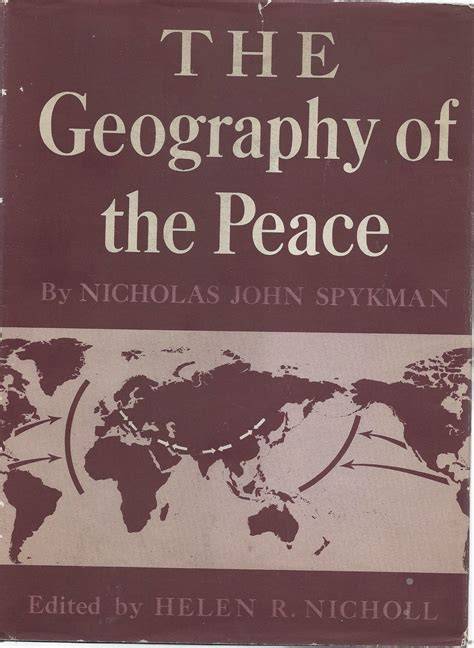
The Geography of the Peace
Published posthumously in 1944, this slim volume distills Spykman's final argument: the peace must be built on a realistic assessment of geography and power, not internationalist ideals. The book's central contribution is the full articulation of the Rimland thesis—the coastal crescent of Eurasia (Europe, the Middle East, Asia's monsoon lands) is the decisive zone for world power, not Mackinder's interior Heartland. Spykman proposes that the United States, Britain, and the Soviet Union form a cooperative security system to prevent any single power from dominating the Rimland. The book's 51 maps apply geopolitical analysis directly to the postwar settlement.
Key Details
Related Books
View AllSimilar books from the same category, ranked by shared topics and reader engagement.

Key Insights — Read in 10 Minutes
What is the central argument of The Geography of the Peace, and how does it revise Mackinder's Heartland theory?
The book argues that the Eurasian Rimland—the coastal crescent including Europe, the Middle East, and monsoon Asia—is the decisive zone for global power, not the interior Heartland. Spykman inverted Mackinder's dictum: 'Who controls the Rimland rules Eurasia; who rules Eurasia controls the destinies of the world' . He reasoned that the Rimland possesses greater population, resources, and industrial potential than the Heartland, and that its amphibious character makes it the natural arena of great-power competition. The book applies this framework to the postwar settlement, proposing that the United States, Britain, and the Soviet Union cooperate to prevent any single power from dominating the Rimland .
Why did Spykman argue that the United States must abandon isolationism and permanently engage in Eurasian power politics?
Spykman reasoned that technological advances in air power and the demonstrated reach of hostile powers during World War II had destroyed the security once provided by the Atlantic and Pacific oceans. He argued that if a single power or coalition controlled the Rimland, the United States would face geopolitical encirclement and lose access to the markets, resources, and strategic depth essential to its security . The book's concluding chapter, 'The Strategy of Security,' calls for the United States to maintain military bases in the Atlantic and Pacific, cooperate with Britain and Russia, and treat the Eurasian balance of power as a permanent American interest .
What role did Helen R. Nicholl play in the creation of this book?
Spykman died of cancer in 1943 at age 49, before completing the manuscript. Helen R. Nicholl, his assistant at the Yale Institute of International Studies, edited and assembled the book from his lecture notes, drafts, and maps . The work was published posthumously by Harcourt, Brace and Company in 1944 . Nicholl's editorial role was substantial enough that some scholars have raised questions about the extent to which the final text reflects Spykman's own views versus those of his colleagues at Yale, particularly regarding the book's prescriptions for Anglo-American cooperation .
How did the book's prescriptions relate to the actual containment policy adopted by the United States after World War II?
Many scholars identify Spykman's Rimland thesis as providing the theoretical foundation for containment . His emphasis on preventing Soviet domination of the Eurasian coastal regions anticipated George Kennan's strategy. However, there are important differences. Spykman advocated a flexible balance-of-power approach that treated the Soviet Union as a potential security partner alongside Britain and the United States . Containment, as actually practiced, was more purely adversarial and defensive. Spykman also envisioned a cooperative security system among the three major powers, whereas the Cold War divided them into opposing blocs .
What did Spykman predict about China's future role in the Rimland, and why is this significant today?
Writing in 1942, Spykman predicted that China would become the dominant power in the Far East after the war and would pose a threat to Western interests in the 'Asiatic Mediterranean'—the marginal seas of East Asia . He recommended a postwar U.S.-Japanese alliance to counterbalance Chinese power and urged American bases in Japan, the Philippines, and elsewhere to project power into the region. This prediction was made when China was America's wartime ally and Japan was its enemy, making it a remarkable act of geopolitical foresight. Contemporary analysts cite these passages in discussions of U.S.-China competition and the Asia-Pacific 'pivot' .
How has the book's argument held up since its publication, and what are its main limitations?
The Rimland thesis has proven durable as a framework for understanding great-power competition in Eurasia, and its influence on American strategy is widely acknowledged . However, the book has been criticized for its geographical determinism—overemphasizing location and resources while neglecting ideology, domestic politics, and economic factors . Its prescriptions for great-power cooperation proved unrealistic given the onset of the Cold War. Some scholars have also questioned the book's authorship, suggesting that Spykman's Yale colleagues may have shaped or modified the text to align with their own policy preferences, particularly regarding Anglo-American cooperation .
Wealthy Psyche is an intellectual archive. We do not host, distribute, or sell book copies — physical or digital. We provide structured knowledge to help you think better, faster.