


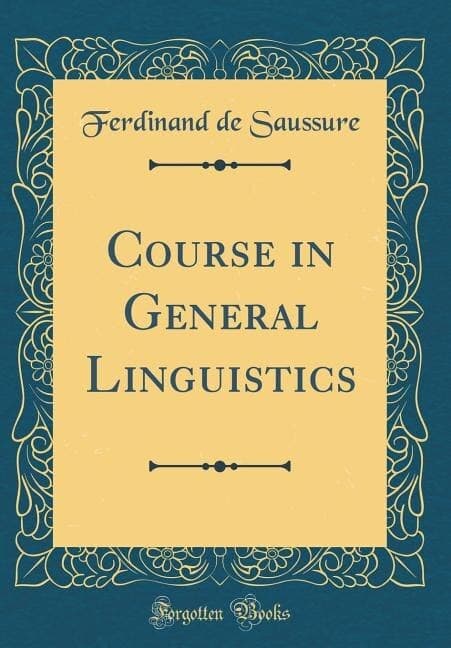
Course in General Linguistics
Compiled after Saussure's death from students' notes of his Geneva lectures, this book founds modern linguistics on the thesis that language is a system of arbitrary signs whose value comes entirely from relations of difference within the system. It separates langue, the shared social system, from parole, individual speech, and insists that language be studied synchronically as a state before it is studied diachronically as change. The sign joins a signified and a signifier, neither of which exists apart from the other or from the system. This relational, non-referential picture displaces the older view of language as a nomenclature for pre-existing things and ideas.
Key Insights
✦Who actually wrote the Course in General Linguistics, and why does that matter?
Saussure did not write the book. Charles Bally and Albert Sechehaye, colleagues at Geneva, assembled it from students' notes of three lecture series Saussure gave between 1907 and 1911. Neither editor attended the lectures. Their synthesis imposed an order that Saussure's own teaching may not have had, and later scholars, notably Rudolf Engler in his critical edition comparing the student notebooks, have documented gaps between the notes and the published text. Because most of structuralism's Saussure is this edited Saussure, the book is best read as a collaborative reconstruction, and claims about what Saussure himself held should be checked against the sources.
✦What does Saussure mean by the arbitrariness of the sign, and what does it not mean?
Arbitrariness means there is no natural, motivated link between a signifier, the sound-image, and its signified, the concept. Different languages pair them differently, and nothing in the sound of a word dictates its meaning. It does not mean individual speakers may choose signs freely. Once a community has adopted a sign, the individual cannot change it at will, which Saussure treats as the social fixity of language. Critics, most famously Émile Benveniste, argued that the link between signifier and signified is necessary within the system, and that the real arbitrariness lies between the sign and the thing it refers to.
✦How do langue and parole structure Saussure's program, and what has been disputed about them?
Langue is the shared system of a speech community, and parole is the individual act of speaking. Saussure assigns linguistics proper to langue because it is a stable, social object that can be studied systematically, while parole is variable and individual. This move shaped later structuralism, but it drew objections. Noam Chomsky's competence/performance distinction is often compared to it, though Chomsky locates the system in individual minds and stresses generative creativity, which he said Saussure's treatment of langue as a store of signs missed. Sociolinguists such as William Labov challenged the exclusion of variation and speech from the core of linguistics.
✦Why does the book insist on synchronic study over diachronic study?
Saussure argues that a language at a given moment forms a system whose elements are defined by their present relations, and speakers do not need to know its history to use it. Treating a state of the language as an object in its own right, he contends, is a precondition for scientific linguistics, which in his time was dominated by comparative and historical philology. He illustrates the point with the analogy of a chess game, where the value of a piece depends on the current position, not on how the position arose. Later linguists have debated whether the strict separation can be maintained, since synchronic systems always contain variation and change in progress.
✦How has the book's influence on structuralism and later thought been assessed?
The Course provided the model of a relational, non-referential account of meaning that Claude Lévi-Strauss applied to kinship and myth, Roland Barthes to cultural signs, and Roman Jakobson to phonology. Its emphasis on difference also fed into poststructuralist readings, most notably Jacques Derrida's critique of the sign in Of Grammatology, which accused Saussure of privileging speech over writing. In linguistics proper, generative and cognitive approaches displaced much of its programme from the 1950s onward, though its basic idea that linguistic units are defined by their place in a system remains widely accepted.
✦What is a common misreading of Saussure's account of meaning?
A frequent misreading takes the signified to be the real-world object that a word names. Saussure explicitly rejects that picture: the signified is a concept, and the sign's value depends on its relations to other signs, not on what it refers to. Another misreading treats the sign as having positive content that is then compared with others. He holds that in language there are only differences without positive terms. The confusion partly arises from popularized versions that present the sign as a label attached to things, which is the nomenclature view the Course was written to oppose.
Wealthy Psyche is an intellectual archive. We do not host, distribute, or sell book copies — physical or digital. We provide structured knowledge to help you think better, faster.