


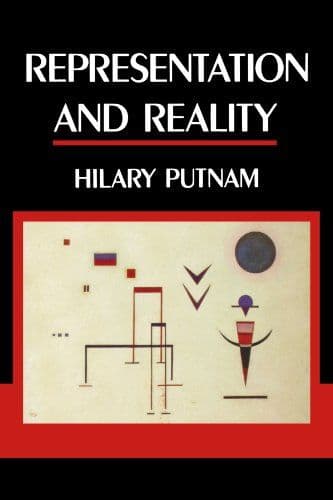
Representation and Reality

In this 1988 book Hilary Putnam turns against the functionalism he had helped found, arguing that mental states cannot be identified with computational states of the brain. His central mechanism is a pair of arguments: content-fixing by an organism's internal functional organization is impossible because meaning depends on the environment and on the community, and a triviality result suggests that almost any physical system can be described as implementing almost any computation. From these he concludes that intentional notions such as belief and reference cannot be reduced to computational vocabulary. The book is therefore a self-critique of his earlier position as much as an attack on the computational theory of mind and on reductive naturalized semantics.
Key Insights
✦Why did Putnam abandon the functionalism he helped create?
Putnam had argued in the 1960s that mental states are defined by their functional roles, much as software states are defined by their causal-computational relations, rather than by physical makeup. In this book he concludes that the idea cannot capture the content of propositional attitudes. Because what a belief is about depends on factors outside the head, including the environment and linguistic community, internal functional organization cannot fix content. He also argues that functionalism, pressed to its limits, trivializes the notion of implementing a computation. The reversal is notable because it comes from one of the view's founders, which gave it special weight in later debate.
✦What is the triviality argument about computational implementation?
Putnam argues that, under liberal enough criteria, almost any open physical system can be described as implementing almost any finite-state automaton, since its physical states can be mapped onto the automaton's formal states. If so, being in a computational state would not be a substantive fact about a system, and a computational account of mind would fail to distinguish minds from rocks. The argument is presented in an appendix and has been disputed in technical detail. David Chalmers and others have replied that proper implementation requires counterfactual-supporting state transitions, which Putnam's mapping does not supply.
✦How does the book use semantic externalism against reductive theories of meaning?
Putnam's earlier work held that the meaning of natural-kind terms depends partly on the actual environment and on a division of linguistic labor, so meanings are not determined by what is in the head. Here he turns this externalism against attempts to reduce meaning to internal functional states. He also criticizes causal, informational, and teleological theories that try to define reference in non-semantic terms, arguing that they presuppose the notions they explain. Jerry Fodor, who defends a naturalistic account of content, is one of the leading opponents of this line, and the exchange became a major axis of debate in philosophy of mind.
✦How does this book fit with Putnam's turn against metaphysical realism?
The book belongs to the same phase of thought as Reason, Truth and History, in which Putnam argued that reference cannot be fixed from outside our conceptual practices. Applying that stance to the philosophy of mind, he argues that a theory capturing mental content in purely scientific terms would require just the view from nowhere he had rejected. The book thus links his philosophy of language and mind to his broader opposition to reductionism, a theme developed further in Renewing Philosophy. Readers tracing his development should read the three together.
✦How has the argument held up since publication?
The critique of functionalism remains a standard reference, but reductive projects continued. Fodor's asymmetric dependence theory, Fred Dretske's informational semantics, and Ruth Millikan's teleosemantics were all developed as attempts to give content a naturalistic account, and their defenders argue that Putnam's objections are not decisive. The triviality argument has stimulated careful work on what implementation requires. The book's lasting influence lies partly in having forced functionalists to say more precisely what they meant by computation and content, whether or not they accepted his conclusions.
✦What is a common misreading of Putnam's rejection of functionalism?
A frequent misreading takes the book as a rejection of scientific study of the mind or as a return to dualism. Putnam does not deny that the brain underlies mental life, nor that cognitive science is valuable. His claim is narrower: that a particular reductive program, identifying mental content with computational or functional states, fails. He also does not retreat to a Cartesian picture of an inner mind. Reading the book as anti-scientific misses his continued commitment to realism and to the importance of empirical inquiry, which he pursued in later writings on natural realism.
Wealthy Psyche is an intellectual archive. We do not host, distribute, or sell book copies — physical or digital. We provide structured knowledge to help you think better, faster.