


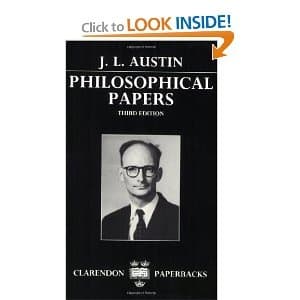
Philosophical Papers

A posthumous collection of J. L. Austin's essays, edited by J. O. Urmson and G. J. Warnock, that shows his method of mining ordinary language for distinctions philosophers have blurred. Its most celebrated pieces include 'A Plea for Excuses,' which uses the vocabulary of excuse and responsibility to refine thinking about action, 'Other Minds,' which treats claims to know as acts of giving one's word rather than reports of a mental state, and 'Performative Utterance,' an early statement of the idea that saying can be doing. The volume is a gathering of separate papers, so its unity lies in a patient, piecemeal linguistic method and not in one system.
Key Insights
✦Who edited the volume, and how does that shape what readers see of Austin?
Austin published little during his lifetime, and the collection appeared after his death in 1960, edited by J. O. Urmson and G. J. Warnock, both philosophers associated with the Oxford milieu in which he worked. The editors chose which papers to gather and arranged them, so the volume reflects their judgment about what best represents his thought. Later editions added further material. Readers should therefore treat it as a curated selection of an author who rarely prepared his own work for publication, and should compare it with his posthumously assembled lecture books to see how far the essays and lectures cohere.
✦What does 'A Plea for Excuses' contribute to the method of ordinary language philosophy?
The essay argues that the many words we use when excusing conduct, such as 'accident,' 'mistake,' 'inadvertently,' and 'on purpose,' mark distinctions that philosophers of action tend to overlook. Austin proposes that careful study of these terms can reveal the structure of responsibility more finely than abstract theory. He also describes a method: collect the vocabulary, examine the contexts in which each term applies, and test the fit with imagined cases. Critics, notably Ernest Gellner in Words and Things, charged that such appeals to what we ordinarily say are parochial, while defenders such as Stanley Cavell argued the method is subtler than its critics allow.
✦How does 'Other Minds' treat claims to know?
Austin argues that saying 'I know' is not a report of an especially strong inner state but a performance in which the speaker gives their word, inviting others to rely on it. This shifts the sceptic's question about certainty into a question about what entitles a speaker to make such a commitment in the circumstances. The paper anticipates the performative account developed in his later lectures and has been influential in discussions of knowledge and testimony. Critics have asked whether the analysis captures all uses of 'know,' and some, including those working in contemporary epistemology, regard the performative reading as incomplete.
✦How does the book relate to Austin's later speech act theory?
Several papers, including 'Performative Utterance,' contain early formulations of the idea that some utterances do not describe states of affairs but perform actions, such as promising or naming. This is developed more systematically in his lectures How to Do Things with Words, which introduced the distinction among locutionary, illocutionary, and perlocutionary acts. The papers therefore offer a view of the thought in progress, with sharper, more tentative formulations than the lectures. John Searle later systematized and modified the framework, and readers interested in that lineage should read Austin's own papers alongside Searle's Speech Acts.
✦How does Austin's ordinary language method differ from Wittgenstein's?
Both philosophers took the everyday use of words as central, and both aimed to dissolve certain philosophical puzzles rather than answer them. Austin, however, favored a more empirical, almost lexicographical approach, carefully cataloguing distinctions in ordinary vocabulary, and he was cautious about grand therapeutic claims. Wittgenstein's later work stresses language games and forms of life, and is more concerned with the pictures that hold us captive. Commentators sometimes treat them as a single school, but the differences in temperament and technique are substantial, and the grouping obscures how Austin's work stands on its own terms.
✦What is a common misunderstanding of Austin's appeal to ordinary language?
A frequent misunderstanding is that Austin held ordinary usage to be the final authority on every philosophical question. He described it instead as the first word, not the last: ordinary distinctions embody accumulated practical experience and should not be dismissed lightly, but they can be supplemented or revised when there is good reason. He also did not hold that philosophy is merely linguistics. Treating his method as a naive appeal to what people happen to say overlooks the care with which he tested distinctions and his willingness to admit that ordinary language does not always settle a question.
Wealthy Psyche is an intellectual archive. We do not host, distribute, or sell book copies — physical or digital. We provide structured knowledge to help you think better, faster.