


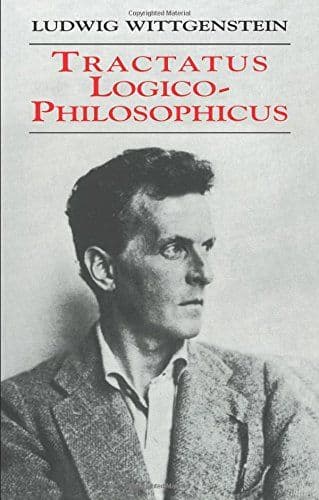
Tractatus Logico-Philosophicus
Wittgenstein's only book published in his lifetime argues that language represents the world by picturing it: a proposition is a picture of a possible state of affairs, sharing logical form with what it depicts. Structured as a hierarchy of numbered remarks, it derives from this picture theory a sharp limit on what can be said. Only propositions of natural science are meaningful; logic shows itself in the structure of symbolism rather than stating truths, and ethics, aesthetics, and metaphysics lie beyond the sayable. The closing remarks invite the reader to discard the work as a ladder once climbed, a gesture that has generated enormous interpretive dispute.
Key Insights
✦What is the picture theory, and what does it claim about meaning?
The picture theory holds that a proposition is a model of reality: its elements correspond to objects, and the way those elements are arranged mirrors a possible arrangement of objects in the world. A proposition is true if that arrangement obtains and false if it does not, and it has sense independently of which. What the proposition and the fact share is logical form, which cannot itself be pictured. This explains how language can say something new and be understood without prior explanation. Critics, including Wittgenstein himself in later work, questioned whether all meaningful language can be analyzed as such pictures and whether the postulated simple objects can be identified.
✦What is the distinction between saying and showing?
Wittgenstein holds that some things cannot be stated in meaningful propositions but are displayed in the way language and logic work. The logical form shared by proposition and fact, the tautologous character of logical truths, and the limits of the world all fall into this category. The distinction lets him deny that logic is a body of substantive truths, in contrast to Russell and Frege, while still allowing that it has a character. It also underlies his claim that ethical and religious matters, though important, are not expressible. Interpreters disagree on whether there are ineffable truths shown or only a recognition that no such truths exist.
✦How should the ladder remark at the end be understood?
Near the close Wittgenstein says that his propositions serve as elucidations by being recognized as nonsensical once the reader has used them to climb beyond them. Traditional readings, associated with the older commentary of G. E. M. Anscombe and with Peter Hacker, take the book to convey real though ineffable insights. The resolute or 'New Wittgenstein' reading, advanced by Cora Diamond and James Conant, argues that the sentences of the book are plain nonsense and that the work's purpose is therapeutic. The dispute over this reading is the most prominent interpretive controversy in Wittgenstein scholarship.
✦How faithful is the standard English translation, and what is its history?
The first English edition, translated by C. K. Ogden with assistance from F. P. Ramsey and with Wittgenstein's involvement, appeared in 1922 with a facing German text and an introduction by Bertrand Russell, which Wittgenstein disliked as a misreading. A later translation by D. F. Pears and B. F. McGuinness, published in 1961, became the standard version for decades, and both translations differ on terms such as 'Sachverhalt' and 'Tatsache.' Because the work is dense and its terminology precise, scholars often compare renderings and consult the German, especially when arguing about the status of objects and states of affairs.
✦How does the Tractatus differ from Wittgenstein's later philosophy?
In the Philosophical Investigations Wittgenstein rejected the Tractatus's picture theory and its assumption that language has one underlying logical form. He replaced it with the idea that meaning lies in use within varied language-games and forms of life, and he criticized his earlier belief in simple objects and fully analyzable propositions. Some scholars emphasize continuity, such as the persistence of a therapeutic aim, while others stress a radical break. The contrast is the basis of the traditional division between early and later Wittgenstein, though the boundaries are contested.
✦What is a common misreading of the Tractatus?
A common misreading ties the book to logical positivism and takes it to claim that anything not verifiable is meaningless, so that ethics and religion are dismissed. The Vienna Circle did admire the book, but Wittgenstein regarded the unsayable as the more important part of his work, and he considered ethics a matter of ultimate value. Another misreading treats it as a systematic theory of language of the kind found in Russell. Its aphoristic structure and its closing self-undermining gesture suggest a different aim, which is why interpretation remains contested.
Wealthy Psyche is an intellectual archive. We do not host, distribute, or sell book copies — physical or digital. We provide structured knowledge to help you think better, faster.