


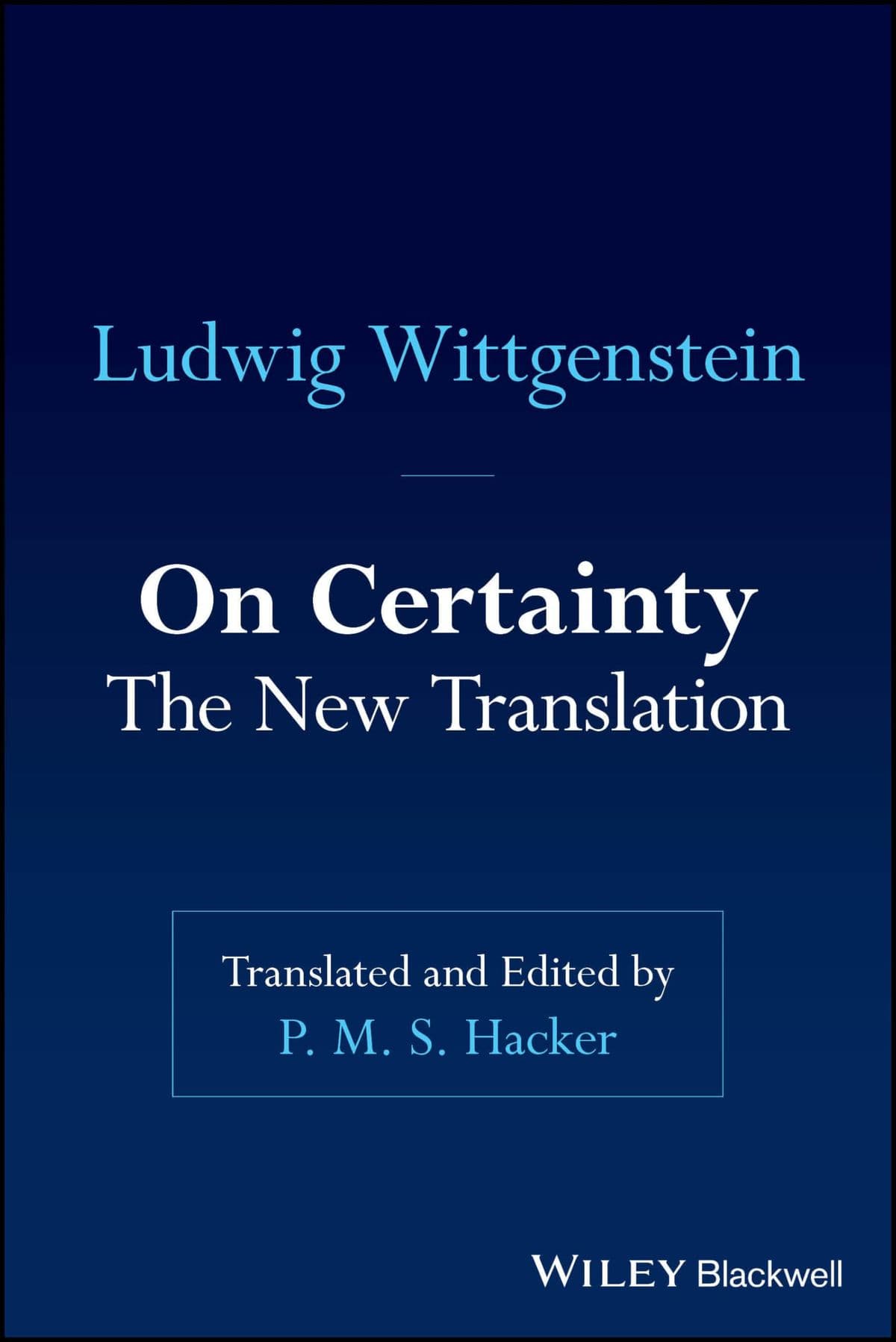
On Certainty
Compiled from notes Wittgenstein wrote in the last eighteen months of his life, this book takes up G. E. Moore's claims to know things like 'here is one hand' and argues that such statements are not ordinary knowledge claims at all. Its central idea is that some propositions function as a hinge or framework on which our inquiries and doubts turn. We do not hold them because we have grounds for them; they stand fast as part of the system within which grounds are given. Doubt therefore presupposes certainty, and radical skepticism misdescribes how doubting works. The text is a set of numbered, unrevised remarks, so its arguments are suggestive rather than systematically stated.
Key Insights
✦How was the text assembled, and why does that matter for interpretation?
On Certainty was not prepared for publication. It consists of remarks Wittgenstein wrote in the final period before his death in 1951, edited by G. E. M. Anscombe and G. H. von Wright, who arranged the material into four groupings by manuscript and numbered the remarks. The editors' sequence is therefore a reconstruction, and the remarks are unrevised drafts, sometimes repeating or abandoning lines of thought. Interpreters who build detailed doctrines on single remarks should be cautious, and many scholars read the text as a record of exploration instead of a settled theory. Later scholarship has also examined the manuscripts directly.
✦What is Wittgenstein's objection to Moore's 'I know' statements?
Moore claimed to know with certainty propositions such as that he has hands or that the earth existed long before his birth, treating them as answers to the skeptic. Wittgenstein replies that 'I know' normally belongs where doubt or a test is possible and some ground can be offered. In Moore's cases no such ground makes sense, because the certainty is more basic than any evidence we could cite. The cases are thus not instances of knowledge but of what stands fast for us. Critics have asked whether this shows Moore wrong or simply recasts his point, and commentators remain divided.
✦What are hinge propositions, and how do they function?
Wittgenstein compares certain propositions to hinges on which the door of inquiry turns, and to the riverbed that channels the flow of thought. They are not tested or justified within ordinary inquiry but form the framework in which testing takes place. Examples include that the earth is old and that one has a body. The term 'hinge' is the usual label in the literature, though Wittgenstein uses several images. Scholars disagree about whether hinges are propositions at all, whether they are known or merely held, and whether they are rationally evaluable. Interpreters such as Duncan Pritchard and Danièle Moyal-Sharrock have developed competing readings.
✦Does the book refute skepticism?
It is better described as undermining the skeptic's presuppositions than as refuting skepticism by proof. Wittgenstein argues that doubt needs grounds, that a doubt which questions everything at once is not a coherent doubt, and that the act of doubting presupposes certainties. Critics such as Barry Stroud have pressed whether this shows only that we cannot live as skeptics, not that skeptical conclusions are false. Others, including Crispin Wright, treat hinges as entitlements that are rationally held without evidence, which moves the discussion toward epistemology in a way Wittgenstein himself may not have intended.
✦How does the book relate to Wittgenstein's earlier views on language and rules?
The remarks extend themes from the Philosophical Investigations, especially the view that justification comes to an end in practice and that rules and meaning are embedded in shared forms of life. Language-games depend on agreement not only in definitions but in judgments, and hinge propositions mark where that agreement lies. The connection is often drawn through his remarks on following a rule. Specialists differ on whether the late notes introduce a new epistemological doctrine or simply apply the earlier outlook to Moore's problem, and the difference affects how much weight the book carries in contemporary epistemology.
✦What is a common misreading of the book?
A frequent misreading takes it to say that our deepest beliefs are arbitrary or merely conventional, as though hinges were unjustified assumptions we could choose to revise. Wittgenstein does not say that, and he also does not claim that hinges are fixed forever, since he notes that the riverbed can shift over time. Another misreading treats the book as a form of relativism. The remarks aim to describe how certainty and doubt actually function, and they leave open how far individual hinges could be questioned. Reading it as idle skepticism or as dogmatism misses its descriptive intent.
Wealthy Psyche is an intellectual archive. We do not host, distribute, or sell book copies — physical or digital. We provide structured knowledge to help you think better, faster.