


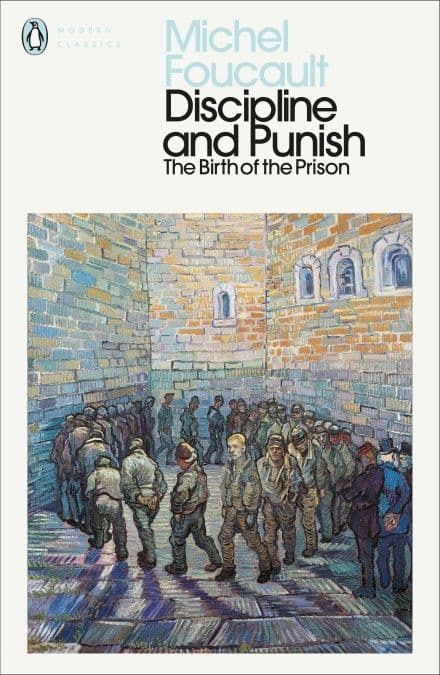
Discipline and Punish: The Birth of the Prison
Foucault's central argument is that the modern prison is not a reformist improvement over public execution but the culmination of a new technology of power—discipline—that operates through surveillance, normalization, and the examination. The book's distinctive mechanism is the shift from sovereign power (which punishes the body spectacularly) to disciplinary power (which corrects the soul through meticulous training of the body). The Panopticon serves as the architectural diagram of this power: a visibility so total that the inmate internalizes surveillance and becomes his own guard.
Key Insights
✦What is the central argument of Discipline and Punish, and what does it reject about the history of punishment?
The central argument is that the shift from public execution to imprisonment was not a story of humanitarian progress but a transformation in the technology of power. Foucault rejects the view that reformers like Beccaria humanized punishment out of compassion. Instead, he argues that a new form of power—discipline—emerged, which operates not by destroying the body but by training it, correcting it, and normalizing it. The prison is the institutional crystallization of this disciplinary technology. The book's famous opening contrasts the gruesome public execution of Damiens in 1757 with the meticulous prison timetable of 1838 to show that punishment shifted from attacking the body to correcting the soul—and that this 'correction' is itself a form of power.
✦What is the Panopticon, and why is it the book's central diagram?
The Panopticon is Jeremy Bentham's architectural design for a prison: a central tower from which a guard can observe every cell, with inmates unable to tell whether they are being watched. Foucault uses it not merely as a historical curiosity but as a diagram of disciplinary power. Its effect is to induce in the inmate a state of conscious and permanent visibility that assures the automatic functioning of power. The inmate internalizes the gaze and becomes his own guard. Foucault argues that the Panopticon's logic extends far beyond prisons—to schools, hospitals, barracks, and factories. It is a 'machine for creating and sustaining a power relation independent of the person who exercises it' .
✦How does the book treat the prison reform movement, and what does it say about reformers like Beccaria?
Foucault treats the reformers not as humanitarians but as strategists of a new power. Beccaria and others argued against torture and capital punishment on grounds of efficiency, legality, and the prevention of crime. Foucault does not deny their sincerity but insists that their reforms were part of a broader transformation: punishment was becoming a function of a generalized disciplinary society, not merely a response to crime. The reformers' demand that punishment be 'humane' was also a demand that it be more effective—that it target the soul rather than the body. The prison, which they had not intended as the universal penalty, became the instrument through which this new power operated.
✦How was the book received, and what criticisms have been made of its historical claims?
The book was widely acclaimed and became one of Foucault's most influential works. But historians have raised substantive criticisms. The most common is that Foucault's account is empirically thin: he relies on prescriptive texts (rules, regulations, architectural plans) rather than evidence of actual practice, and he generalizes from French examples to a universal theory of disciplinary society. Critics have also noted that the book's periodization is too sharp—the shift from sovereign to disciplinary power was more gradual and uneven than Foucault suggests. Some have questioned his treatment of the prison reform movement, arguing that he flattens the diversity of reformers' motives into a single strategy. These criticisms do not invalidate the book's influence, but they complicate its status as history.
✦How does the book relate to Foucault's earlier work on madness and his later work on sexuality?
Discipline and Punish is the pivotal work of Foucault's middle period. It develops the themes of Madness and Civilization—confinement, exclusion, the constitution of the subject through institutional practices—but shifts from the asylum to the prison and from the Classical Age to the modern era. It also introduces the vocabulary of power/knowledge that Foucault would develop in Power/Knowledge and The History of Sexuality. The later work on sexuality extends the analysis of disciplinary power to the body and to the formation of sexual identity. In retrospect, Discipline and Punish is the book in which Foucault's mature conception of power—productive, capillary, and pervasive—first takes full shape.
✦What does Foucault mean by 'the soul is the prison of the body,' and why is this phrase important?
The phrase inverts the Platonic and Christian idea that the body is the prison of the soul. For Foucault, the modern prison produces a soul—a psyche, a personality, a subject—that is the effect of power operating on the body. The prison does not merely incarcerate a pre-existing criminal; it constitutes the criminal as a psychological subject to be corrected, observed, and known. This is why Foucault says that the prison's real target is not the body but the soul: disciplinary power works by producing the very interiority it claims to liberate. The phrase condenses the book's argument that the modern subject is not the foundation of knowledge and freedom but the product of disciplinary practices.
Wealthy Psyche is an intellectual archive. We do not host, distribute, or sell book copies — physical or digital. We provide structured knowledge to help you think better, faster.