


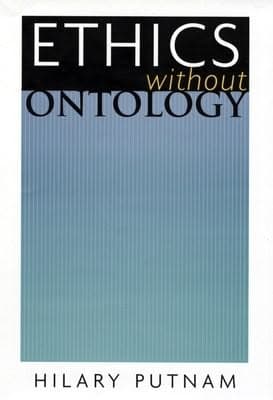
Ethics without Ontology

Based on lectures Hilary Putnam gave in the early 2000s, this book argues that ethical and mathematical objectivity do not depend on settling what kinds of objects exist. His central move is to reject the picture on which a discourse is objective only if it describes a special domain of entities, whether moral facts or abstract mathematical objects. Instead, he defends 'conceptual relativity,' the claim that the same situation can be correctly described using different, non-interdefinable vocabularies, together with the view that ordinary questions in ethics and mathematics can have right answers without ontological backing. The book draws on Dewey, Wittgenstein, and Kant, and it extends the arguments of his earlier work on fact and value.
Key Insights
✦What does Putnam mean by saying ethics can be objective without an ontology?
Putnam rejects the assumption that a discourse is objective only if it answers to a distinctive domain of objects, such as moral facts or Platonic entities. He argues that this assumption forces a false choice between realism about queer entities and a subjectivist or projectivist account in which ethical claims merely express attitudes. On his view, ethical questions can be answered correctly or incorrectly by reasoned inquiry, as other questions are, without any metaphysical explanation of what makes the answers true. Critics, including those who favor naturalist metaethics, have asked whether this leaves the objectivity of ethics unexplained instead of secured.
✦What is conceptual relativity, and how does it differ from ordinary relativism?
Conceptual relativity is the claim that a single situation can be described in more than one correct way, using vocabularies that cannot be reduced to one another, and that the question of how many objects exist can have different right answers depending on the conventions of the description chosen. Putnam illustrates it with the case of counting objects in a world of three particles, where the answer varies with whether mereological sums are admitted. He insists it is not relativism about truth, since within a description the facts are not up to us. Critics, notably those defending a single privileged ontology, have challenged whether the doctrine is coherent.
✦How does the book apply the same approach to mathematics?
Putnam argues that the objectivity of mathematics does not require the existence of abstract objects, and that the indispensability argument he once defended, with Quine, rests on assumptions he now rejects. He suggests that mathematical statements may be understood in terms of what is mathematically possible, a modal approach that avoids positing a realm of sets or numbers. The proposal places him against both Platonism and nominalist fictionalism. This is a revision of the position he took in his early work, so readers should compare the book with Philosophy of Logic to see how his view changed.
✦How does Putnam draw on Dewey, Wittgenstein, and Kant here?
From Dewey, Putnam takes the idea that ethics is a domain of inquiry in which problems arise and are resolved in practice. From Wittgenstein he draws the view that philosophical demands for foundations often rest on pictures that mislead, and from Kant a form of constructivist emphasis on the role of our conceptual contribution. He does not adopt any of these thinkers wholesale. The combination is idiosyncratic, and commentators have disagreed about how far his readings of them are accurate and how well the three influences fit together in a single position.
✦How does the book relate to Putnam's earlier writing on fact and value?
It continues the line of argument in Reason, Truth and History and in his later collection on the fact-value dichotomy, where he argued that factual inquiry depends on epistemic values and that ethics is therefore not cut off from rational discussion. Ethics without Ontology adds the claim that the objectivity of ethics does not hinge on the existence of special entities. Readers interested in this thread should treat it as the late stage of an argument that began decades earlier, in which his target shifted from the fact-value split to the idea that objectivity needs an ontology.
✦What is a common misreading of the book's title and thesis?
The title suggests to some readers that Putnam denies that ethical statements have any truth value, or that he is an anti-realist who treats morals as projections. That reading is mistaken. He argues that ethical claims can be true or false and can be better or worse justified, while rejecting the further demand that their truth be explained by a special class of entities. The thesis is a claim about what objectivity requires, not a denial of it. Taking the book as a form of subjectivism overlooks his explicit opposition to that view.
Wealthy Psyche is an intellectual archive. We do not host, distribute, or sell book copies — physical or digital. We provide structured knowledge to help you think better, faster.