


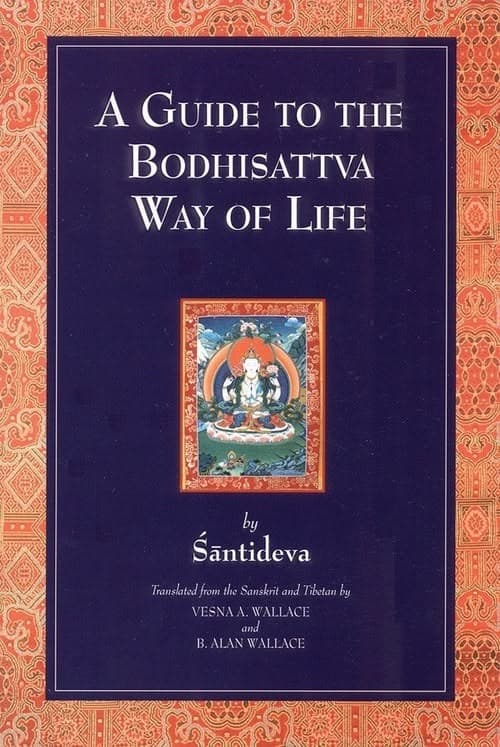
A Guide to the Bodhisattva's Way of Life (Bodhicaryāvatāra)
The Bodhicaryāvatāra is Śāntideva's poetic masterpiece, a ten-chapter guide to the bodhisattva's path that moves from the initial generation of bodhicitta to the perfection of wisdom. Its central framework is the cultivation of bodhicitta—the aspiration to attain awakening for the sake of all beings—as the transformative power that converts ordinary self-concern into the exchange of self and other. Śāntideva argues that all suffering arises from self-cherishing and that the root of the bodhisattva's path is the willingness to take on the suffering of others. The eighth chapter, on meditation, and the ninth, on wisdom, are its philosophical heart.
Key Insights
✦What is the central argument of the Bodhicaryāvatāra, and what does it reject?
The central argument is that bodhicitta—the aspiration to attain awakening for the sake of all beings—is the transformative power that converts ordinary self-concern into the exchange of self and other. Śāntideva argues that all suffering arises from self-cherishing and that the root of the bodhisattva's path is the willingness to take on the suffering of others and give them one's own happiness . This is the practice of 'exchanging self and other' (parātmaparivartana), which Śāntideva presents as the logical conclusion of the recognition that self and other are equal in their desire for happiness and aversion to suffering. The text rejects the ordinary egoistic orientation that treats one's own welfare as paramount and others' as secondary, and it argues that this orientation is both ethically wrong and the cause of suffering.
✦What is the relationship between the eighth and ninth chapters, and why are they considered the philosophical heart of the text?
The eighth chapter, on meditation (dhyāna), and the ninth, on wisdom (prajñā), are the philosophical heart of the Bodhicaryāvatāra. The eighth chapter develops the practice of exchanging self and other, arguing that the distinction between self and other is not as sharp as we assume and that the bodhisattva's compassion is the natural expression of this recognition. The ninth chapter, on wisdom, presents the Madhyamaka analysis of emptiness, arguing that all phenomena lack inherent existence and that this realization is the ground of compassion . The two chapters are complementary: the meditation on self and other prepares the mind for the realization of emptiness, and the realization of emptiness deepens the compassion that the meditation cultivates. The text's path is thus an integration of wisdom and method, not a sequence of separate stages.
✦What does Śāntideva mean by 'exchanging self and other,' and how does he defend it?
Exchanging self and other (parātmaparivartana) is the practice of taking on the suffering of others and giving them one's own happiness. Śāntideva defends this practice by arguing that the distinction between self and other is not as absolute as we assume. Just as we protect our future self from present suffering, we can extend the same concern to others; the boundary between self and other is a construction, not a natural fact . He also argues that self-cherishing is the root of all suffering, while cherishing others is the root of all happiness. The practice is not merely a moral ideal but a path to liberation: by dissolving the egoistic orientation, the bodhisattva achieves the wisdom that realizes emptiness. The exchange is thus both an ethical practice and a soteriological method.
✦What is the textual history of the Bodhicaryāvatāra, and how do the Sanskrit and Tibetan versions differ?
The Bodhicaryāvatāra survives in Sanskrit and in Tibetan translation. The Sanskrit text was edited by Louis de La Vallée Poussin and others, and a critical edition by P. L. Vaidya was published in 1960 . The Tibetan translation was made in the eleventh century by the Indian scholar Sumatikīrti and the Tibetan translator Ngok Loden Sherab, and it was later revised by the Kashmiri scholar Tilakakalaśa and others. The Sanskrit and Tibetan versions differ in some verses and in the arrangement of the text, and there is also a Dunhuang recension that differs from the canonical version . These differences suggest that the text was fluid in transmission and that the version we read today is one of several recensions. The ninth chapter, on wisdom, is particularly important for the study of Madhyamaka, and it has been the subject of extensive commentary.
✦How was the Bodhicaryāvatāra received in Tibet, and what role did it play in Tibetan Buddhism?
The Bodhicaryāvatāra became one of the most widely studied and commented upon texts in Tibetan Buddhism. It is included in the Tibetan canonical collections and has been the subject of commentaries by many of the greatest Tibetan scholars, including Tsongkhapa, Mipham, and the Dalai Lama . The text's emphasis on bodhicitta and the exchange of self and other made it a foundational text for the Mahāyāna path, and its ninth chapter on wisdom became a key source for the study of Madhyamaka. The Dalai Lama has said that the Bodhicaryāvatāra is the text he would choose if he could keep only one book, and it has been widely translated and taught in the West . Its influence extends beyond Buddhism: its arguments for altruism and compassion have been cited by philosophers and psychologists.
✦What is the most common misunderstanding of the Bodhicaryāvatāra's purpose?
The most common misunderstanding is that it is a devotional or inspirational poem, a collection of beautiful verses about compassion with little philosophical content. In fact, it is a rigorous philosophical and ethical treatise, with a sustained argument for the exchange of self and other and a detailed Madhyamaka analysis of emptiness. The eighth and ninth chapters are among the most sophisticated philosophical texts in the Mahāyāna tradition . A related misunderstanding is that the Bodhicaryāvatāra is a beginner's text, a simple introduction to the bodhisattva path. While it is accessible in style, it presupposes a serious commitment to the path and engages with advanced philosophical issues. Readers who approach it as a devotional poem will miss its argumentative rigor; readers who approach it as a philosophy text will miss its transformative intent.
Wealthy Psyche is an intellectual archive. We do not host, distribute, or sell book copies — physical or digital. We provide structured knowledge to help you think better, faster.