


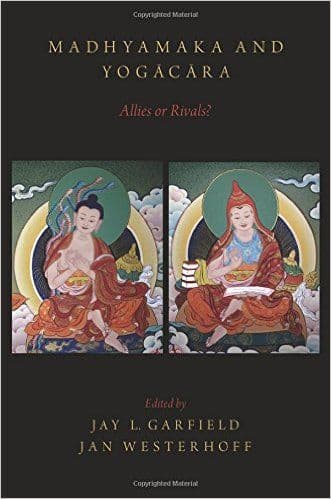
Madhyamakāvatāra (Introduction to the Middle Way)
The Madhyamakāvatāra is Chandrakīrti's independent treatise introducing Nāgārjuna's Madhyamaka philosophy, structured around the ten bodhisattva grounds. Its central framework is the integration of emptiness with compassion: the bodhisattva's realization of the lack of inherent existence is inseparable from the compassionate vow to liberate all beings. The text's sixth chapter, on the perfection of wisdom, is its philosophical heart, presenting a sustained critique of Yogācāra's dependent nature and self-awareness of cognition, and defending the Prāsaṅgika view that dependent arising itself proves emptiness. It became the foundational Madhyamaka text in Tibet.
Key Insights
✦What is the central argument of the Madhyamakāvatāra, and how does it integrate emptiness and compassion?
The central argument is that the realization of emptiness (śūnyatā) is inseparable from great compassion. Chandrakīrti structures the text around the ten bodhisattva grounds, and the bodhisattva's progress on these grounds is driven by the compassionate wish to liberate all beings, a wish that is deepened, not undermined, by the realization that beings and their suffering lack inherent existence. The sixth chapter, on the perfection of wisdom, presents the philosophical analysis of dependent arising as emptiness. The text's opening verses praise compassion as the root of the bodhisattva path, and the philosophical analysis serves this soteriological purpose: to remove the cognitive obstructions that prevent full compassion [citation:9]. The work is thus not a dry treatise but a guide to the bodhisattva's integration of wisdom and method.
✦What is the significance of the sixth chapter, and what critique of Yogācāra does it contain?
The sixth chapter, on the perfection of wisdom, is the philosophical heart of the text and its most influential section. It presents Chandrakīrti's sustained critique of Yogācāra (Cittamātra) positions, specifically the notions of a 'dependent nature' (paratantrarūpa) and the 'self-awareness' (svasamvedana) of cognition [citation:4]. Chandrakīrti argues that these concepts covertly reintroduce an inherent existence that the Madhyamaka analysis of dependent arising has refuted. His critique is not merely polemical: it is intended to clear away subtle philosophical attachments that prevent the full realization of emptiness. Until recently, this chapter and its auto-commentary were available only in Tibetan translation; the discovery of a Sanskrit manuscript of the Madhyamakāvatārabhāṣya has allowed scholars to clarify ambiguities and access Chandrakīrti's arguments with greater precision [citation:4].
✦How did this text become the foundational Madhyamaka work in Tibet, and what role did Mipham's commentary play?
The Madhyamakāvatāra became the main entry point into Madhyamaka thought in Tibet, largely due to its comprehensive structure and its integration of philosophical analysis with the bodhisattva path [citation:9]. In the nineteenth century, Jamgön Mipham (1846–1912) composed an extensive commentary that became a standard textbook in the Nyingma and other traditions. Mipham's commentary, composed twelve centuries after Chandrakīrti, provides a point-by-point explanation of the verses and situates them within the Tibetan scholastic context [citation:2][citation:5]. The 2002 Padmakara Translation Group edition made this combination—Chandrakīrti's root verses with Mipham's commentary—widely accessible in English for the first time, and it remains the standard entry point for English-speaking students [citation:6].
✦What is the relationship between the Madhyamakāvatāra and Chandrakīrti's Prasannapadā?
Both works are by Chandrakīrti and belong to the Madhyamaka tradition, but they differ in genre and purpose. The Madhyamakāvatāra is an independent treatise (śāstra) that introduces the Madhyamaka path through the framework of the ten grounds, while the Prasannapadā is a line-by-line commentary on Nāgārjuna's Mūlamadhyamakakārikā [citation:9]. The Madhyamakāvatāra is generally considered the more accessible introduction, which is why it became the standard textbook in Tibet. The Prasannapadā is more technical and polemical, engaging in detailed debates with rival Buddhist and non-Buddhist schools. Together, they represent Chandrakīrti's two major contributions to Madhyamaka: one pedagogical and path-oriented, the other exegetical and dialectical. Readers new to Chandrakīrti should begin with the Madhyamakāvatāra and its commentaries.
✦What does Chandrakīrti mean by 'dependent arising' (pratītyasamutpāda), and why does it prove emptiness?
For Chandrakīrti, dependent arising means that all phenomena arise in dependence on causes, conditions, and conceptual designation. Nothing exists independently, from its own side, or with an inherent nature (svabhāva). This is not a mere philosophical position but a description of how things actually are. The proof of emptiness is that if things existed inherently, they would not depend on anything else; but since they are observed to depend on causes and conditions, and since their identities are established through conceptual imputation, they lack inherent existence [citation:9]. Crucially, Chandrakīrti insists that this analysis applies to the analysis itself: emptiness is not a thing, and the realization of emptiness must not become a new object of grasping. The Madhyamakāvatāra's sixth chapter works through this analysis in dialogue with rival views, showing that dependent arising and emptiness are not two truths but two descriptions of the same reality.
✦What is the most common misunderstanding of this text's purpose?
The most common misunderstanding is that the Madhyamakāvatāra is a purely philosophical treatise, a work of abstract logic or ontology to be studied for its arguments alone. In fact, it is a path text (mārga-śāstra) structured around the bodhisattva's progression through the ten grounds, and its philosophical analysis is embedded in a soteriological framework [citation:9]. The sixth chapter's critique of Yogācāra is not an end in itself but a means of removing subtle cognitive obstructions to the realization of emptiness, which in turn deepens compassion. A related misunderstanding is that the text is a neutral survey of Madhyamaka views. It is a polemical work that defends a specific interpretation—the Prāsaṅgika position—against rival Buddhist schools, and its arguments are meant to be internalized and practiced, not merely analyzed.
Wealthy Psyche is an intellectual archive. We do not host, distribute, or sell book copies — physical or digital. We provide structured knowledge to help you think better, faster.