


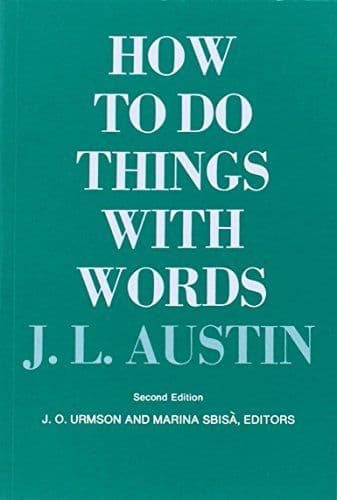
How to Do Things with Words

Assembled from J. L. Austin's 1955 William James Lectures at Harvard, this book begins by separating performative utterances, which do something such as promising or naming, from constative utterances, which describe. Austin then shows that the distinction breaks down: both kinds can succeed or fail, and the true/false model of meaning cannot capture how utterances work. In its place he offers a theory of speech acts, analyzing each utterance as a locutionary act (saying something meaningful), an illocutionary act (the force with which it is said, such as warning or asserting), and a perlocutionary act (the effects it produces). Its distinctive method is classifying the ways utterances can misfire, which he calls infelicities.
Key Insights
✦Why does Austin abandon his own distinction between performative and constative utterances?
He begins by treating performatives as utterances that are not true or false but can be happy or unhappy, in contrast to constatives, which describe. He then finds that statements also depend on conditions of felicity, such as presupposition and appropriate circumstances, while performatives can be assessed against facts, as when a warning is mistaken. No grammatical or vocabulary test cleanly separates the classes. Austin concludes that stating is itself one kind of illocutionary act, and he shifts to a general theory of the forces of utterances. Many readers treat the abandoned contrast as a failure, but it is better seen as a deliberate route toward a broader view.
✦How are locutionary, illocutionary, and perlocutionary acts distinguished?
The locutionary act is the act of uttering a meaningful sentence with a sense and reference. The illocutionary act is what one does in saying it: asking, warning, promising, or asserting, depending on the force the utterance carries. The perlocutionary act concerns the consequences produced in an audience, such as persuading or alarming them. Austin treats illocutions as conventional, so they can be made explicit by formulas like 'I warn you that,' whereas perlocutionary effects are not guaranteed by convention. The boundary between the second and third categories has been contested, and later theorists have proposed several refinements.
✦What are infelicities, and why does Austin catalog them?
Austin identifies ways in which a performative can go wrong without being false, including misinvocations, where no accepted procedure exists, misexecutions, where the procedure is flawed, and abuses, where the speaker lacks the required intentions or fails to follow through. A marriage ceremony conducted by someone without authority, or a promise made with no intention of keeping it, illustrate the contrast. The catalog shows that the success of speech depends on social conventions and on speakers' commitments, not solely on semantic content. This concern with the conditions of success is one reason the book influenced law, sociology, and literary theory.
✦Who edited the text, and how does that affect the reading of the book?
Austin died in 1960, and the book was published in 1962 under the editorship of J. O. Urmson, who worked from Austin's lecture notes and drafts. A second edition prepared with Marina Sbisà in 1975 added material and clarified the text. Because the book reconstructs spoken lectures that Austin had not prepared for publication, its tone is exploratory and sometimes tentative, and some of its structure reflects editorial choices. Readers should recognize that it presents thought in progress, and that interpretations resting on a single passage should be weighed against the whole sequence of the argument.
✦How did John Searle's treatment of speech acts differ from Austin's?
Searle, in Speech Acts, systematized Austin's insights into a theory of constitutive rules governing illocutionary acts, and proposed a classification of illocutionary types that replaced Austin's less tidy five-fold taxonomy. He also stressed the role of intentionality, which brought the theory closer to the philosophy of mind. Critics of Searle, notably Jacques Derrida in 'Signature Event Context,' argued that Austin's emphasis on speaker intention and ideal conditions neglects the iterability of signs, and the Derrida-Searle exchange is one of the best-known disputes in the book's reception.
✦What is a common misreading of Austin's theory?
A frequent misreading treats performatives as a special class of exotic utterances, such as 'I do' or 'I name this ship,' and takes the book's contribution to end there. Austin's real aim is broader: to replace the assumption that language mainly describes with an account of the many acts we perform in speaking. A second misreading takes the theory to be about the speaker's inner mental state, when Austin's treatment gives priority to conventions and context. Reading the book only as a taxonomy of verbs also overlooks its critical target, the descriptive fallacy.
Wealthy Psyche is an intellectual archive. We do not host, distribute, or sell book copies — physical or digital. We provide structured knowledge to help you think better, faster.