


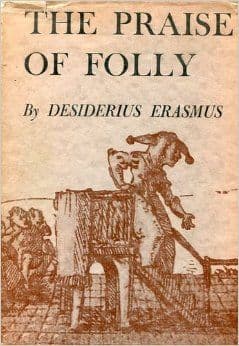
In Praise of Folly (Moriae Encomium)

A satirical declamation in which Erasmus gives the speaking voice to Folly herself, who praises her own power over human life. Its central device is ironic self-praise: Folly claims credit for pleasure, self-love, and the illusions that make society bearable, then turns to mock theologians, monks, princes, and the pope for the foolishness of institutions that claim wisdom. In the closing section the argument shifts, as Folly invokes the Pauline idea of the 'foolishness' of Christian faith, linking worldly folly to a spiritual simplicity that overturns conventional values. The book is a work of comic paradox with a serious critical edge, not a straightforward treatise, and its irony makes its precise targets and intentions a matter of continuing debate.
Key Insights
✦How did the work come to be written, and what is the connection to Thomas More?
Erasmus later said he composed it in 1509 while traveling to England and finished it at the house of Thomas More, whose name the Greek title echoes: Moriae Encomium can be heard as a pun on 'Moria' (folly) and 'Morus' (More). It was dedicated to More and printed in Paris in 1511, with many later editions that Erasmus revised and expanded. The pun and the dedication show the work as a product of a humanist friendship, though scholars caution that Erasmus's own account of its composition was written years afterward and may be shaped by his purposes in defending it.
✦Who or what does Erasmus satirize, and how pointed is the satire?
The speech mocks scholastic theologians for hair-splitting, monks for formalism, pardoners and relic-sellers for exploiting piety, and rulers and popes for worldly ambition. It also laughs at grammarians, lawyers, and philosophers. Erasmus later insisted that he had attacked types and vices rather than named individuals, a defense he offered when critics such as Martin Dorp objected. Historians differ on how much real reform is implied, since the irony allows Folly's claims to be taken as both true and absurd, and the target is often a way of thinking as much as a particular institution.
✦How should the ironic structure be read, and what is the role of the final section?
Folly is unreliable: she praises vices and is herself a figure of self-love, so readers must infer what Erasmus means. In the last part she draws on Scripture, notably Paul's discussion of the 'foolishness' of the cross, to suggest that true Christians appear mad to the world. Interpreters disagree whether this concluding turn is a sincere religious message or a further layer of irony. Scholars such as Erika Rummel and others have emphasized the work's rhetorical tradition, in which the paradoxical encomium is a recognized form, and this context helps limit overreading.
✦How did Erasmus defend the book against criticism?
Theologians at Louvain and elsewhere, along with the Dominican Martin Dorp, attacked the book as disrespectful. Erasmus answered in letters, including a long reply to Dorp, arguing that satire is a legitimate and ancient genre, that Folly speaks in a comic persona, and that his criticism targets abuses rather than the Church. His defense became part of the book's reception history. Later Catholic authorities censored his works, and the Folly was placed on lists of prohibited books, which shows how contested its meaning remained after the Reformation began.
✦How does the Folly relate to Erasmus's more earnest works and to the Reformation?
Its criticism of ritualism and scholastic theology parallels the earnest programme of the Enchiridion and his edition of the Greek New Testament, and it was read by contemporaries as sympathetic to reform. Yet Erasmus declined to join Luther, and later disputes with Luther over free will, such as in his work on the freedom of the will, show the limits of his reformism. Historians debate whether the Folly helped prepare the Reformation or was merely misused by it, a question captured in the old saying that Erasmus laid the egg that Luther hatched.
✦What is a common misreading of the book?
A common misreading takes Folly's speech as Erasmus's direct opinion, so that he is seen as endorsing foolishness or as a simple enemy of the Church. The work is built on irony, and statements must be weighed against the speaker's unreliability. Another misreading treats it as a purely comic piece without religious seriousness, ignoring its scriptural close. A third reads it only as a Reformation text, though Erasmus remained within the Catholic Church. Attention to genre and to his later replies to critics helps avoid these errors.
Wealthy Psyche is an intellectual archive. We do not host, distribute, or sell book copies — physical or digital. We provide structured knowledge to help you think better, faster.