


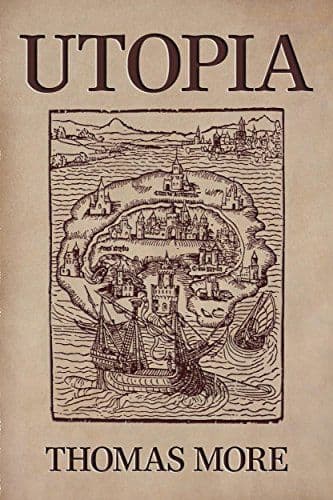
Utopia (De optimo reipublicae statu deque nova insula Utopia)

More's Utopia is a Latin prose work in two books that pairs a critique of contemporary England with a description of an imagined island commonwealth. In Book One, the traveler Raphael Hythloday and a character named Thomas More debate whether a philosopher should serve a prince. In Book Two, Hythloday describes Utopia, where private property is abolished, goods are held in common, work is shared, and daily life is regulated. Its central mechanism is the deliberate ambiguity of its frame: a fictional narrator, a punning island name, and a persona named More make it unclear how far the described society is a proposal, a satire, or a thought experiment.
Key Insights
✦What is the central design of Utopia, and what does the frame accomplish?
The book combines a dialogue on political counsel with a travelogue about an invented island. The frame matters as much as the content: More appears as a character, the narrator Hythloday is a fictional traveler, and the name Utopia plays on Greek words that can suggest both 'no place' and 'good place'. These devices keep More at a distance from the proposals described. The effect is to let the work test radical ideas, especially communal property, without simply endorsing them, and to invite readers to judge rather than merely accept what they are told.
✦Is Utopia a serious blueprint, a satire, or something in between?
Scholars have long disagreed. Some readers, including many socialist interpreters, have treated it as a genuine proposal for communal life. Others stress its irony: Hythloday's name suggests a speaker of nonsense, some Utopian practices are harsh or authoritarian, and the closing note in the text distances More the character from what he heard. J. H. Hexter and later scholars emphasized the humanist and Christian context, which complicates a straightforward reading. The fairest view holds that the work is a deliberate provocation, using an imagined society to expose the flaws of European practice while leaving the proposals open to challenge.
✦What is the argument of Book One about counsel, and why does it matter for Book Two?
Book One debates whether a philosopher should enter royal service. Hythloday refuses, arguing that rulers listen to flattery rather than sound advice and that honest counsel would be ignored. The character More replies that a philosopher should still work within existing institutions to do what good he can. This unresolved debate shapes how readers take Book Two: if Hythloday is right about courts, Utopia may be a vision that cannot be implemented, but if More is right, the work may be an exercise in indirect counsel. Book One also contains the famous critique of enclosure and harsh punishment in England.
✦How was Utopia first published, and how did its editions develop?
The work was first printed in Louvain in 1516 and was shepherded into print by Erasmus and Peter Giles, with supporting material such as letters, a Utopian alphabet, and verses added in the early editions. These paratexts are part of the work's playful hoax, since they present the island as though it were a real discovery. Later printings in Basel and elsewhere in the same decade circulated the book widely among humanists. Readers working on the text should note that the surrounding letters and poems are part of its literary design and are not incidental additions.
✦How does Utopia relate to Plato's Republic and to Erasmus's political writing?
Utopia draws on Plato's Republic for the idea of a rationally ordered community in which property is shared among the ruling class, but More extends communal arrangements to the whole society and places the account inside a Christian humanist critique of pride and greed. It also stands in dialogue with Erasmus's Education of a Christian Prince, which similarly criticizes princely ambition and war. The relation is one of kinship rather than identical positions: More's work is a fictional experiment, while Erasmus's is a direct treatise on rulership. Comparing them shows the range of humanist political writing.
✦Which English translations of Utopia should readers consult?
The earliest English translation was by Ralph Robinson in 1551, which is lively but belongs to the language of its time. Modern readers commonly use the Cambridge Texts edition translated and edited by George M. Logan and Robert M. Adams, as well as the scholarly Yale Edition of the Complete Works of St. Thomas More, which includes the Latin text with commentary. Because tone and irony are central, readers should compare how translators treat names and puns and consult introductions that explain the ambiguity of the work's frame.
Wealthy Psyche is an intellectual archive. We do not host, distribute, or sell book copies — physical or digital. We provide structured knowledge to help you think better, faster.