


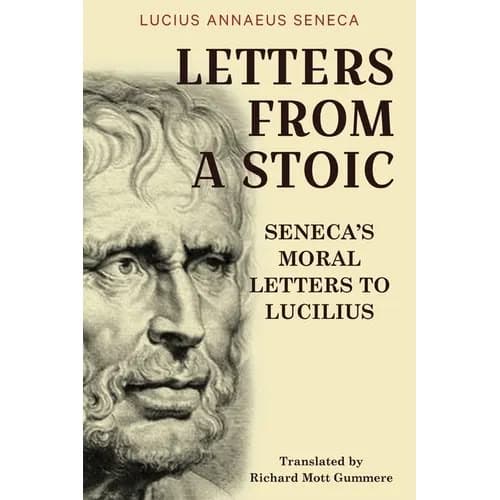
Letters from a Stoic (Epistulae Morales ad Lucilium)

Framed as a long correspondence with Lucilius, a provincial administrator, these letters turn Stoic doctrine into a practice of gradual self-correction. Seneca's distinctive method is the personal, unsystematic letter: each short piece takes one daily problem, such as fear of death, distraction, illness, wealth, or friendship, and works it into an exercise the reader can attempt that day. Instruction runs in both directions, since Seneca presents himself as a fellow traveller who is still improving, not a finished sage. The form lets him slip doctrine into conversation, borrow useful maxims even from Epicurus, and treat philosophy as a daily discipline rather than a closed system.
Key Insights
✦What does the letter form allow Seneca to do that a treatise would not?
The letter lets Seneca treat philosophy as an ongoing conversation instead of a system laid out from first principles. Each piece can start from an incidental occasion, a visit, an illness, a remark from Lucilius, and move to a doctrinal point without announcing a full argument. This suits his aim of moral improvement, since a single concern can be pressed on the reader in a few pages and then left. It also lets him present himself as a fellow learner rather than an authority. Readers expecting the systematic exposition found in Cicero's philosophical dialogues or in Stoic handbooks will find instead an exercise in persuasion, where tone, repetition, and vivid example do much of the work.
✦Why does a Stoic quote Epicurus so often?
Seneca frequently cites Epicurus, especially in the early letters, and explains that he treats good sayings as common property rather than as the private holdings of a school. This is a deliberate rhetorical choice as much as a philosophical one. It signals that his goal is moral progress, not partisan loyalty, and it lets him borrow Epicurean advice on simplicity and on facing death. Later scholars have debated how far this shows genuine openness and how far it is a tactic for pressing Stoic conclusions on a reader who might already admire Epicurus. Either way, it complicates any picture of the Stoics as hostile to every rival school.
✦Were these letters actually sent to Lucilius?
This is a real scholarly dispute. Lucilius was a historical figure, an equestrian official who served in Sicily, but the letters read as carefully shaped literary compositions rather than spontaneous private notes, and they show clear signs of planned arrangement. Many modern scholars, working in the tradition of Latin literary criticism, treat the collection as a published work addressed to a real friend but written with a wider audience in mind. Others stress that real exchanges may underlie some of them. The question matters because it shapes how we read Seneca's self-portrait: as intimate confession, as an artful pedagogical persona, or as both at once.
✦Is the collection complete as it survives?
No. The surviving collection runs to 124 letters arranged in 20 books, but ancient testimony and the text itself suggest that more existed. The numbering and the abrupt shape of the final book point to a work that was either left unfinished or partly lost, and Seneca's forced death under Nero in AD 65 makes unfinished composition plausible. This affects how readers treat the progression of the letters, since an apparent arc from beginner's advice to more demanding philosophy may reflect the point where the text stops rather than a plan the author completed. Editions and translations also differ in how many letters they include, with many popular selections reprinting only a fraction.
✦How have selected translations shaped the book's reputation?
Because the full collection is long, most readers meet it through selections, and the choice of letters strongly colors the impression. Popular anthologies tend to foreground the accessible pieces on time, death, friendship, and tranquility, which supports a reading of Seneca as a gentle self-help writer. The longer and more technical letters, which deal with Stoic logic, physics, and the classification of goods, receive less attention in these editions. Different translators also vary in register, from plain modern English to more formal renderings. Anyone judging Seneca's seriousness as a philosopher should read beyond the curated selections and compare more than one translation.
✦What is the most common misreading of the Letters?
The most common misreading treats them as a collection of consoling life advice detached from Stoic theory. In reality the practical counsel depends on doctrinal commitments: that virtue is the only genuine good, that externals are indifferent, and that emotions are errors of judgment to be corrected through training. A second misreading takes Seneca's calls for simplicity and detachment at face value without noticing the tension with his own great wealth and political life, which ancient critics already pressed against him. The better reading holds both together, treating the letters as an honest if imperfect record of someone trying to practice what he teaches.
Wealthy Psyche is an intellectual archive. We do not host, distribute, or sell book copies — physical or digital. We provide structured knowledge to help you think better, faster.