


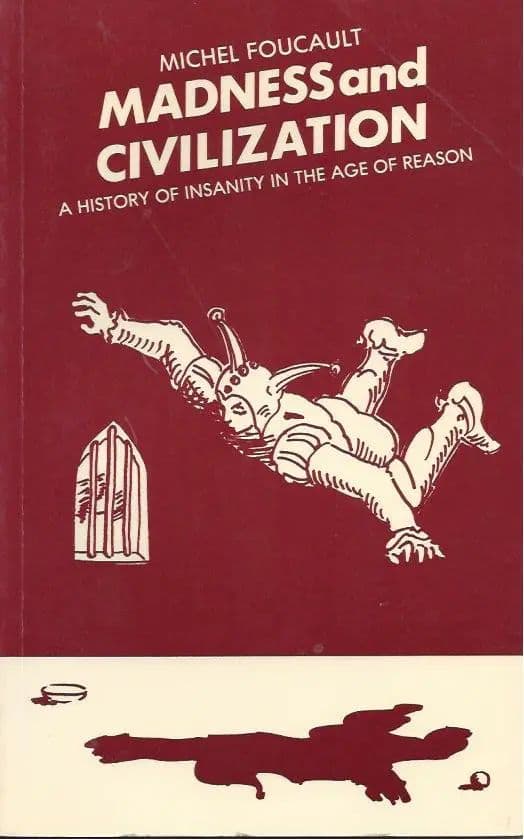
Madness and Civilization: A History of Insanity in the Age of Reason

Foucault's first major work argues that madness is not a natural, transhistorical object but a category produced by the exclusionary practices of reason. The book traces a decisive rupture: in the Classical Age, the mad were confined alongside the poor and criminal in the 'Great Confinement,' silenced as unreason; only later did they become objects of medical knowledge in the asylum. The central mechanism is that reason constitutes itself by expelling its Other—and the modern 'liberation' of the mad by Pinel and Tuke merely replaced physical chains with moral ones.
Key Insights
✦What is the 'Great Confinement,' and why is it the pivot of Foucault's argument?
The Great Confinement refers to the seventeenth-century practice of locking up the mad alongside the poor, vagrants, and criminals in institutions like the General Hospital of Paris. Foucault argues this was not a medical measure but a moral and economic one: confinement served to control the socially undesirable and regulate wages . The significance is that madness was not yet a medical category—it was lumped with unreason. The mad were silenced, excluded from the dialogue of reason. This establishes Foucault's central claim: the distinction between reason and madness is a social construction produced by practices of exclusion, not a natural fact awaiting scientific discovery.
✦How does the English translation differ from the original French, and why does that matter for readers?
The standard English text, Madness and Civilization, is a heavily abridged translation by Richard Howard, published by Pantheon in 1965 . It is based on the abridged French edition of 1964, not the complete 1961 original . The full French text, Histoire de la folie à l'âge classique, runs to 725 pages; the English abridgement is 299 pages . A complete English translation, History of Madness, translated by Jonathan Murphy and Jean Khalfa, was finally published by Routledge in 2006 . Readers who know only the abridged version are encountering a curated text that omits substantial material, including the original preface and appendices.
✦How have historians of psychiatry received the book, and what are the main criticisms?
Reception has been deeply divided. Some historians call it 'a beautiful book' and a new model for writing cultural history, while others see it as a set of 'over-simplifications' flying in the face of empirical evidence . The most persistent criticism concerns Foucault's treatment of the asylum reforms of Pinel and Tuke: he presents them as a continuation of confinement through moral means rather than a genuine liberation, a claim that historians of psychiatry have contested on documentary grounds. A survey of the book's reception concluded that there had been 'no real test of the fruitfulness' of Foucault's interpretive framework, leaving his status as a historian of madness an open question .
✦Why did Foucault reject the label of 'structuralism' that was applied to this book?
Foucault consistently and adamantly rejected the structuralist label, even though Madness and Civilization is often read as a transitional work moving from phenomenology toward something like structuralism . The reason is that structuralism, in its classical form, seeks universal laws of underlying systems. Foucault's project is historical and critical: he wants to show how categories like madness are contingent products of specific practices at specific times, not manifestations of a universal structure. To call his work structuralist would be to miss its genealogical ambition—to defamiliarize the present by showing that what seems natural has a history of exclusion and violence.
✦How does this book relate to Foucault's later work on power and discipline?
Madness and Civilization is the first statement of themes Foucault would develop for the rest of his career. The analysis of confinement prefigures the carceral archipelago of Discipline and Punish; the critique of the asylum's moral treatment anticipates the analysis of disciplinary power; and the concern with how subjects are constituted through exclusion runs through The History of Sexuality. What changes in the later work is the vocabulary: the early Foucault speaks of exclusion and unreason, while the later Foucault speaks of power/knowledge and biopower. But the fundamental intuition—that reason and its Others are mutually constituted through practices of separation—remains constant.
✦What is the significance of Foucault's claim that madness 'does not exist outside the forms of sensibility that isolate it'?
This claim, which Foucault made to Le Monde in 1961, is the book's thesis in miniature . It does not mean that mental suffering is unreal or that people do not experience distress. It means that 'madness' as a unified category—the object of psychiatry, the opposite of reason—is produced by the social practices that isolate and name it. Different societies have organized the experience of unreason differently: the Renaissance allowed the mad a kind of tragic wisdom; the Classical Age silenced them; the modern asylum made them objects of medical knowledge. The claim is thus a historical one: there is no transhistorical essence of madness, only the forms of sensibility that capture and expel it.
Wealthy Psyche is an intellectual archive. We do not host, distribute, or sell book copies — physical or digital. We provide structured knowledge to help you think better, faster.