


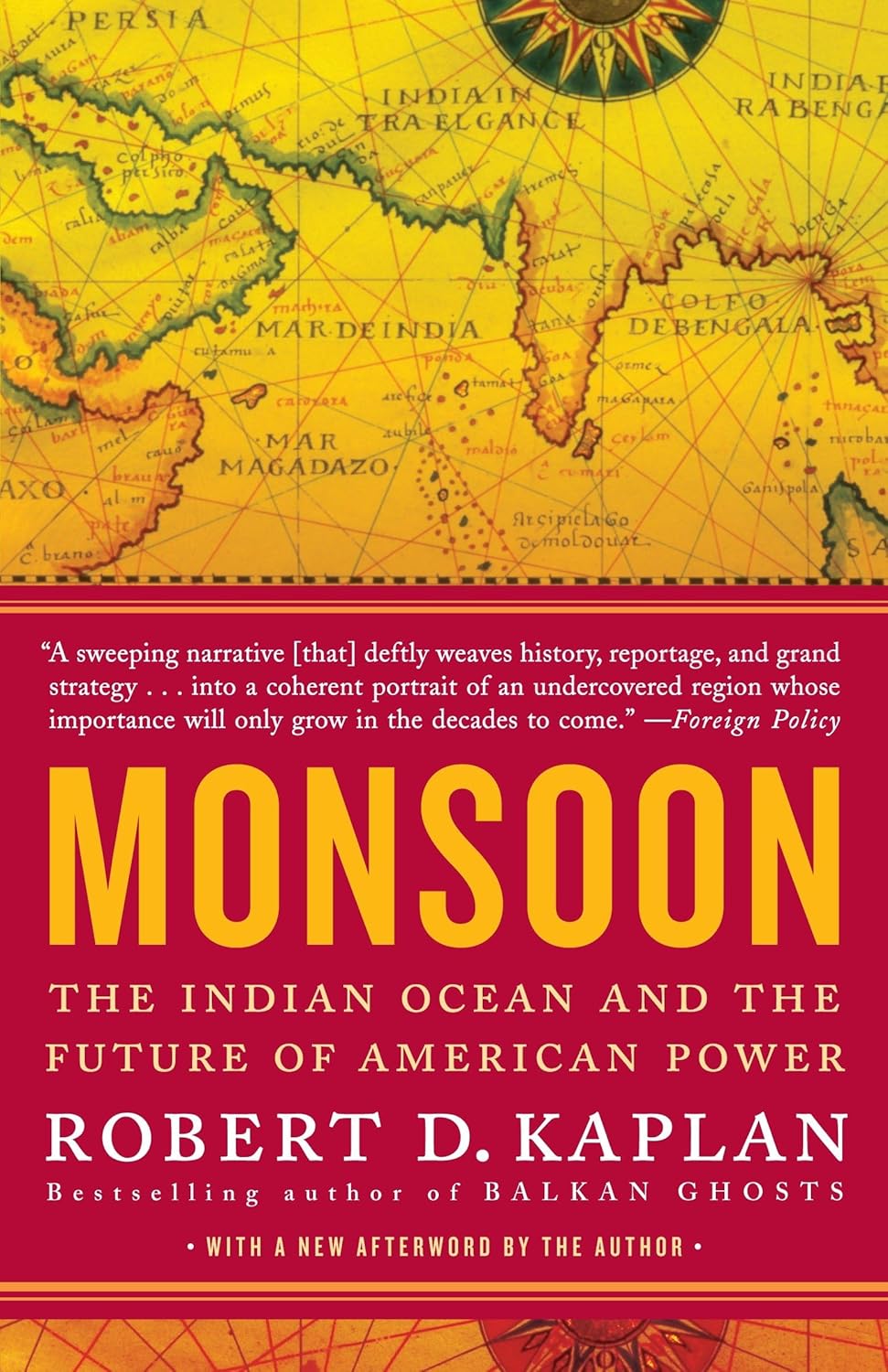
Monsoon: The Indian Ocean and the Future of American Power
 Robert D. Kaplan
Kaplan argues that the Indian Ocean rim—'Monsoon Asia'—has replaced Europe and the Atlantic as the defining geopolitical theater of the twenty-first century. The mechanism is economic and naval: 90% of global commerce travels by sea, and the Indian Ocean carries half the world's container traffic and most petroleum shipments between the Persian Gulf and rising Asian economies. China's search for energy security drives port investments across Pakistan, Sri Lanka, and Burma, while India claims the ocean as its Monroe Doctrine sphere. Kaplan contends the U.S. Navy can manage an 'elegant decline' by fostering naval cooperation, remaining the indispensable balancer as China and India compete without war.
Key Details
Related Books
View AllSimilar books from the same category, ranked by shared topics and reader engagement.

Key Insights — Read in 10 Minutes
What is the central claim of Monsoon, and what does it reject?
Kaplan argues that the Greater Indian Ocean—stretching from the Horn of Africa to the Indonesian archipelago—is becoming the defining geopolitical theater of the twenty-first century, replacing the Atlantic and Europe as the locus of great-power competition. He rejects the assumption that the post-Cold War era's land wars in Iraq and Afghanistan should remain America's primary strategic focus, contending that the future is maritime and that the Indian Ocean's energy routes and choke points are the true 'silk roads' of the coming century.
What specific concept or framework does Kaplan introduce, and how is it used today?
Kaplan introduces 'Monsoon Asia' as a strategic region encompassing India, Pakistan, China, Indonesia, Burma, Oman, Sri Lanka, Bangladesh, and Tanzania—unified not by institutions but by the monsoon's historic trade winds and the Indian Ocean's contemporary shipping lanes. He contends this region now constitutes the world's 'global energy interstate' and the most nuclearized ocean, where U.S., Chinese, Indian, and Pakistani navies all operate. Analysts now routinely invoke 'Monsoon Asia' when discussing Indo-Pacific strategy, even as the term remains contested for its geographic breadth.
How does Monsoon differ from Kaplan's later book The Revenge of Geography?
Monsoon is a hybrid travelogue and strategic primer focused on a single ocean basin, while The Revenge of Geography (2012) is a broader theoretical rehabilitation of classical geopolitics as a lens for understanding world politics generally. Monsoon's argument is regionally specific: it contends the Indian Ocean is the fulcrum of twenty-first-century rivalry. The later book generalizes from this and other cases to argue that geography constrains state behavior everywhere. Monsoon preceded The Revenge of Geography and provided its most detailed empirical case study.
What does Kaplan mean by an 'elegant decline' for American power?
Kaplan acknowledges that the U.S. Navy's relative advantage is eroding as India and China expand their fleets, but he argues this need not mean catastrophic loss of influence. His concept of 'elegant decline' holds that the United States can preserve its role as the region's indispensable balancer by fostering naval cooperation among rising powers rather than trying to maintain hegemony alone. The U.S. Navy would continue protecting the maritime commons while welcoming the growth of allied and partner navies. Critics note this prescription assumes China and India will accept American leadership indefinitely.
Why did some reviewers find Monsoon's optimism surprising given Kaplan's earlier work?
Kaplan had previously been associated with pessimistic forecasts—The Coming Anarchy (1994) predicted global disorder, and Balkan Ghosts (1993) warned of ancient hatreds. In Monsoon, he argues that Asian investment may develop Africa, ethnic conflicts may soften as democracy takes hold, and China and India will compete more with soft power than hard power since territorial expansion is an option for neither. Hugh White of The Monthly observed that Monsoon's subtext is the waning of U.S. dominance, making its relatively upbeat tone 'a very different view' from Kaplan's earlier predictions of American primacy.
How have reviewers assessed the book's prediction of China-India rivalry in the Indian Ocean?
Kaplan's forecast has proven broadly accurate in outline. Both navies have expanded, and strategic competition over ports, influence, and sea lanes has intensified. However, critics note he understated the degree of Sino-Indian economic interdependence and the possibility of cooperative outcomes. Robert Killebrew noted that Kaplan's assertion that China's economic growth should concern the U.S. ignores the fact that America remains China's top trading partner. The prediction of rivalry without war has held, but the mechanisms Kaplan identified—energy security, port access, naval expansion—have proven only partial explanations.
Show 2 more insights
What is a common misconception about Monsoon's argument regarding the U.S. role in the Indian Ocean?
A common misreading treats Monsoon as a call for American withdrawal or disengagement from the Middle East and Indian Ocean. In fact, Kaplan argues the opposite: the United States must concentrate its diplomatic, economic, and military attention on the region if it is to remain relevant. His critique is not of American presence but of American distraction by land wars in Iraq and Afghanistan, which 'fast-forwarded' the arrival of the Asian Century. The book is a strategic reorientation argument, not an isolationist one.
What did Kaplan identify as the most critical chokepoints in the Indian Ocean system?
Kaplan emphasizes three navigational chokepoints as the region's strategic pressure points: the Strait of Hormuz at the western end, through which 40 percent of seaborne crude oil passes; the Strait of Bab el Mandeb connecting the Red Sea to the Gulf of Aden; and the Strait of Malacca at the eastern end, hosting half of the world's merchant fleet capacity and close to a quarter of global trade. He argues these chokepoints make the Indian Ocean 'the globe's busiest and most important interstate,' a formulation that has become a fixture in Indo-Pacific strategic discourse.
Wealthy Psyche is an intellectual archive. We do not host, distribute, or sell book copies — physical or digital. We provide structured knowledge to help you think better, faster.